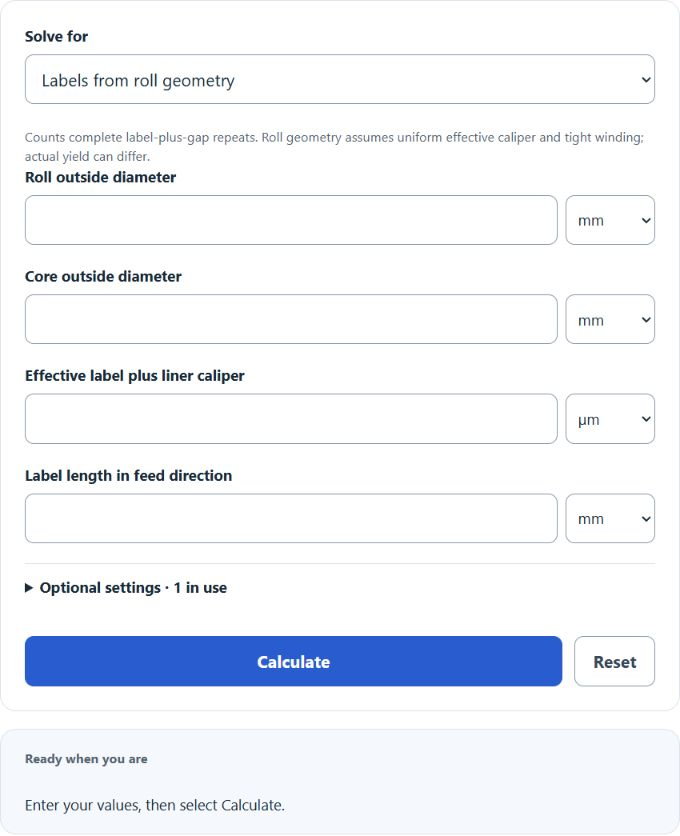
Calculate usable labels from roll geometry or known length, or size outer diameter for a target using core, caliper, pitch, gap, labels across, and waste.
Labels Per Roll Formula
The labels per roll calculation counts complete label-plus-gap repeats after waste, then multiplies by the number of labels across the web. The formula below assumes one label across and includes a trailing gap in each repeat. Choose known web length, estimated roll geometry, or target-count outer diameter in the calculator. Uniform caliper and tight winding are assumptions in the geometry modes; production yield is not guaranteed.
| Variable | Meaning | Typical Unit |
|---|---|---|
LPR |
Labels per roll | labels |
RL |
Total usable roll length | in, mm, cm, m, ft |
LL |
Label length measured along the web | in, mm, cm, m, ft |
G |
Gap between labels | in, mm, cm, m, ft |
The calculation rounds down because a partial label at the end of the roll cannot be counted as a complete usable label.
How to Calculate Labels Per Roll
- Measure the total roll length that is actually usable for labels.
- Measure one label length in the feed direction.
- Measure the gap between consecutive labels.
- Add the label length and gap to get the repeat length, sometimes called the pitch.
- Divide the roll length by that repeat length.
- Round down to the nearest whole label.
Example
If a roll has a usable length of 5000 inches, each label is 4 inches long, and the gap between labels is 0.25 inches, then the repeat length is:
Now divide the roll length by the repeat length and round down:
That roll contains 1176 complete labels.
Why Labels Per Roll Matters
- Production planning: estimate how many finished labels can be produced before a roll change is required.
- Purchasing: compare suppliers by total label yield instead of only roll length.
- Costing: calculate cost per label more accurately.
- Inventory control: estimate how many rolls are needed for a print run or packaging job.
- Machine setup: confirm that label repeat and material length align with production targets.
Practical Notes
- Use one unit system throughout. Convert all values to the same unit before calculating.
- Measure in the web direction. Label length must be the dimension that moves through the printer or applicator, not the label width.
- Include the gap only once. If your machine specification already gives a repeat or pitch value, do not add the gap again.
- Round down, not to the nearest whole number. Only complete labels count.
- Account for waste if necessary. Leader material, trailer material, setup waste, missing labels, and splice loss can reduce the true usable count.
Adjusted Formula for Waste or Unusable Length
If part of the roll cannot be used, subtract that amount first. This is helpful when there is known setup waste, damaged stock, or a non-printable section at the beginning or end of the roll.
| Additional Variable | Meaning |
|---|---|
W |
Total unusable roll length |
Common Mistakes
- Using label width instead of label length.
- Mixing inches with millimeters or feet without converting.
- Ignoring the inter-label gap.
- Counting partial labels at the end of the roll.
- Using full roll length when some portion is not usable in production.
Frequently Asked Questions
Does label width affect labels per roll?
Feed-direction repeat length controls the number of repeats. Label width constrains how many lanes fit across the web; enter that whole-number lane count under Optional settings. Width cancels from the uniform wound-roll length formula when caliper is held constant.
What happens if the gap is zero?
If there is no spacing between labels, then the repeat length is simply the label length, and the count increases accordingly.
Why is the result always rounded down?
A roll may end with a fraction of a label space remaining. Since that remainder cannot produce a full label, the usable count must be the greatest whole number less than or equal to the calculated value.
Can this calculator be used for metric and imperial units?
Yes. The unit does not matter as long as the roll length, label length, and gap are all entered in the same unit.
When should I use a different calculator?
Choose Labels from roll geometry when you know outside diameter, core outside diameter and effective label-plus-liner caliper. Choose Outer diameter for a target count to estimate the required roll size. Confirm physical winding and machine limits before production.