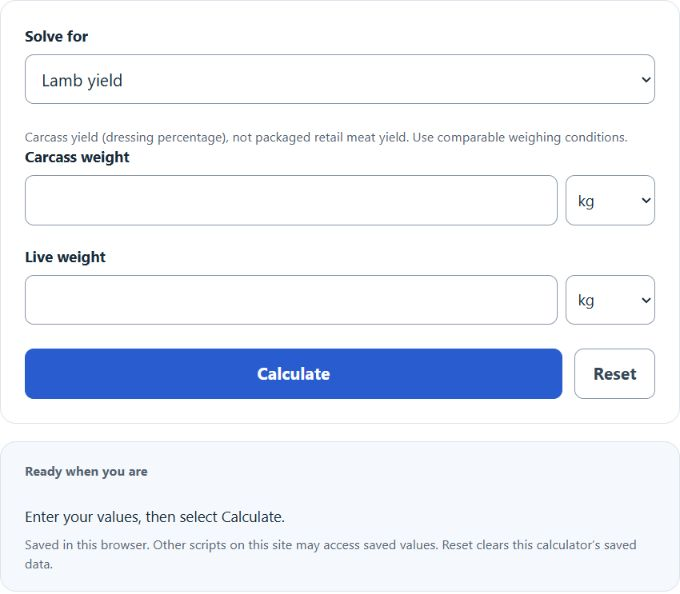
Calculate lamb yield percentage from carcass and live weight, or find missing carcass or live weight using kg, g, lb, or oz units.
- All Food and Cooking Calculators
- Deer Meat Yield Calculator
- Turkey Yield Calculator
- Beef Yield Calculator
Lamb Yield Formula
Lamb yield measures how much carcass weight is produced from a lamb’s live weight. It is a practical percentage used for estimating processing output, comparing animals, and understanding how efficiently live weight converts into carcass weight.
The calculator converts each selected weight unit before calculating. For a hand calculation, use the same unit for both weights. Select the value to solve, enter the two known values, and select Calculate.
Rearranged Forms
If you know the yield percentage and one weight, you can solve for the other value.
| Symbol | Meaning | How It Is Used |
|---|---|---|
| LY | Lamb Yield (%) | Shows carcass weight as a percentage of live weight |
| CW | Carcass Weight | The processed carcass weight used in the calculation |
| LW | Live Weight | The animal’s weight before processing |
What Is Lamb Yield?
Lamb yield is the share of a lamb’s live weight that remains as carcass weight after processing. In practical terms, it tells you how much carcass is obtained from the animal’s total live weight. This is useful for producers, processors, buyers, and anyone comparing production results across multiple animals or groups.
A higher yield percentage means more carcass weight is retained relative to live weight. That can improve planning and pricing, but yield should still be interpreted alongside body composition, finish, and how carcass weight was measured.
How to Calculate Lamb Yield
- Measure the live weight of the lamb.
- Measure the carcass weight.
- Divide carcass weight by live weight.
- Multiply the result by 100 to convert it to a percentage.
This calculator can also work in reverse. If you already know the yield percentage, you can estimate carcass weight from live weight or estimate live weight from carcass weight using the rearranged formulas above.
Example
If a lamb has a carcass weight of 24 lb and a live weight of 48 lb, the yield is:
That result means half of the live weight is represented by carcass weight.
What Affects Lamb Yield?
- Body composition: Muscling and fat cover can change how much weight remains in the carcass.
- Breed and frame type: Different animals may convert live weight to carcass weight differently.
- Age and maturity: Growth stage can influence both live weight distribution and carcass percentage.
- Feeding status: Live weight can vary depending on gut fill at the time of weighing.
- Shrink before weighing: Transport, time off feed, and handling can reduce live weight and affect the percentage.
- Measurement method: Yield comparisons are most meaningful when carcass weight is defined and recorded the same way each time.
Tips for More Accurate Results
- Select the correct unit for each weight; the calculator converts between them.
- Record live weight consistently, especially if comparing multiple animals.
- Avoid mixing different carcass weight standards when analyzing results.
- Round at the end of the calculation for better precision.
- Use yield as a carcass planning metric rather than a direct estimate of packaged take-home meat.
Lamb Yield Interpretation
The percentage from this calculator is best used as a comparison tool. It helps answer questions such as:
- Which lambs are converting live weight into carcass weight more efficiently?
- How much carcass weight should be expected from a target live weight?
- What live weight is needed to reach a desired carcass weight?
Because yield can shift with weighing conditions and carcass definitions, the most useful comparisons come from using the same process every time.
Frequently Asked Questions
Is lamb yield the same as retail meat yield?
No. This calculator measures carcass weight relative to live weight. Packaged retail meat is usually lower because additional trimming, deboning, and fabrication occur after carcass weight is recorded.
Why can two lambs with similar live weights have different yields?
Differences in muscling, fat cover, maturity, gut fill, and weighing conditions can all change the final percentage.
Can I use pounds instead of kilograms?
Yes. Choose kg, g, lb, or oz for each input. The calculator converts both weights to the same basis before applying the formula.
Why does the calculator return a percentage?
Yield is a ratio, not a raw weight. Converting the ratio to a percentage makes it easier to compare animals and production outcomes.