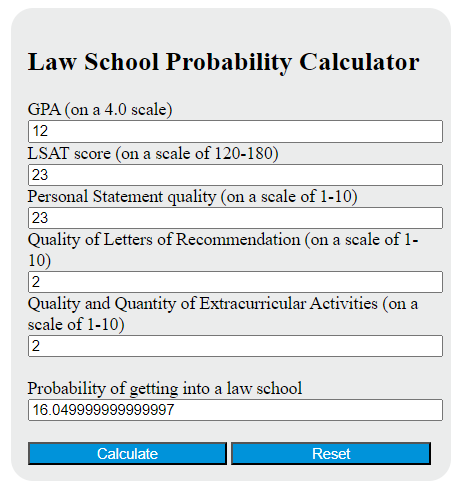
Estimate your law school admission probability from GPA, LSAT, personal statement, recommendation letters, and extracurricular activity quality.
Related Calculators
- Academic Index Calculator
- Posterior Probability Calculator
- Placement Ratio Calculator
- Weighted Mean Calculator
- All Statistics Calculators
Law School Probability Formula
This calculator estimates an applicant’s overall admission strength by converting each input to a common scale and applying a weight to each factor. The result is a quick directional percentage, not an official law school admissions prediction and not a guarantee of acceptance at any specific program.
Because the inputs use different scales, the calculator first normalizes each one and then combines them into a weighted total. Higher values in GPA, LSAT, writing quality, recommendations, and extracurricular depth all increase the estimated result.
Input Guide
| Input | Expected Range | Role in the Estimate |
|---|---|---|
| GPA | 0.0 to 4.0 | Represents academic performance across undergraduate coursework. |
| LSAT | 120 to 180 | Captures standardized test performance and carries the largest weight in this model. |
| Personal Statement (PS) | 1 to 10 | Reflects the quality, clarity, and persuasiveness of the written application narrative. |
| Letters of Recommendation (LOR) | 1 to 10 | Measures the strength, credibility, and specificity of academic or professional endorsements. |
| Extracurricular Activities (EC) | 1 to 10 | Represents leadership, service, work experience, campus involvement, and other differentiators. |
Weight Breakdown
| Factor | Weight | Why It Matters |
|---|---|---|
| GPA | 25% | Shows long-term academic consistency and classroom performance. |
| LSAT | 35% | Acts as the largest numerical driver in this calculator. |
| Personal Statement | 20% | Helps distinguish applicants with similar academic numbers. |
| Letters of Recommendation | 10% | Adds outside validation of ability, work ethic, and readiness. |
| Extracurricular Activities | 10% | Captures breadth of experience, commitment, and leadership potential. |
How the Calculator Works
- Enter GPA on a 4.0 scale.
- Enter LSAT on the 120–180 scale.
- Score the personal statement, recommendation letters, and extracurricular profile from 1 to 10.
- Each value is converted to a comparable normalized form.
- The normalized values are multiplied by their assigned weights.
- The weighted values are added together and multiplied by 100 to produce the final percentage.
Normalization Formulas
Example Calculation
Suppose an applicant has a 3.5 GPA, a 160 LSAT, a personal statement rated 8 out of 10, letters of recommendation rated 9 out of 10, and extracurricular activities rated 7 out of 10.
In this model, a result near 77% indicates a strong overall profile relative to the formula inputs. It does not mean there is a 77% guaranteed chance of admission at every law school.
How to Interpret the Result
| Estimated Range | General Interpretation |
|---|---|
| 0% to 39% | Lower relative profile strength in this model; strengthening one or more major inputs could materially improve the estimate. |
| 40% to 59% | Moderate profile; some areas appear competitive, but the application may still need stronger academic or qualitative support. |
| 60% to 79% | Solid overall profile by this formula, especially when paired with strong school selection and a polished application package. |
| 80% to 100% | Very strong modeled profile; however, real admission outcomes still depend on the selectivity and priorities of each school. |
What This Estimate Does Not Capture
- School-specific selectivity and how your numbers compare with a particular program’s applicant pool.
- Application timing, including whether materials are submitted early or late in the cycle.
- Upward or downward GPA trends, course rigor, addenda, and academic context.
- Interview performance, character and fitness issues, residency factors, or special program priorities.
- The difference between a merely good essay and a highly memorable application story.
Tips for Using the Calculator Effectively
- Rate subjective inputs honestly. Inflating essay or recommendation quality can make the output less useful.
- Run multiple scenarios to see which improvement would have the largest effect on the result.
- Use the estimate as a comparison tool for planning, not as a final admissions forecast.
- If you are between schools, compare the same profile across your target, reach, and safer options using consistent input assumptions.
- Recalculate after meaningful changes such as an updated LSAT score, revised statement, or stronger recommendations.
Why This Calculator Is Helpful
A law school application is made up of both hard metrics and softer qualitative factors. This calculator combines both into one simplified framework so you can quickly see how each component affects the overall estimate. It is especially useful for identifying whether the biggest improvement opportunity is academic, test-related, or application-quality related.