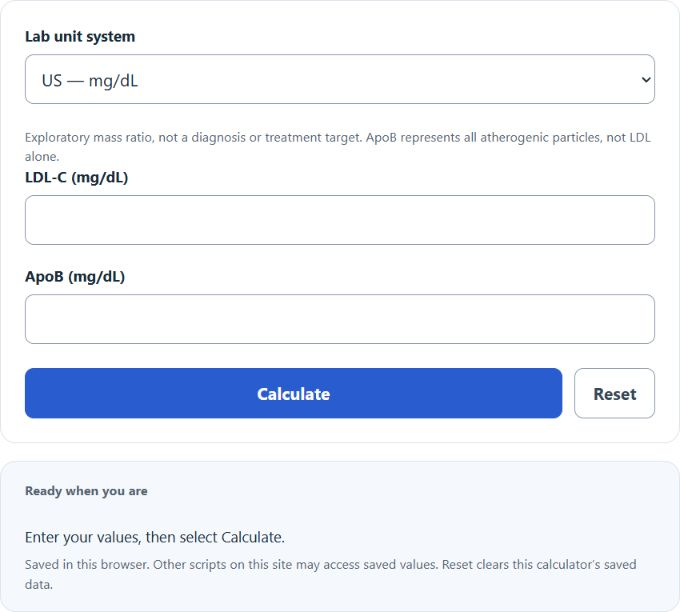
Calculate the LDL-C/ApoB ratio from lipid lab values in mg/dL or mmol/L and g/L as an exploratory cholesterol-per-apoB-particle proxy. The result is not a guideline treatment threshold.
Educational use only; not medical advice. Use LDL-C and ApoB values from a recent laboratory blood test. Do not use this calculator to diagnose, treat, or change medications—discuss results with a qualified clinician.
LDL-C/ApoB Ratio Formula
The LDL-C/ApoB ratio compares the amount of LDL cholesterol to the amount of apolipoprotein B. The calculator first puts both values into compatible units, then divides LDL-C by ApoB.
- LDL-C = low-density lipoprotein cholesterol
- ApoB = apolipoprotein B
- LDL-C/ApoB Ratio = LDL-C divided by ApoB, after both values are expressed in compatible mass units
For US units, both LDL-C and ApoB are entered in mg/dL, so the calculator uses the values directly:
For international units, LDL-C is entered in mmol/L and ApoB is entered in g/L. The calculator converts them before calculating the ratio:
- US units mode calculates the ratio from LDL-C in mg/dL and ApoB in mg/dL.
- International units mode converts LDL-C from mmol/L to mg/dL and ApoB from g/L to mg/dL, then calculates the same ratio.
- Interpretation is limited to an exploratory cholesterol-per-apoB-particle proxy; no treatment category is assigned.
LDL-C/ApoB Ratio Research Context
LDL-C/ApoB is an exploratory cholesterol-per-apoB-particle proxy. ApoB counts all atherogenic particles, not LDL alone. A value below 1.2 has been studied as a possible marker of cholesterol-depleted or small dense LDL in selected diabetes cohorts, but it is not a guideline treatment threshold. The 2026 ACC/AHA dyslipidemia guideline uses the complete risk assessment and established lipid goals rather than generic LDL-C/ApoB bands.
Common Unit Conversions
| Lab value | Entered unit | Conversion used |
|---|---|---|
| LDL-C | mmol/L | Multiply by 38.67 to get mg/dL |
| ApoB | g/L | Multiply by 100 to get mg/dL |
| LDL-C and ApoB | mg/dL | No conversion needed |
Example Calculations
Example 1: US units
If your LDL-C is 120 mg/dL and your ApoB is 95 mg/dL:
The LDL-C/ApoB ratio is 1.26. This is an arithmetic research proxy; no treatment category is assigned.
Example 2: International units
If your LDL-C is 3.1 mmol/L and your ApoB is 0.95 g/L:
The LDL-C/ApoB ratio is 1.26.
FAQ
What does the LDL-C/ApoB ratio tell you?
The LDL-C/ApoB ratio gives a rough comparison between the cholesterol carried in LDL particles and the number of ApoB-containing particles. Since each LDL particle usually carries one ApoB molecule, ApoB can reflect particle number, while LDL-C reflects cholesterol mass. A lower ratio can suggest more particles for the same amount of LDL cholesterol.
Is a higher LDL-C/ApoB ratio always better?
No ratio category is automatically better. ApoB represents all ApoB-containing atherogenic particles, not LDL alone, and LDL-C/ApoB is not a guideline treatment target. Interpret LDL-C, ApoB, non-HDL-C, triglycerides, and the complete clinical risk assessment together.
Why do the units matter?
The ratio only works when LDL-C and ApoB are compared in compatible units. If LDL-C is in mmol/L and ApoB is in g/L, the values must be converted before division. Using the wrong unit mode can give an incorrect result.