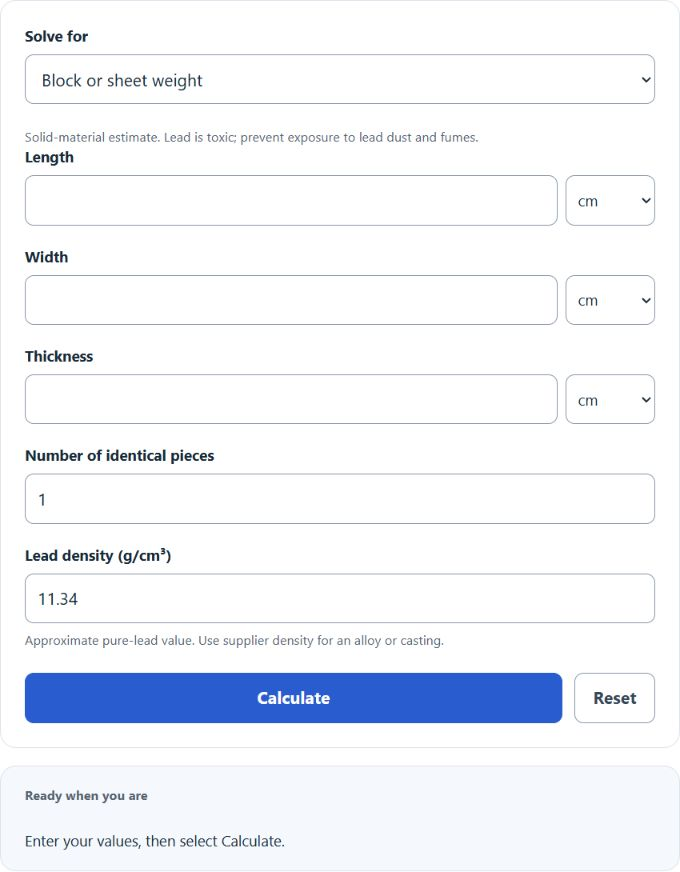
Calculate the weight of lead from its dimensions or volume for sheets, blocks, bars, balls and tubes in kg and lb, using lead’s density of 11.34 g/cm³.
Lead Weight Formulas
The following formulas are used to calculate the weight of lead in different shapes.
Lead Flat Sheet Weight Formula = L * W * T * d
Lead Round Bar Weight Formula = π * D2/4 * L * d
Lead Square Hollow Tube Weight Formula = [W2 – (W – 2T)2] * L * d
Lead Round Hollow Tube Weight Formula = π * (R2 – r2) * L * d
Lead Square Angle Weight Formula = T * (A + B – T) * L * d
Lead T Bar Weight Formula = (Wf * Tf + Tw * (H – Tf)) * L * d
Lead C Channel Weight Formula = [Tw * (H – 2Tf) + 2 * W * Tf] * L * d
Variables used in these equations:
- L is the length
- W is the width (or outside width/flange width, depending on the shape)
- H is the overall height
- T is the thickness (sheet thickness, wall thickness, or angle thickness, depending on the shape)
- d is the density
- D is the diameter
- R is the outer radius
- r is the inner radius
- A is angle leg A
- B is angle leg B
- Wf is the T-bar flange width
- Tf is the flange thickness (T bar or C channel)
- Tw is the web thickness (T bar or C channel)
The calculator converts each dimension to centimeters and uses density in g/cm³. It supports blocks or sheets, round bars, spheres, round tubes, known volume, and reverse-solving solid volume from weight. Quantity applies to identical pieces. The other cross-section formulas above can be used separately with consistent volume and density units.
What is the density of lead?
The density of pure lead at room temperature (about 20 °C) is approximately 0.4097 lb/in³ (11.34 g/cm³).