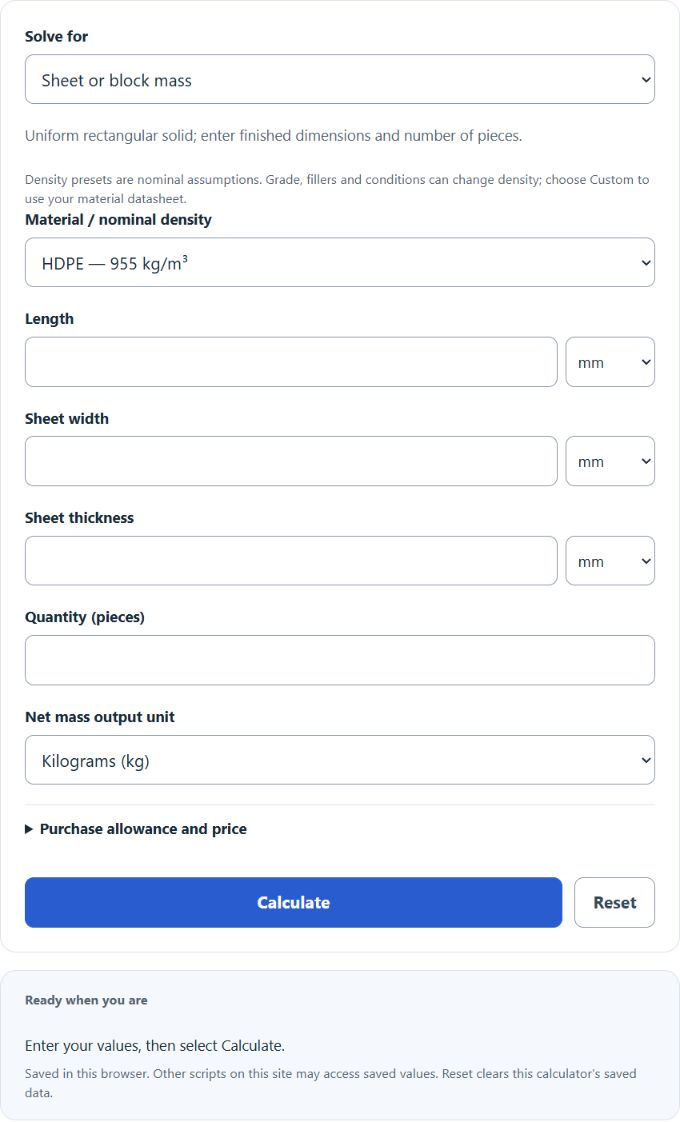
Calculate plastic sheet, rod, or tube weight with material densities and units, or reverse-solve sheet thickness with allowance, cost, and density sensitivity.
- All Construction Calculators
- All Weight Calculators
- ABS Weight Calculator
- Nylon Weight Calculator
- Acetal Weight Calculator
Plastic Weight Formulas
For uniform solid plastic of density d, total mass equals cross-sectional area × length × density × quantity Q. The calculator supports rectangular sheet/block, solid round rod and concentric round tube, plus a reverse sheet-thickness solve. The square hollow tube, equal-leg angle, T bar and C channel formulas below are additional reference formulas, not calculator modes. They idealize constant cross-sections without fillets; all dimensions must form a physically valid non-overlapping section.
Plastic Flat Sheet Total Mass = L * W * H * d * Q
Plastic Round Bar Total Mass = pi * D^2/4 * L * d * Q
Plastic Square Hollow Tube Total Mass = [W^2-(W-2T)^2] * L * d * Q, where W is the outside side length and 0 < 2T < W.
Plastic Round Hollow Tube Total Mass = pi * (Do^2 – Di^2)/4 * L * d * Q, with 0 ≤ Di < Do. Di = 0 gives a solid rod.
Plastic Equal-Leg Angle Total Mass = (2*W*T – T^2) * L * d * Q, with equal outside leg lengths W and common thickness T.
Plastic T Bar Total Mass = [W*T + (H-T)*T] * L * d * Q, with overall depth H, flange width W and the same flange/web thickness T.
Plastic C Channel Total Mass = [2*W*T1 + (H-2*T1)*T2] * L * d * Q, with overall depth H and flange width W; H must exceed 2T1 and the web thickness T2 must fit within W.
Variables used in these equations (Q is the positive whole number of identical pieces; use Q = 1 for a single piece):
- L is the length
- W is the width (or leg width/flange width, depending on the shape)
- H is the height (or thickness for flat sheet, and overall height for T bar / C channel)
- d is the density
- D is the diameter (solid round bar)
- Do is the outer diameter (round hollow tube)
- Di is the inner diameter (round hollow tube)
- T is the thickness (sheet thickness, wall thickness, etc.)
- T1 is the channel flange thickness
- T2 is the channel web thickness
The calculator accepts dimensions in mm, cm, inches or meters, converts them to meters, and uses density in kg/m³ to obtain mass in kg. Forward results can be displayed in kg, g or lb; the reverse target also accepts these mass units. Custom density is entered in kg/m³, with 1 g/cm³ = 1000 kg/m³. For the reference formulas, use any consistent length and density units: meters with kg/m³ give kg, while inches with lb/in³ give lb. The term weight here means mass, rather than gravitational force.
Reverse sheet thickness = target total net mass ÷ (density × length × width × Q). The target is the finished mass of all Q sheets before allowance. Purchase mass = total net mass × (1 + allowance/100); the optional material-only cost uses the entered USD/kg price. Allowance changes the estimated purchasing mass, not the finished geometry or solved thickness; fabrication, tax and shipping are excluded.
Preset densities are illustrative and can vary with grade, fillers, moisture and temperature; use the actual material datasheet or a measured solid-material density for a closer estimate. For example, Ensinger’s engineering-plastics manual distinguishes unfilled and glass-filled grades and describes conditioning effects. Powder or pellet bulk density is not the same as the solid part’s material density. The ±5% rows are illustrative density sensitivity, not a tolerance or confidence interval: mass scales directly with density at fixed dimensions, while required thickness varies inversely with density at fixed target total mass.