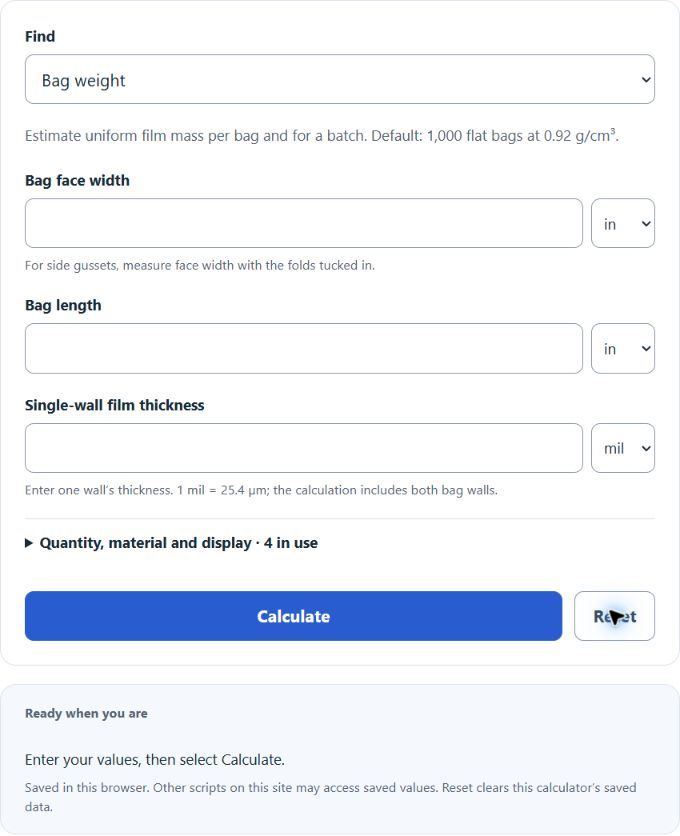
Calculate poly bag weight per bag or by quantity from width, length, thickness, material density, and optional gusset dimensions in metric or imperial units.
- Business Finance Calculators
- All Weight Calculators
- Flat Bag Volume Calculator
- BOPP Film Weight Calculator
- Plastic Weight Calculator
- Mass Per Unit Area Calculator
How to Calculate Poly Bag Weight
The Poly Bag Weight Calculator estimates ideal uniform film mass using face width, length, single-wall thickness and density. It reports grams per bag, pounds per 1,000 bags and total batch weight. Optional settings select quantity, flat or side-gusset style, and material density. The thickness and bag-count modes solve the inverse tasks.
Poly Bag Weight Formula
| Variable | Description | Typical Unit |
|---|---|---|
| PBW | Poly bag weight | lb per 1,000 bags |
| W | Bag width | inches |
| L | Bag length | inches |
| M | Millage, or film thickness | mils |
The traditional formula above is an approximate shortcut for pounds per 1,000 simple flat LDPE bags, with width and length in inches and single-wall thickness in mils. It uses a rounded material factor; this calculator instead uses area × thickness × the selected density. Its metric model is grams per bag = 2 × (face width + full opened side-gusset depth) × length × thickness in cm × density in g/cm³, with other dimensions in cm. Use zero gusset depth for flat bags. Atlantic Poly publishes the shortcut.
Rearranged Forms
The rearranged formulas below apply to the same approximate flat-LDPE shortcut. They are useful for manual estimates; the calculator’s thickness mode uses the full density-based model.
How to Use the Calculator
- Enter the bag width.
- Enter the bag length.
- Enter the millage value for the film thickness.
- Click calculate to return the estimated poly bag weight.
- Read the per-bag, per-1,000 and total batch weights together; use Optional settings to change bag quantity, style or density.
Select Film thickness to enter target total film weight and bag quantity, or Bag count to enter available film weight and single-wall thickness. Counts are rounded down to complete bags; the quantity input must be a positive whole number.
Examples
Example 1: A poly bag is 6 inches wide, 12 inches long, and 3 mil thick.
This means 1,000 bags weigh approximately 14.4 pounds.
If you want the weight of one bag, convert the 1,000-bag result to a single piece value.
For this bag, the single bag weight is approximately 0.0144 pounds.
Example 2: A poly bag is 10 inches wide, 12 inches long, and 1.5 mil thick.
This means 1,000 bags weigh approximately 12 pounds.
Estimating Total Order Weight
Once you know the weight per 1,000 bags, scaling to a full order is straightforward.
| Term | Meaning |
|---|---|
| TW | Total bag weight for the order |
| PBW | Weight per 1,000 bags |
| N | Number of bags in the order |
If the bag weight is 14.4 pounds per 1,000 and the order quantity is 25,000 bags, the total bag weight is 360 pounds.
| Order Quantity | Multiply the Calculator Result By |
|---|---|
| 1,000 bags | 1 |
| 5,000 bags | 5 |
| 10,000 bags | 10 |
| 25,000 bags | 25 |
| 50,000 bags | 50 |
How Each Input Changes the Result
- If width increases while length and thickness stay the same, the bag weight increases in the same proportion.
- If length increases while width and thickness stay the same, the bag weight increases in the same proportion.
- If thickness increases while width and length stay the same, the bag weight increases in the same proportion.
- If one dimension is reduced, the estimated weight decreases proportionally.
This makes the calculator especially useful for quick side-by-side comparisons between bag sizes and film gauges.
Accuracy Tips
- Use the same measurement convention throughout your calculation.
- Select the correct single-wall thickness unit. 1 mil = 0.001 inch = 25.4 microns; it is not a millimeter. The model already includes front and back walls.
- Double-check width and length units before calculating.
- For side gussets, enter face width with folds tucked in and full opened side-pleat depth. If the supplier gives inward fold depth, double it first; do not add a gusset again if width already includes unfolded material. Bottom-gusset and specialized pouch geometry differs. Seals, closures, printing, additives and manufacturing tolerances can change actual weight.
- For purchasing or freight decisions, use the calculated value as a planning estimate and compare it to supplier specifications when available.
Common Questions
- What does the result represent?
- Bag weight mode shows grams per bag, pounds per 1,000 bags and total batch weight. The other modes estimate single-wall film thickness or whole-bag count.
- What is millage?
- Millage refers to the film thickness, typically stated in mils. Thicker film produces a heavier bag when width and length stay the same.
- Can this be used for shipping estimates?
- Yes. Once the 1,000-bag weight is known, you can quickly scale it to any production run or shipment quantity.
- Why might actual weight differ from the estimate?
- Actual production weight can vary because of bag style details, material formulation, sealing configuration, and normal manufacturing tolerances.