Use this Leakage Current Calculator to solve capacitive AC or resistive DC leakage, convert electrical units, and review impedance, current, and calculation steps.
- All Electrical Calculators
- Fault Current Calculator
- All Physics Calculators
- Current Imbalance Calculator
Leakage Current Formula
For this calculator, leakage current refers to the capacitive charging current that flows from line to ground in an AC system because of stray or intentional capacitance. The calculation assumes a sinusoidal waveform and uses RMS voltage.
In a 60 Hz system, the frequency term becomes a constant multiplier, which makes the equation easier to use.
If you are solving for capacitance or voltage instead of current, rearrange the equation as follows.
Variable Definitions
| Variable | Description | Typical Units |
|---|---|---|
| IL | Leakage current caused by line-to-ground capacitance | A, mA, µA |
| f | AC frequency | Hz |
| V | Line-to-ground RMS voltage | V, mV, kV |
| C | Equivalent capacitance from line to ground | F, mF, µF, nF, pF |
How to Use the Calculator
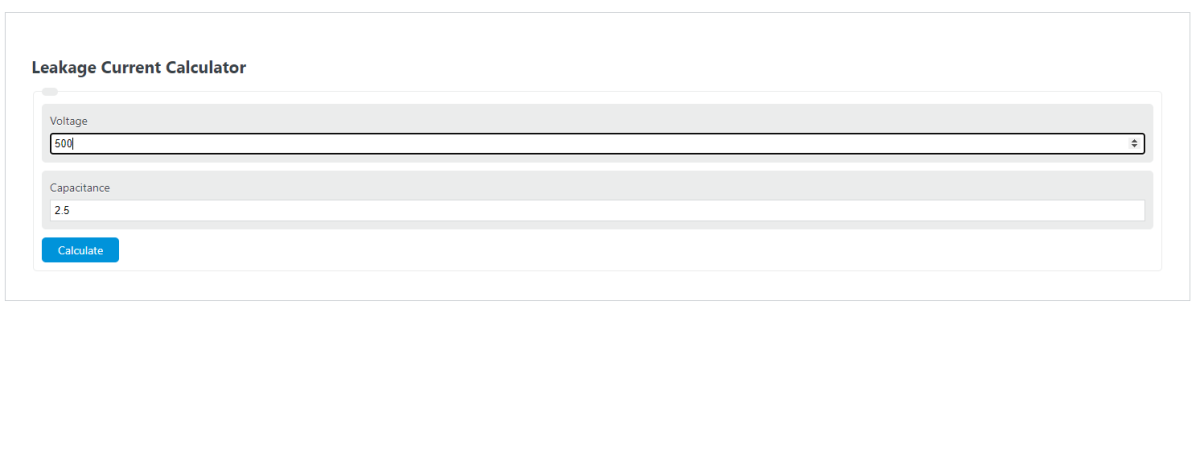
- Enter any two of the three values: voltage, capacitance, or leakage current.
- Use the unit selectors carefully so the entered values match the real system.
- For voltage, use the RMS line-to-ground value for a sinusoidal AC circuit.
- For capacitance, enter the total effective capacitance from the conductor to ground.
- The calculator returns the missing value assuming a 60 Hz AC supply.
How to Interpret the Result
The result is the current that flows because the line and ground behave like the two plates of a capacitor. This does not necessarily represent insulation failure. In many cables, filters, motors, transformers, and long wiring runs, some capacitive leakage is expected.
- Higher voltage produces higher leakage current.
- Higher capacitance produces higher leakage current.
- Higher frequency produces higher leakage current.
- Doubling any one of those inputs doubles the calculated capacitive current.
Example
If the line-to-ground voltage is 500 V RMS and the capacitance is 0.1 µF in a 60 Hz system, the current is:
That is approximately 18.85 mA of capacitive leakage current.
Finding Maximum Allowable Capacitance
The calculator can also be used in reverse. If a 120 V system should stay at or below 0.25 mA of capacitive leakage current at 60 Hz, the maximum capacitance is:
So the maximum capacitance is about 5.53 nF.
Common Unit Conversions
- 1 µF = 0.000001 F
- 1 nF = 0.000000001 F
- 1 pF = 0.000000000001 F
- 1 mA = 0.001 A
- 1 µA = 0.000001 A
What This Calculator Does and Does Not Cover
This page is intended for capacitive leakage current in AC systems. Real-world measured leakage can also include additional current caused by:
- Insulation resistance breakdown
- Surface contamination or moisture
- EMI/RFI suppression capacitors
- Semiconductor junction leakage
- Filters, shields, and long cable runs
If you are troubleshooting a real device, the total leakage seen on a meter may be the sum of capacitive current and conductive leakage through unwanted paths.
Practical Notes
- At DC steady state, an ideal capacitor does not continuously conduct current; current mainly appears during charging or transients.
- At AC, the capacitor continuously charges and discharges, which is why a repeating leakage current exists.
- Longer cables and larger equipment often have more line-to-ground capacitance and therefore more leakage current.
- If your system is not 60 Hz, use the full frequency-based equation instead of the simplified 377 multiplier.
Frequently Asked Questions
Is leakage current always bad?
No. A certain amount of capacitive leakage is normal in AC systems. The key question is whether the value is expected for the equipment and whether it exceeds design or safety limits.
Why does frequency matter?
Capacitive current increases directly with frequency. A 400 Hz system will produce much more capacitive leakage than a 60 Hz system with the same voltage and capacitance.
Should I use line-to-line or line-to-ground voltage?
Use the voltage that exists across the capacitance being modeled. For this calculator, that is typically the line-to-ground RMS voltage.
Why is my measured leakage higher than the calculator value?
The calculator only estimates the capacitive portion. Actual measurements may also include resistive leakage, filter currents, meter effects, harmonics, and multiple parallel capacitance paths.