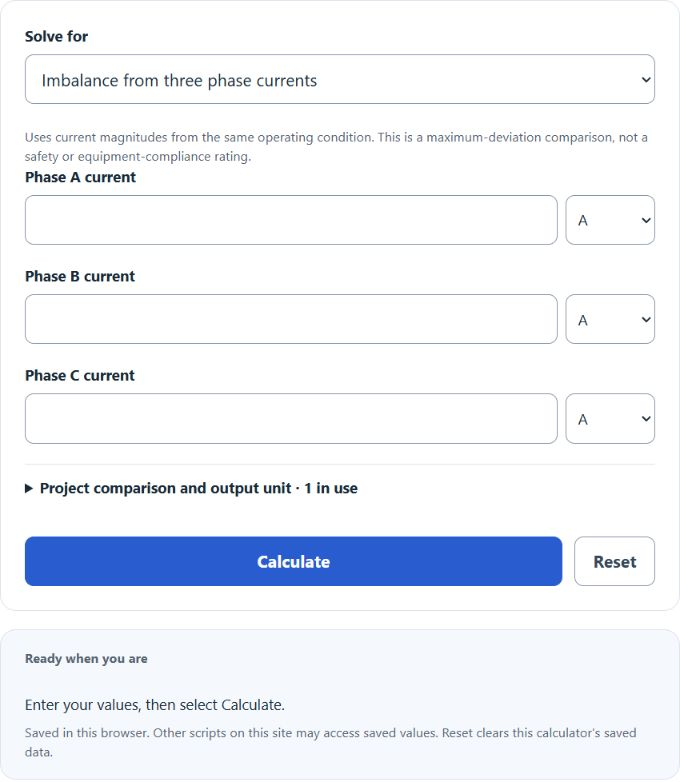
Calculate three-phase current imbalance by maximum deviation from average, or solve the third phase for a target mean, with neutral-current context.
- All Physics Calculators
- All Electrical Calculators
- Leakage Current Calculator
- Fault Current Calculator
- Sequence Current Calculator
Current Imbalance Formula
The following equation is used to calculate the Current Imbalance.
- Where CI is the current imbalance percentage
- Imd is the maximum deviation from the average current (amps)
- Iave is the average current (amps)
To calculate a current imbalance, divide the maximum deviation from the average current by the average current, then multiply by 100.
What is Current Imbalance?
Definition:
This measure compares the magnitudes of three phase currents at the same operating condition. It is not a measure of how one current varies over time. A greater maximum phase deviation relative to their positive arithmetic mean produces a greater imbalance.
How to Calculate Current Imbalance?
Example Problem:
The following example outlines the steps and information needed to calculate Current Imbalance.
First, enter three phase currents: 122.5 A, 100 A and 77.5 A. Their arithmetic mean is 100 A.
Next, determine the maximum deviation from the average. The maximum current deviation for this system is measured to be 22.5 amps.
Finally, calculate the current imbalance using the formula above:
CI % = Imd / Iave * 100
CI % = 22.5/100 * 100
CI % = 22.5%
The inverse mode finds phase C = 3 × target mean − phase A − phase B, rejecting a negative solution. The optional project threshold has no universal default. The neutral estimate assumes ideal sinusoidal currents separated by 120°; phase-angle differences and harmonics require a fuller analysis.