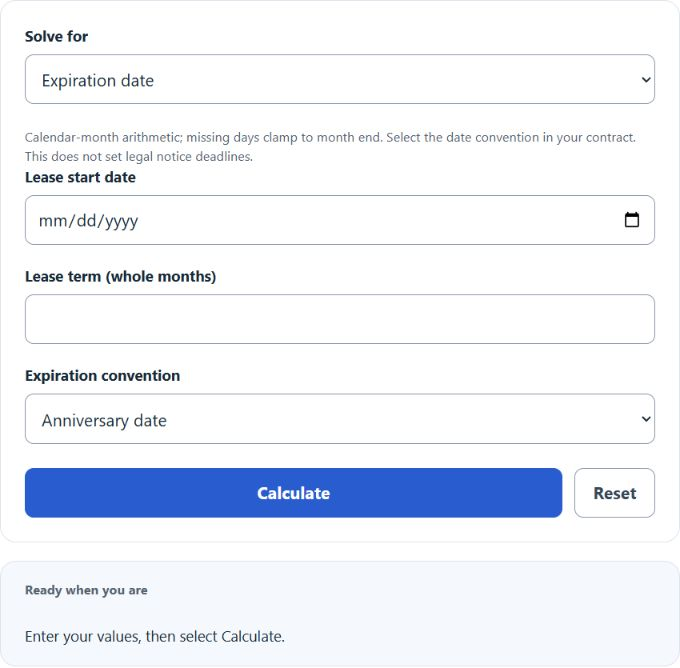
Calculate a lease expiration date, compatible start date, or calendar term by selecting the unknown value and entering the known values. Select the contract’s expiration convention.
Related Calculators
- Holdover Rent Calculator
- Rent Escalation Calculator
- Payment Factor Calculator
- 40X Rent Rule Calculator
- All Personal Finance Calculators
Lease Expiration Date Formula
For the anniversary-date convention, E = S + T adds calendar months with month-end clamping. The last-included-day convention uses that anniversary minus one day.
Variables:
- E is the lease expiration date
- S is the lease start date
- T is the lease term in months
Add whole calendar months to the start date, clamping a missing day to the destination month’s last day. The anniversary-date convention uses that result; the last-included-day convention subtracts one calendar day. The contract’s explicit dates control. Month-end clamping can produce multiple compatible start dates, which the calculator lists.
What is a Lease Expiration Date?
The lease expiration date marks the end of the agreed fixed term. Continued occupancy and renewal rights depend on the lease and applicable law; acceptance of rent or statutory tenant protections can affect the tenancy after that date. It is distinct from the lease termination date, which arises from early cancellation or breach. The expiration date drives three immediate decisions: move-out, renewal, or renegotiation. For commercial tenants, missing the renewal notice window specified in the lease can permanently forfeit the renewal option regardless of when the expiration date falls.
Typical Lease Terms by Property Type
The lease term determines how far into the future the expiration date falls. Commercial and residential leases differ significantly, and within commercial real estate, average terms vary by property type.
| Property Type | Typical Term | Average (2024) |
|---|---|---|
| Residential apartment | 6 to 24 months | 12 months |
| Office (renewal) | 3 to 7 years | 60 months |
| Office (new lease or relocation) | 5 to 10 years | 74 months |
| Retail NNN (quick-service restaurant) | 10 to 20 years | 12.6 years |
| Retail NNN (convenience store) | 10 to 20 years | 14 years |
Renewal Notice Windows
Most commercial leases specify a written notice deadline before expiration to exercise renewal options. Missing this deadline can void the right to renew even if the tenant intends to stay. The required notice period depends on the actual lease and applicable law. The table below gives planning examples, not universal legal deadlines; negotiation lead times are suggestions.
| Tenant Type | Example Notice Window (verify lease and law) | Recommended Start of Negotiations |
|---|---|---|
| Residential | 30 to 60 days | 90 days out |
| Small commercial (under 2,000 sq ft) | 3 to 6 months | 9 months out |
| Mid-size commercial | 6 months | 12 months out |
| Large commercial (10,000+ sq ft) | 9 to 12 months | 18 months out |
Holdover Tenant Consequences
A tenant who remains in possession after the lease expiration date without a new agreement is a holdover tenant. Penalties are enforced through the original lease holdover clause and vary substantially by state. Commercial holdover penalties are far higher than residential, with 200 to 300% of monthly rent not unusual in extended holdover situations.
| Jurisdiction / Lease Type | Holdover Rent Penalty |
|---|---|
| Commercial (typical) | 150% of lease rent short term; 200 to 300% for extended holdover |
| New Jersey (commercial) | Double yearly rental value for willful holdover after written demand and notice under N.J.S.A. 2A:42-6 |
| Illinois | Double yearly rental value for willful holdover after written demand under 735 ILCS 5/9-202 |
| New York | Month-to-month if landlord accepts rent; double rent if tenant gave vacate notice but held over |
| California (residential) | Acceptance of rent may renew a monthly tenancy; applicable termination notice may be 30 or 60 days, with tenant-protection exceptions |
How to Calculate Lease Expiration Date?
The following steps outline how to calculate the Lease Expiration Date.
- First, determine the lease start date (S).
- Next, determine the lease term in months (T).
- Finally, add the whole calendar-month term with month-end clamping; subtract one day if the contract uses the last-included-day convention.
- After inserting the values and calculating the result, check your answer with the calculator above.
Example Problem:
A retail tenant signs a 60-month commercial lease starting April 1, 2023. In this example, the contract uses the last-included-day convention and specifies a six-month renewal notice window.
Lease Start Date (S) = 2023-04-01
Lease Term (T) = 60 months
Lease Expiration Date (E) = 2028-03-31
For this example’s stated six-month notice clause, subtracting six clamped calendar months from March 31, 2028 gives September 30, 2027. Starting negotiations by April 1, 2027 provides about a year of lead time. The calculator does not determine notice deadlines or renewal rights.