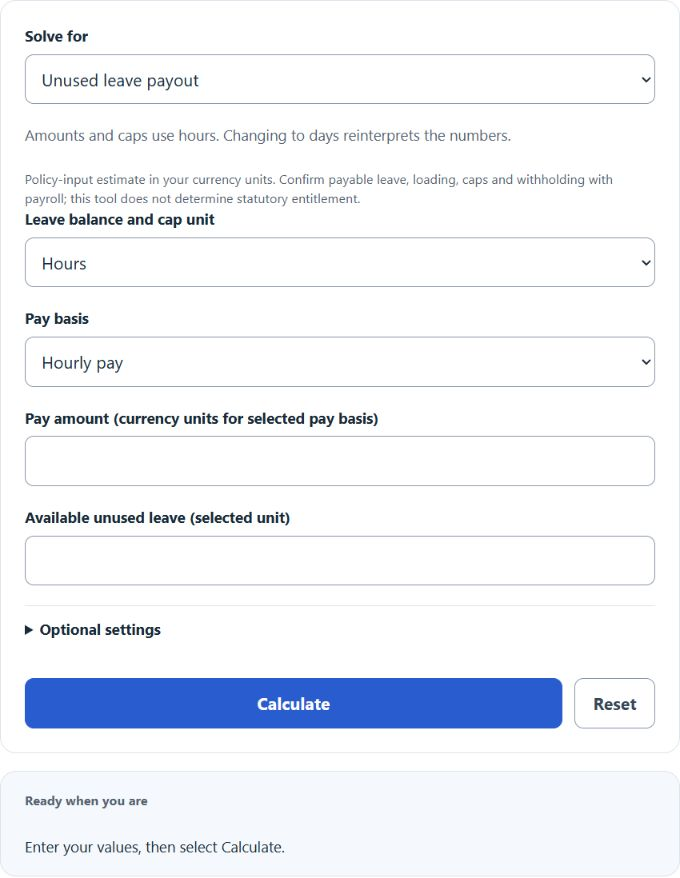
Calculate unused leave pay from hourly, annual, or monthly compensation, or reverse-solve leave balance and hourly rate with optional caps, loading, and withholding.
Leave Pay Formula
Select payout, balance from gross payout, or hourly rate from gross payout. The model converts compensation to an hourly rate, limits payable leave by an optional cap, and applies the entered loading and flat withholding assumptions. It does not determine statutory entitlement.
Annual salary mode:
Hourly pay basis:
Leave balance payout mode:
Variables:
- Annual Salary: gross yearly pay before tax.
- Workdays per Year: paid working days in your year, commonly 260 for a 5-day week.
- Leave Days: days being valued, using the entered paid hours per workday. Weeks must be converted to days or hours separately.
- Hourly Rate: gross pay per hour worked.
- Paid Leave Hours: hours of leave being paid; days are converted using hours per day.
- Loading: extra percentage paid on top of base leave pay (such as 17.5% annual leave loading).
- Balance Hours: accrued but unused leave at the time of payout.
- Tax: estimated withholding percentage applied to a payout.
In payout mode, select hourly, annual or monthly pay basis. Annual and monthly compensation require paid workdays per year and paid hours per day. Leave balances and caps share the selected hours/days unit; changing the unit reinterprets the numbers. A binding cap makes the inverse available balance nonunique, so the minimum balance is reported.
Reference Tables
The schedule values below are illustrative assumptions, not payroll rules. Enter the applicable paid-work schedule. The percentage examples use different bases and must not all be entered as loading. Confirm the policy with payroll.
| Schedule | Workdays / Year | Hours / Day |
|---|---|---|
| Full-time, 5 days a week | 260 | 8 |
| Full-time, less public holidays | 250 to 252 | 8 |
| Part-time, 4 days a week | 208 | 7.5 to 8 |
| Part-time, 3 days a week | 156 | 7.5 to 8 |
| Compressed, 9-day fortnight | 234 | 8.9 |
| Percentage example | Basis and limitation | Enter as |
|---|---|---|
| 0% | Standard salaried leave | 0 |
| 17.5% | Some Australian awards or agreements provide loading; confirm eligibility, rate and basis | 17.5 |
| 8% | New Zealand pay-as-you-go holiday pay in limited eligible arrangements; applies to gross earnings instead of holiday pay when leave is taken | Not a loading input |
| 12.07% | Great Britain qualifying irregular-hours/part-year accrual or rolled-up pay rules; hours or pay-period earnings basis, not a premium on valued leave | Not a loading input |
Examples and FAQ
Example 1: Salaried leave. You earn $65,000 a year, take 5 days of leave, work 260 days a year, and have no loading. Daily rate is $65,000 / 260 = $250. Leave pay is $250 × 5 = $1,250.
Example 2: Balance payout. You leave a job with 76 hours of accrued leave at $25 per hour. Gross payout is 76 × $25 = $1,900. With 22% withholding, net is $1,900 × 0.78 = $1,482.
Does the result include tax? An optional flat withholding/deduction percentage gives a net estimate in each solve mode. Inverse targets are gross amounts. Actual tax and deductions depend on applicable rules and payroll circumstances.
How do I handle weeks of leave? Convert weeks to the applicable paid days or hours yourself, then select days or hours. No universal five-day week is assumed.
What if I work irregular hours? In payout mode, select hourly pay and enter leave hours directly, or select days and enter the applicable paid hours per workday. Confirm any required average earnings method with payroll.
Why does my employer's number differ? Payroll systems may use a different averaging period, exclude certain allowances, round hours, or apply award rules. Treat this calculator as an estimate, not a payslip.