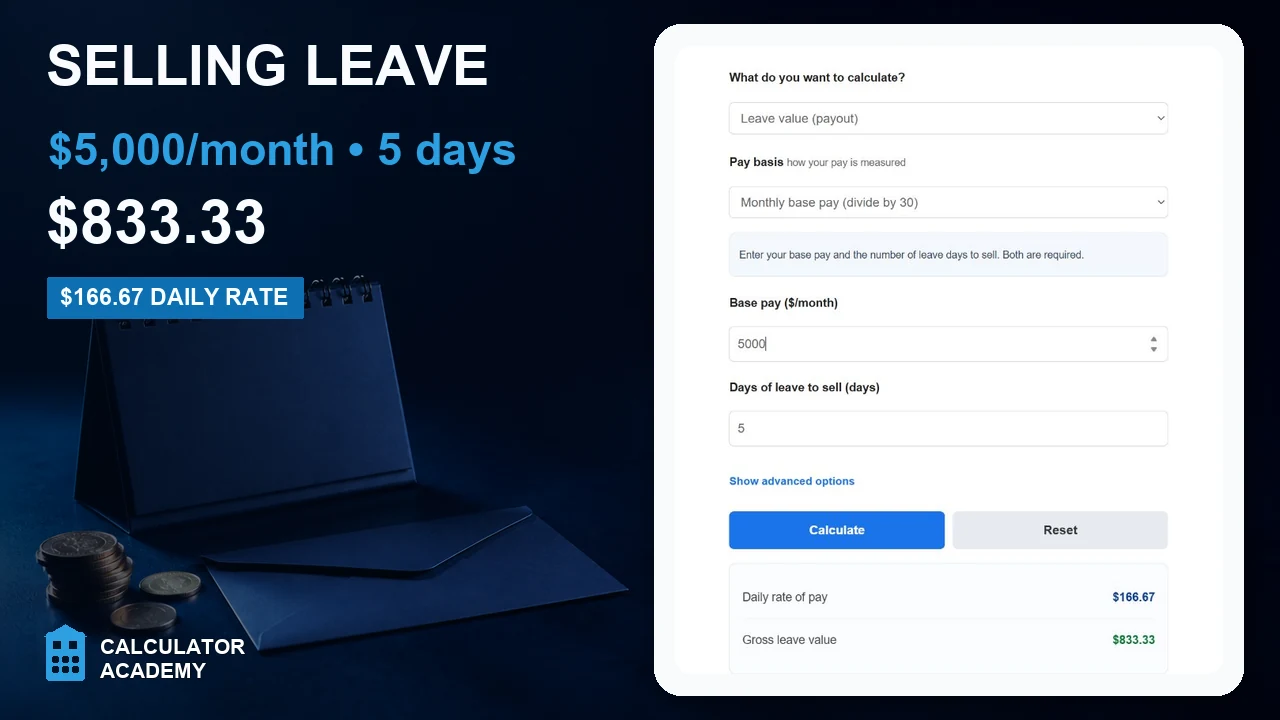
Calculate the value of selling leave from monthly base pay and days of leave, or solve for missing pay or leave days using the same formula.
Selling Leave Formula
The default mode turns monthly base pay and a number of leave days into a cash value. It treats a month as 30 days, so one day of pay is the base pay divided by 30:
SL = BP / 30 * D
The same relationship rearranges to solve for the base pay or for the number of days when you already know the value:
BP = (SL / D) * 30
D = SL / (BP / 30)
The annual salary mode builds the daily rate from a yearly figure and the number of working days you are paid for, then multiplies by the days sold:
SL = (Salary / WD) * D
The hourly mode builds the daily rate from an hourly wage and the length of a standard day:
SL = (HR * HPD) * D
If your employer pays less than a full day for each day sold, the advanced buyback rate scales the result:
Payout = SL * (BR / 100)
Variables:
- SL is the selling leave value, the cash you receive
- BP is the monthly base pay
- D is the number of leave days you sell
- Salary is the gross annual salary
- WD is the number of working days paid per year, often 260
- HR is the hourly rate of pay
- HPD is the number of paid hours in a standard day, often 8
- BR is the buyback rate as a percent, usually 100
Pick what you want to calculate at the top. In the default value mode you enter your pay and the days you plan to sell, and the tool returns your daily rate of pay and the gross leave value. Switch the solve setting to base pay or to days of leave when you already know the payout and want to work backward to the missing figure.
The pay basis setting changes how the daily rate is found. Monthly base pay divides by 30 calendar days, which is the convention many payroll systems use for leave. Annual salary divides by the working days you are actually paid for, so it ignores weekends and holidays. Hourly rate multiplies your wage by the hours in a standard day. The advanced options let you apply a buyback rate below 100 percent and an optional tax rate to estimate the take-home amount.
Leave Value at Common Pay Levels
The first table uses the monthly method, dividing base pay by 30 to get a daily rate, then showing the value of one day and of five days sold. Find the row closest to your pay to get a quick estimate before you use the calculator.
| Monthly base pay | Daily rate (÷30) | 1 day sold | 5 days sold |
|---|---|---|---|
| $2,000 | $66.67 | $66.67 | $333.33 |
| $3,000 | $100.00 | $100.00 | $500.00 |
| $4,000 | $133.33 | $133.33 | $666.67 |
| $5,000 | $166.67 | $166.67 | $833.33 |
| $7,500 | $250.00 | $250.00 | $1,250.00 |
The second table shows how the same salary produces a different daily rate depending on which basis you choose. Dividing an annual salary by 260 working days gives a higher daily figure than dividing the equivalent monthly pay by 30, because the 30-day method spreads pay across weekends too.
| Annual salary | Monthly ÷30 daily | Salary ÷260 daily |
|---|---|---|
| $36,000 | $100.00 | $138.46 |
| $48,000 | $133.33 | $184.62 |
| $60,000 | $166.67 | $230.77 |
| $90,000 | $250.00 | $346.15 |
Example Problems
Example 1: Find the value of leave from monthly pay.
You earn $5,000 per month and want to sell 5 days of leave. Divide the base pay by 30 to get the daily rate, then multiply by the days:
SL = 5000 / 30 * 5 = $833.33.
Selling 5 days is worth $833.33, which matches the value mode with the monthly basis selected.
Example 2: Find the value from an annual salary.
Your salary is $60,000 and you are paid for 260 working days. You want to sell 3 days. Build the daily rate first, then multiply by the days:
SL = (60000 / 260) * 3 = 230.77 * 3 = $692.31.
Switching the pay basis to annual salary and entering 260 working days returns the same $692.31.
Frequently Asked Questions
How do you calculate the value of selling leave?
Work out your daily rate of pay, then multiply it by the number of days you sell. Using the common monthly method, divide your monthly base pay by 30 and multiply by the days. For a $4,500 monthly wage and 4 days, that is 4500 / 30 * 4 = $600. If your employer pays a set percent of a day rather than a full day, multiply the result by that buyback rate.
Why divide by 30 instead of the number of working days?
Dividing by 30 treats every calendar day in the month the same, which is the rule many payroll systems apply to leave. Dividing an annual salary by the working days you are actually paid for, often 260, produces a higher daily rate because it leaves out weekends and public holidays. Use whichever method your employer uses, and switch the pay basis in the calculator to match.
Is the money from selling leave taxed?
Yes. In most places a leave payout is treated as ordinary earnings and is subject to the same income tax and payroll deductions as your regular pay, so the amount that lands in your account is lower than the gross value. Enter a tax rate in the advanced options to see a rough take-home figure, and check your own payslip or a tax professional for the exact deductions that apply to you.