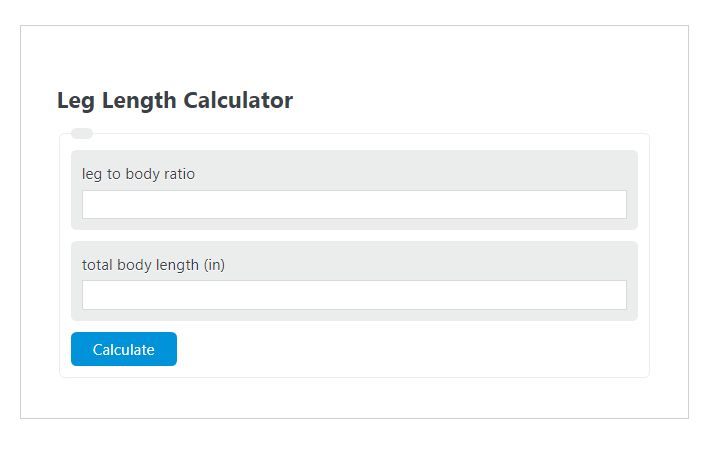
Calculate leg length from standing and sitting height or estimate leg length and inseam from height, with metric, imperial, reverse, and ratio results.
- All Health and Medical Calculators
- All Length Calculators
- Torso Length Calculator
- Leg to Body Ratio Calculator
How the Leg Length Calculator Works
The leg length calculator uses a proportional relationship between total body length and the leg-to-body ratio. Enter any two values to solve for the third. The ratio is unitless and should be entered as a decimal from 0 to 1. If you have a percentage, convert it first. Length values can be handled in inches, centimeters, meters, or feet as long as you stay consistent with the measurement definition.
Variable Definitions
| Variable | Meaning | Notes |
|---|---|---|
| LL | Leg Length | Returned in the same length unit used for the body length input |
| LBR | Leg-to-Body Ratio | Unitless decimal; under this definition it must be between 0 and 1 |
| BL | Total Body Length | Can be entered in in, cm, m, or ft |
Fast Reference for What to Calculate
| If You Know | You Can Find | Formula |
|---|---|---|
| Leg-to-body ratio and total body length | Leg length | LL = LBR × BL |
| Leg length and total body length | Leg-to-body ratio | LBR = (LL) / (BL) |
| Leg length and leg-to-body ratio | Total body length | BL = (LL) / (LBR) |
How to Use the Calculator
- Enter the leg-to-body ratio as a decimal, not a whole-number percent.
- Enter the total body length in your preferred unit.
- If the calculator is being used in reverse, enter the leg length and one other value instead.
- Click calculate to solve the missing variable.
- Review the result and make sure the units and measurement method match your original inputs.
Measurement Notes That Matter
- Be consistent with landmarks: the ratio only makes sense if your leg length and body length were defined the same way when measured.
- Keep units aligned: never mix inches for one length and centimeters for another unless you convert first.
- Use decimals for the ratio: 55% should be entered as 0.55, not 55.
- Check ratio bounds: if your ratio is below 0 or above 1, the input is invalid for this calculator’s definition.
- Remember the ratio is unitless: dividing one length by another cancels the units.
Quick Interpretation Table
| Ratio | Meaning | Leg Length if Total Body Length = 60 in |
|---|---|---|
| 0.45 | Leg length is 45% of total body length | 27 in |
| 0.50 | Leg length is 50% of total body length | 30 in |
| 0.55 | Leg length is 55% of total body length | 33 in |
| 0.60 | Leg length is 60% of total body length | 36 in |
Examples
Example 1: If the leg-to-body ratio is 0.50 and the total body length is 60 inches, the leg length is:
Example 2: If the leg-to-body ratio is 0.55 and the total body length is 70 inches, the leg length is:
Example 3: If the leg length is 32 inches and the total body length is 64 inches, the ratio is:
Example 4: If the leg length is 36 inches and the ratio is 0.45, the total body length is:
Common Entry Errors
- Typing 50 instead of 0.50 for the ratio.
- Using a leg measurement from one method and a ratio based on another method.
- Mixing units without converting.
- Rounding the ratio too early, which can slightly change the result.
- Assuming the calculator can correct inconsistent measurements automatically.
Helpful FAQs
Does the ratio need units?
No. It is a pure proportion, so it has no unit.
Can I use centimeters or feet?
Yes. Any supported length unit works as long as the measurements are entered consistently.
Why must the ratio stay between 0 and 1?
Because the leg length is being treated as a fraction of the total body length. A part of a whole cannot exceed the whole under this definition.
What if I already know my leg length?
You can use the rearranged equations above to solve for either the total body length or the leg-to-body ratio.