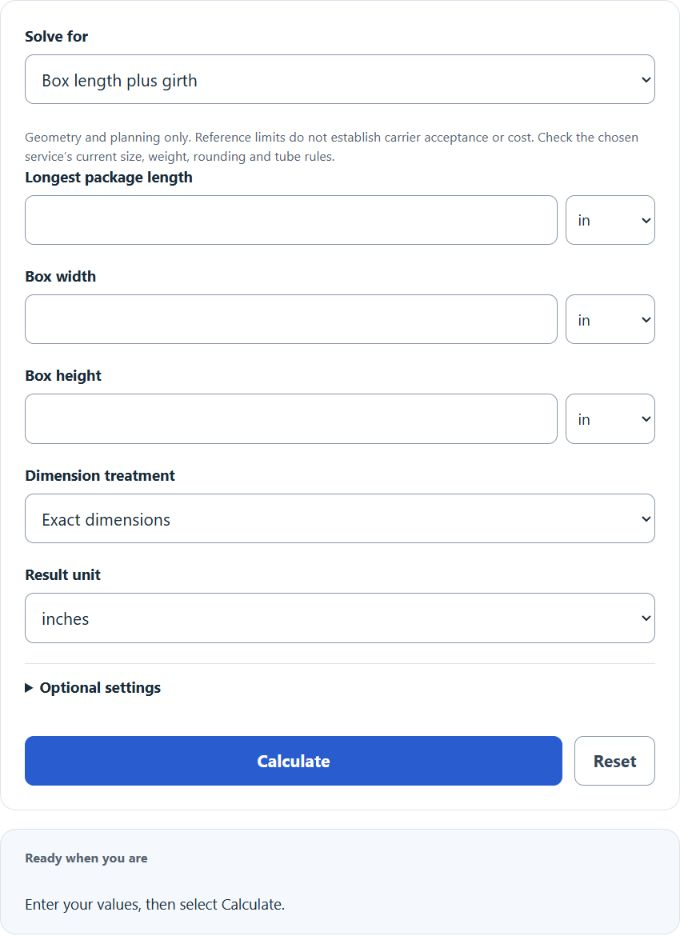
Calculate length plus girth for a box or tube from its dimensions in inches or cm, or solve length or girth from a known combined total.
Length + Girth Formula
The basic length plus girth calculation adds the package length to its girth.
- LG = length plus girth
- L = length
- G = girth
If you know the combined length plus girth and one other value, the missing value is found by subtraction.
For a box, length is the longest side. Girth is the distance around the two shorter sides.
- L = longest side of the box
- W = one shorter side
- H = the other shorter side
- G = girth
- LG = length plus girth
Choose box dimensions, tube geometry, maximum box length, or a direct solve for total, length or girth. For a box, enter the longest side as length and use G = 2(W + H). For a geometric cylinder, G = πD using outside diameter D; a carrier may instead require a rectangular bounding-box measurement. Each length input can use inches, centimeters, feet or meters, with results in inches or centimeters. The optional round-up setting first converts each applicable dimension to inches, then rounds it up to a whole inch. This is a stated planning rule, not a universal carrier rule. Reverse box mode uses Lmax = target − margin − 2(W + H); with round-up enabled it rounds W and H upward and floors the resulting allowed length. A blank optional margin means zero. The solved box length must remain at least as long as either other side.
Common Length Plus Girth Limits
The 108-, 130- and 165-inch values below are service-specific reference scenarios. For maximum-length planning, supply your own target and optional margin. A numerical result within one scenario does not verify weight, separate length limits, shape restrictions, destination, packaging, surcharges or acceptance. Check the current rules for the exact service before shipping.
| Carrier or service | Length + Girth Reference | Notes |
|---|---|---|
| USPS, many domestic services | 108 in | USPS domestic parcel guidance; service and destination exceptions apply. |
| USPS Ground Advantage | 130 in | USPS Ground Advantage; over 108 through 130 inches uses oversized pricing. Other limits still apply. |
| UPS | 165 in | UPS small-package guidance also states a separate 108-inch length limit and 150-lb weight limit; shipment-specific limits may differ. |
| FedEx Home Delivery / Express Saver | 165 in | FedEx service comparison lists 165 inches combined for these services, with separate length limits of 108 and 119 inches respectively. Ground Economy instead lists 130 inches combined. Verify the exact service; this is not a price quote. |
Length and Girth Unit Conversions
| Unit | Equivalent in inches | Equivalent in centimeters |
|---|---|---|
| 1 inch | 1 in | 2.54 cm |
| 1 foot | 12 in | 30.48 cm |
| 1 centimeter | 0.393701 in | 1 cm |
| 1 meter | 39.3701 in | 100 cm |
Examples
Example 1: Find length plus girth
You have a package with a length of 40 in and a girth of 60 in.
The length plus girth is 100 in.
Example 2: Find length plus girth from box dimensions
A box measures 36 in by 14 in by 10 in. The longest side is 36 in, so the two shorter sides are 14 in and 10 in.
The girth is 48 in, and the length plus girth is 84 in.
FAQs
What is girth on a package?
Geometric girth is the distance around the cross-section perpendicular to package length. A rectangular box uses 2 × width + 2 × height; a circular cylinder uses π × outside diameter. Carrier measurement rules can differ: for example, UPS instructs measuring irregular shapes as a rectangular bounding box. Tube geometry alone does not establish service eligibility.
Which side counts as length?
The length is the longest side of the package. If you enter box dimensions, the longest of the three measurements should be treated as length, even if the box label calls a different side the length.
Is length plus girth the same as total dimensions?
No. Total dimensions usually means length plus width plus height. Length plus girth means the longest side plus the distance around the two shorter sides. For a box, that is length plus 2 times width plus 2 times height.