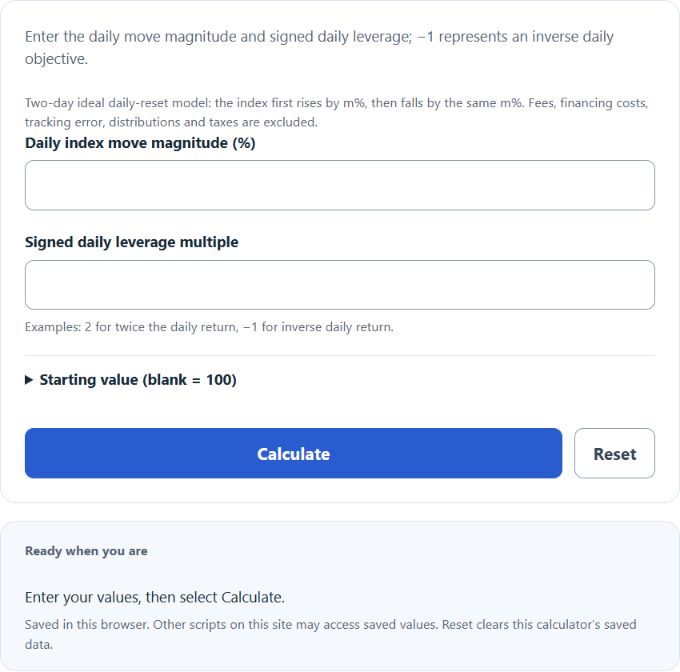
Compare an index and an ideal daily-reset leveraged fund after an equal percentage rise and fall on successive days. The calculation shows the effect of compounding over that specific two-day path.
Two-day compounding
Let m be the daily move as a decimal and L the signed daily leverage. The index factor is (1 + m)(1 − m) = 1 − m². The fund factor is (1 + Lm)(1 − Lm) = 1 − L²m².
Thus the modeled loss magnitudes are 100m²% for the index and 100L²m²% for the fund. For a nonzero move, the loss ratio is L². A negative L represents an inverse daily objective.
Example
With a 2% move and 3× daily leverage, a starting value of 100 becomes 102 then 99.96 for the index. The fund becomes 106 then 99.64. The index loses 0.04% and the ideal fund loses 0.36%, a ninefold loss ratio.
Frequently asked questions
Is an equal rise and fall a flat index return?
No. A fall is applied to the larger value after the rise. For example, +2% followed by −2% multiplies the starting value by 0.9996.
What happens at a 100% daily modeled fund loss?
The path wipes out modeled fund value. An implied daily loss greater than 100% is rejected because this simplified nonnegative fund-value model cannot represent it.
Does the result forecast long-term ETF decay?
No. It is one two-day identity. Actual funds depend on the complete return path, fees, financing, tracking, distributions and taxes. The SEC explains that daily objectives need not equal a leverage multiple of longer-period performance.
References