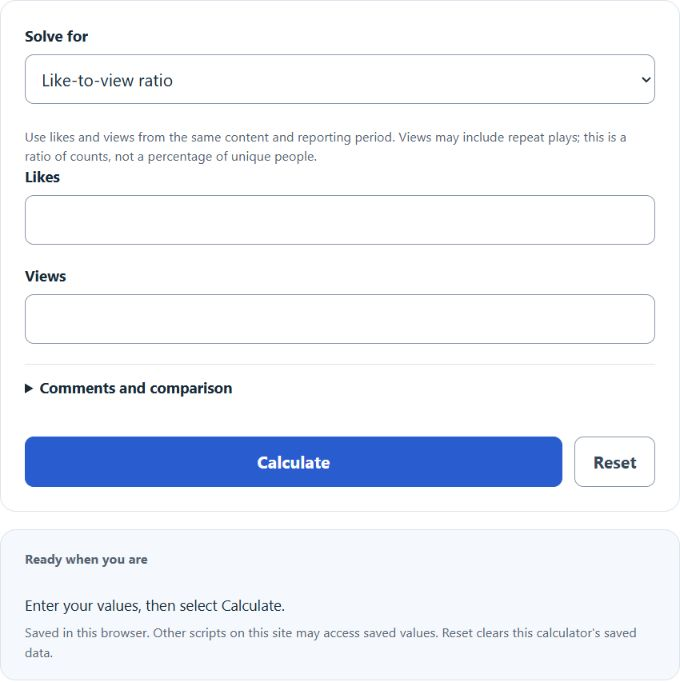
Enter the number of likes and views into the calculator to determine the Like to View Ratio. This calculator can also evaluate any of the variables given the others are known.

Like To View Ratio Calculator

Enter any 2 values to calculate the missing variable

Like To View Ratio Formula

The following formula is used to calculate the Like to View Ratio.

LVR = (L / V) * 100

Variables:

  • LVR is the Like to View Ratio (%)
  • L is the number of likes
  • V is the number of views

To calculate the Like to View Ratio, divide the total number of likes by the total number of views, then multiply by 100 to express the result as a percentage. This metric isolates the “like” action from all other forms of engagement (comments, shares, saves), giving content creators a focused measure of passive approval relative to reach.

What is a Like To View Ratio?

The like-to-view ratio (LVR) is an engagement metric that measures the percentage of viewers who actively liked a piece of content. Unlike broader engagement rate formulas that combine likes, comments, shares, and saves into a single number, LVR isolates one specific behavior: the decision to tap “like.” This makes it useful for comparing content performance within a single platform where the definition of a “view” stays constant.

LVR functions as a signal of passive approval. A viewer who likes a video has consumed enough of it to form a positive opinion but has not been compelled to comment or share. Because liking requires minimal effort, it captures a broader slice of audience sentiment than comment-based or share-based metrics. For this reason, LVR tends to be higher than comment-to-view or share-to-view ratios on every major platform.

Platform Benchmarks for Like to View Ratio

Each social media platform defines a “view” differently, which directly affects what constitutes a good like-to-view ratio. TikTok counts a view the instant a video begins playing. YouTube requires approximately 30 seconds of watch time (or the full video if shorter). Facebook and Instagram count a view at 3 seconds. These differences mean that a 5% LVR on TikTok and a 5% LVR on YouTube represent very different levels of viewer commitment, and direct cross-platform comparisons are misleading without accounting for this.

TikTok

TikTok’s average like-to-view ratio sits around 4% as of 2025, meaning roughly 4 out of every 100 views result in a like. A ratio in the 5 to 10% range is considered strong. Content that reaches 10% or higher typically hits a highly receptive niche audience or rides a trending topic. Accounts with fewer than 5,000 followers tend to see the highest LVR (averaging 4.2% by views) because their content reaches a more targeted For You Page audience during the initial distribution phase. TikTok’s algorithm uses LVR as one of several signals to decide whether to push a video beyond the first batch of 200 to 500 viewers. Videos that fall below roughly a 1-in-10 like-to-view threshold often stop being promoted on the For You Page.

YouTube

YouTube’s average like-to-view ratio falls between 2% and 5% for mid-sized channels (10K to 500K subscribers). Larger channels with millions of subscribers often see ratios closer to 1.5% because their audience includes more passive viewers drawn in by algorithmic recommendations rather than direct subscriptions. A ratio above 3.75% is considered healthy for most content types. In 2025, YouTube shifted its recommendation system toward “satisfaction-weighted discovery,” which layers qualitative signals from viewer surveys and sentiment analysis on top of traditional engagement metrics. This means a high LVR alone no longer guarantees algorithmic promotion, but a low LVR still serves as a negative signal.

Instagram

Instagram Reels display like-to-view ratios that vary widely depending on content type and account size. The platform’s average engagement rate by followers is approximately 0.48% as of 2025, though per-view engagement on Reels tends to be higher since not all followers see every post. Instagram’s algorithm has increasingly prioritized “Sends per Reach” (the rate at which viewers share content via direct message) over raw likes, a shift publicly confirmed by Instagram head Adam Mosseri. Despite this, LVR remains a relevant metric for Reels creators because it captures the broadest form of viewer approval.

How Account Size Affects Like to View Ratio

There is a well-documented inverse relationship between audience size and like-to-view ratio across all platforms. Nano-influencers (1K to 10K followers) and micro-influencers (10K to 100K followers) consistently achieve the highest engagement rates, often exceeding 3 to 6% LVR. As audience size grows, the ratio declines because algorithmic distribution introduces the content to increasingly broad (and therefore less targeted) audiences. Mega-influencers and celebrities with 500K+ followers typically see LVR between 1% and 3%. This pattern is not a sign of declining content quality; it reflects the mathematical reality that broader reach dilutes per-viewer engagement.

LVR as an Algorithm Signal

On TikTok, the like-to-view ratio directly influences whether a video gets pushed to broader audiences. The platform distributes new videos to a small test group first (typically 200 to 500 users), then evaluates early engagement signals including LVR, comment rate, share rate, and watch completion. Videos that maintain at least a 5 to 7% LVR in the first 24 hours combined with a watch completion rate above 50% are the most likely candidates for viral distribution. A video with a high LVR but low completion rate may still receive limited promotion because the algorithm interprets the combination as clickbait.

YouTube’s algorithm treats likes as one component of a broader satisfaction model. Since the 2025 algorithm overhaul, the platform weighs viewer surveys, post-view behavior (whether a viewer watches more content from the same creator afterward), and sentiment analysis alongside traditional engagement metrics. A high LVR contributes positively to these signals but is not sufficient on its own. The removal of the public dislike count in 2021 also shifted how LVR is interpreted by creators, since the like-to-dislike ratio is no longer visible to viewers, though YouTube’s internal systems still use it.

LVR vs. Other Engagement Metrics

Like-to-view ratio measures a single, low-friction interaction. The broader engagement rate formula typically combines likes, comments, shares, and saves, then divides by either total views, reach, or follower count depending on the calculation method used. The choice of denominator matters significantly: a Socialinsider 2026 report found TikTok’s engagement rate at 3.70% when calculated by views, while Hootsuite’s 2026 data showed TikTok at 2.0% when using a different methodology. Both numbers are accurate; the discrepancy comes from the denominator and which interaction types are included.

The comment-to-view ratio and share-to-view ratio are higher-friction metrics that often carry more algorithmic weight. A video with fewer likes but many comments can still go viral because comments signal active conversation. Shares indicate that a viewer found the content valuable enough to associate their identity with it by sending it to someone else. On TikTok, shares per post increased 45% year-over-year in 2025, while average comments per post fell 24%, suggesting a behavioral shift toward sharing over commenting. On Instagram, the same trend appeared with a 16% decline in comments.

Why the Same Video Gets Different LVRs on Different Platforms

When a creator cross-posts the same video to TikTok, YouTube Shorts, and Instagram Reels, the like-to-view ratio will almost always differ across platforms for three reasons. First, view counting thresholds vary (instant play on TikTok vs. 3 seconds on Instagram vs. ~30 seconds on YouTube), meaning the denominator of the LVR formula changes even if the same number of people watch the full video. Second, audience behavior differs by platform culture; TikTok users are conditioned to like more freely as a bookmarking mechanism, while YouTube viewers tend to reserve likes for content they found genuinely valuable. Third, algorithmic distribution patterns differ, meaning the same content reaches different audience segments on each platform, affecting who sees and interacts with the video.

For creators tracking LVR across platforms, the most useful approach is to benchmark each platform independently. A 4% LVR on TikTok, a 3% LVR on YouTube, and a 2% LVR on Instagram Reels can all represent equally strong performance given each platform’s norms.