Calculate VTR (view-through rate) as completed video views divided by impressions, or solve for views or impressions, plus view-through conversion rate.
- Click-Through Rate (CTR) Calculator
- Engagement Rate Calculator
- All Business Calculators
- CVR (Conversion Rate) Calculator
Calculator Functions
| Function | What it does | What it requires |
|---|---|---|
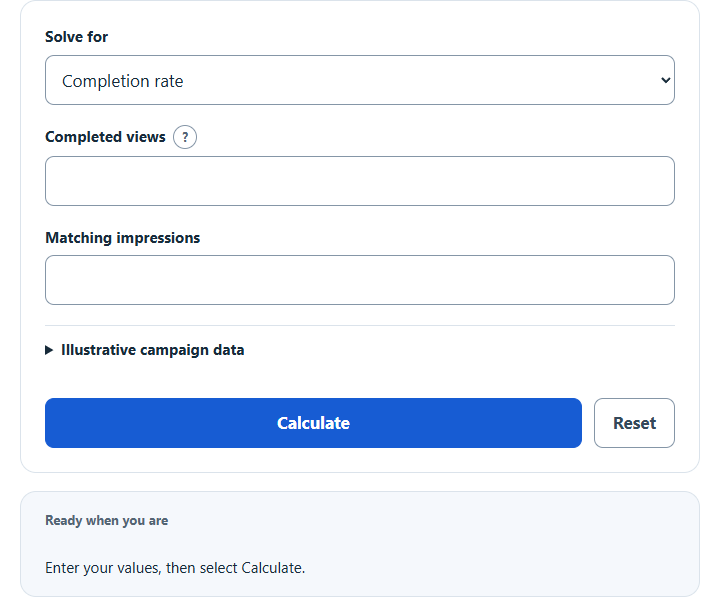
| Completion rate | Finds the percentage of impressions on which the video ad played to the end | Requires the completed views and the matching impressions |
| Expected completed views | Estimates how many completed views a number of impressions yields at a known completion rate | Requires the completion rate in percent and the impressions |
| Impressions from completed views | Estimates the impressions behind a count of completed views at a known completion rate | Requires the completed views and the completion rate in percent |
| View-through conversion ratio | Finds attributed view-through conversion credits as a percentage of impressions | Requires the attributed view-through conversion credits and the matching impressions |
| Expected conversion credits | Estimates conversion credits from a number of impressions at a known ratio | Requires the conversion credits per impression in percent and the impressions |
| Impressions from conversion credits | Estimates the impressions behind a count of conversion credits at a known ratio | Requires the attributed conversion credits and the conversion credits per impression in percent |
Impressions are whole numbers above zero, and the counts and the impressions have to come from the same campaign, period and counting rules. The three completion functions offer two illustrative campaigns to fill the fields, 30,000 completions on 100,000 impressions and 5,000 completions on 100,000 impressions. They are examples, not platform benchmarks.
VTR Formulas
| VTR | View-through rate, here the completion rate (%) |
| CV | Completed views, meaning the video ad played to 100% of its length |
| I | Impressions served for the same ad over the same period |
Ad platforms do not agree on one meaning of VTR. Campaign Manager 360 describes video completion rate as the share of video impressions on which the ad played to completion, and calculates it from completions and video plays [1]. Google Ads uses the older name view-through rate for its TrueView view rate, which is views ÷ impressions, and a view there does not require the whole ad: on a skippable in-stream ad it counts at 30 seconds or at the end, whichever comes first [2]. A rate copied from a report is only comparable with this one if it counts full completions against impressions.
Completion rate
The formula above applies. A video ad with 15,000 completed views on 1,000,000 impressions has a completion rate of 15,000 ÷ 1,000,000 × 100 = 1.5%. Completed views cannot exceed impressions, because each impression can be completed once.
Expected completed views
At a 30% completion rate, 100,000 impressions are expected to produce 100,000 × 30 ÷ 100 = 30,000 completed views. The result is an expected count, so it can be a fraction.
Impressions from completed views
5,000 completed views at a 5% completion rate imply 5,000 ÷ 0.05 = 100,000 impressions. When the answer is not a whole number, the calculator also shows the next whole impression count.
View-through conversion ratio
VTC is the number of view-through conversion credits. A view-through conversion is recorded when someone sees an ad, does not interact with it and later converts, and the last impression before the conversion gets the credit [3]. With 120 credits on 80,000 impressions the ratio is 120 ÷ 80,000 × 100 = 0.15%. This is credits per impression, not the chance that one impression converts, so counting rules that allow several credits per impression can push it above 100%.
Expected conversion credits
At a ratio of 0.15%, 80,000 impressions are expected to earn 80,000 × 0.15 ÷ 100 = 120 conversion credits.
Impressions from conversion credits
50 conversion credits at a ratio of 0.3% imply 50 ÷ 0.003 = 16,666.67 impressions, which the calculator also rounds up to 16,667.
How to Calculate Video Completion Rate
Divide the number of times the video ad played to the end by the number of impressions it received, then multiply by 100. Both numbers must cover the same ad, placement and dates. For 15,000 completions on 1,000,000 impressions: 15,000 ÷ 1,000,000 = 0.015, and 0.015 × 100 = 1.5%. To measure completion against viewers who started the video instead, divide by video plays, which gives a higher percentage whenever some impressions never started playing [1].
Limits of This Estimate
- Completion rate and the view-through conversion ratio measure different things and cannot be compared with each other. There is no universal good value for either: compare the same metric, ad format, placement, audience and settings.
- A reported “view rate” may count partial views or clicks, and “video played to 100%” in Google Ads is measured against viewers who started the player, not against impressions [2]. Check the definition before entering a reported rate.
- View-through conversion counts depend on the conversion window the advertiser sets, and a longer window usually records more of them [3].
- Working back from a rounded rate gives an estimate of impressions, not the exact count.
Sources
- Google, Campaign Manager 360 Help, Industry Benchmark: Video completion rate: completion rate as completions against video plays
- Google Ads Help, About YouTube ads and view metrics: TrueView view rate, what counts as a view and the “video played to” metrics
- Google Ads Help, About view-through conversions: view-through conversion definition, credit and conversion window