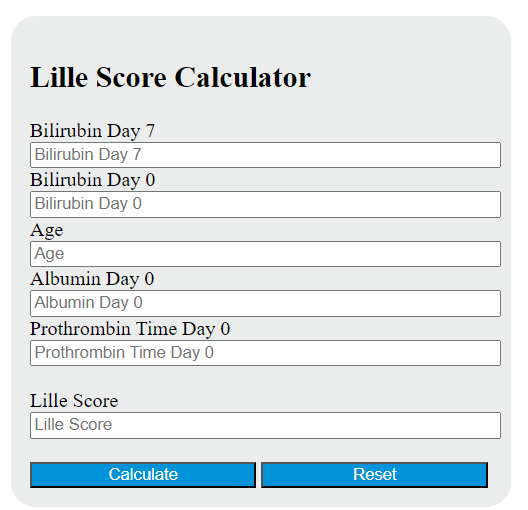
Calculate the classic day-7 Lille score using the validated variable definitions and adult treatment-response population.
Related Liver & Gastrointestinal Calculators
- ALT/LDH Ratio Calculator
- AST/ALT Ratio Calculator
- Child-Pugh Score Calculator
- Albumin/Globulin (A/G) Ratio Calculator
- Maddrey Score Calculator
- All Liver & Gastrointestinal Calculators
Adjacent Calculators
- Creatinine mmol/L to mg/dL Converter — Convert creatinine units separately before applying the Lille renal-status threshold; unit conversion does not determine renal insufficiency or calculate Lille score.
- AUDIT-C Alcohol Screening Calculator — Screen alcohol-use patterns separately; AUDIT-C is not a severity or corticosteroid-response model and cannot substitute for day-7 Lille assessment.
Lille Score Formula
The Lille model was developed for adults with severe alcohol-associated hepatitis who have already started corticosteroid therapy. The classic version combines baseline data with the bilirubin change from day 0 to day 7. It is not a general liver-function score.
The calculation begins with a linear predictor, commonly labeled R:
The linear predictor is then converted to the Lille score:
The final result falls between 0 and 1. In the published score orientation, a lower result reflects a more favorable early biochemical response pattern and a higher result reflects a less favorable response pattern. The original model used 0.45 as its main study cutoff after seven days.
Lille Score Variables
| Variable | Required Value | Timing and Unit |
|---|---|---|
| Age | Age at the treatment episode | Years |
| Albumin | Baseline serum albumin | g/L |
| Bilirubin day 0 | Baseline total bilirubin | µmol/L |
| Bilirubin day 7 | Total bilirubin after seven days | µmol/L |
| Renal indicator | 1 if baseline creatinine is greater than 1.3 mg/dL; otherwise 0 | Binary value |
| PT | Baseline prothrombin time | Seconds |
The calculator accepts common alternate units and normalizes them before applying the formula. It converts albumin from g/dL to g/L, bilirubin from mg/dL to µmol/L, and creatinine from µmol/L to mg/dL for the renal-indicator comparison.
What Is the Lille Score?
The Lille score was created to add an early on-treatment response measure to baseline severity assessment in severe alcohol-associated hepatitis. Baseline values alone cannot show how bilirubin changes after therapy begins. By including both day-0 and day-7 bilirubin, the Lille model incorporates that early biochemical trajectory together with age, albumin, renal status, and prothrombin time.
The original investigators developed the model in 320 adults treated with corticosteroids and validated it in a separate group of 118 adults. Its intended use is therefore narrow: a defined treatment episode with correctly timed baseline and day-7 measurements. It should not be applied to unrelated causes of jaundice, general cirrhosis assessment, or untreated alcohol-associated hepatitis.
Why the Bilirubin Change Matters
The formula uses day-0 bilirubin minus day-7 bilirubin. When bilirubin falls over the first seven days, that difference becomes positive. The positive change term increases R, and because the final score is 1 divided by 1 plus e raised to R, the Lille result moves lower. If bilirubin stays flat or rises, the difference becomes smaller or negative and the score tends to move higher.
This direction is easy to reverse by mistake. Enter day 0 and day 7 in their labeled fields rather than manually subtracting them. The calculator performs the subtraction in the published order.
How to Use the Lille Score Calculator
- Confirm that the clinical setting matches the validated population: an adult with severe alcohol-associated hepatitis already receiving corticosteroid therapy.
- Enter age in years.
- Enter baseline albumin and choose the unit printed on the report.
- Enter baseline creatinine and its unit. The calculator assigns the renal indicator from this value.
- Enter baseline total bilirubin and the day-7 total bilirubin using one consistent bilirubin unit.
- Enter baseline prothrombin time in seconds.
- Calculate the score, review the normalized values, and interpret it within the full clinician-led reassessment.
Worked Lille Score Example
Assume an adult has the following values for an educational example:
- Age: 48 years
- Baseline albumin: 3.0 g/dL
- Baseline creatinine: 1.1 mg/dL
- Day-0 total bilirubin: 18 mg/dL
- Day-7 total bilirubin: 10 mg/dL
- Baseline PT: 18 seconds
First convert albumin and both bilirubin values to the units used by the equation:
Creatinine is not greater than 1.3 mg/dL, so the renal indicator is 0. Substitute the normalized values into the linear predictor:
Now convert R to the final score:
The calculated Lille score is approximately 0.0554, which is below the original published 0.45 cutoff. This example demonstrates the arithmetic only; it does not determine an individual’s diagnosis, prognosis, or treatment.
How to Interpret a Lille Score
The original validation study used 0.45 to distinguish response groups. This calculator reports results at or below 0.45 separately from results above 0.45, matching the study’s strict greater-than boundary for nonresponse. A value near the cutoff is not biologically discontinuous from a nearby value on the other side, and measurement timing or laboratory variation can affect it.
The 2024 American College of Gastroenterology guideline places Lille assessment inside a broader evaluation of response in severe alcohol-associated hepatitis. That evaluation also considers infection, kidney injury, bleeding, contraindications, diagnostic certainty, and other severity information. This page calculates the score but does not issue an instruction to start, continue, change, or stop treatment.
Classic Day 7 Versus Day 4
This implementation is the classic day-7 Lille model. A day-4 Lille assessment has been evaluated separately and is acknowledged in current guidance, but a day-4 bilirubin value should not simply be placed in the day-7 field and relabeled. Use a separately validated day-4 protocol when that is the clinical question.
Common Mistakes to Avoid
- Using the calculator before corticosteroid therapy has started or outside severe alcohol-associated hepatitis.
- Entering a day-4 bilirubin value as though it were the classic day-7 value.
- Swapping the day-0 and day-7 bilirubin measurements.
- Mixing mg/dL and µmol/L between bilirubin inputs.
- Entering albumin in g/dL while selecting g/L, which introduces a tenfold error.
- Treating creatinine of exactly 1.3 mg/dL as positive for the renal term; the published boundary used here is greater than 1.3 mg/dL.
- Substituting INR for PT in seconds.
- Using the score as a bilirubin target or reverse-solving a desired laboratory value.
Clinical Scope and Limitations
The Lille score does not establish the diagnosis of alcohol-associated hepatitis or capture every factor relevant to an acutely ill patient. A calculator cannot assess infection, active bleeding, changing kidney function, encephalopathy, contraindications, diagnostic uncertainty, or sample quality.
The model should be interpreted by the treating team alongside the patient’s course and other validated severity information. It is not a general screening tool, an individual mortality prediction, or a substitute for clinical judgment.
Frequently Asked Questions
Does a Lower Lille Score Mean the Bilirubin Fell?
A bilirubin decline tends to lower the score because of the direction of the change term, but the final result also depends on age, albumin, renal status, baseline bilirubin, and PT. The score should therefore be checked against all displayed inputs rather than inferred from bilirubin alone.
What Happens at Creatinine of Exactly 1.3 mg/dL?
The renal indicator remains 0 at exactly 1.3 mg/dL. It changes to 1 only when baseline creatinine is greater than 1.3 mg/dL. The calculator applies that strict boundary after normalizing the selected creatinine unit.
Can INR Be Used Instead of Prothrombin Time?
No. The classic Lille equation uses baseline PT in seconds. INR is a different laboratory expression and should not be inserted into the PT field.
Can the Calculator Solve for a Desired Day-7 Bilirubin?
No. The validated model calculates a score from observed clinical data and is not a target-setting equation for bilirubin. Working backward from a cutoff would create an unsupported treatment target, so this calculator intentionally does not provide that mode.
Medical note: The Lille score is intended for clinician-led use in a narrowly defined treatment setting. Do not delay or change care based on an online calculation.
Primary and current sources: Louvet et al., original Lille model and validation study and 2024 ACG Clinical Guideline: Alcohol-Associated Liver Disease.