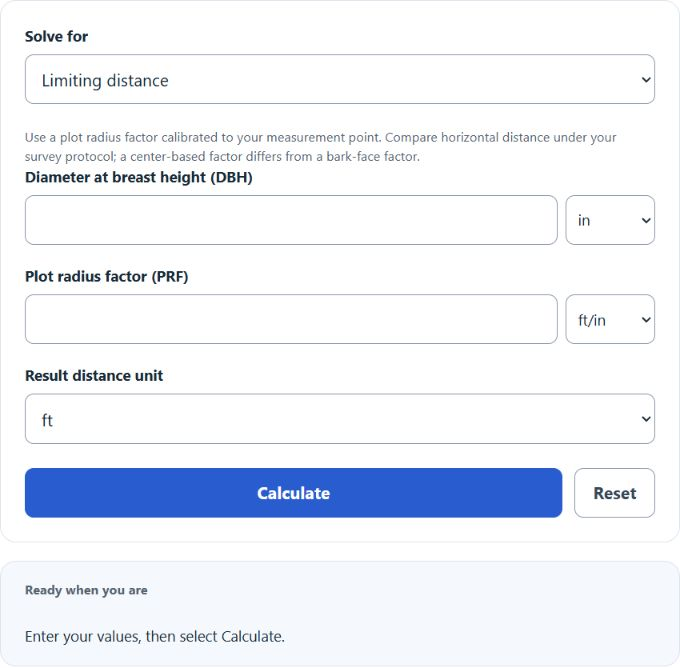
Calculate limiting horizontal distance, DBH, or PRF by choosing a solve mode and supplying the two known values. Length and ratio units are converted consistently, including ft/in, m/cm, m/m, and cm/cm.
Related Calculators
- Angle Of Projection Calculator
- Vertical & Horizontal Component Calculator
- Horizontal and Vertical Velocity Calculator
- Surface Gravity Calculator
- All Physics Calculators
Limiting Distance in Variable-Radius Sampling
The limiting distance is the maximum horizontal distance for a tree under a variable-radius sampling protocol. A standard center-based factor refers to the tree center; a face-corrected factor refers to the bark face. Use the factor and measurement point specified by your survey. This calculation is most often used for borderline trees when cruising timber with a prism or angle gauge.
Core Formula
- LD = limiting distance
- DBH = diameter at breast height
- PRF = plot radius factor
DBH is typically measured at 4.5 ft above ground in U.S. forestry or 1.3 m in metric forestry. In practice, a larger tree diameter or a larger PRF produces a larger limiting distance.
Decision Rule for Borderline Trees
Here, D is the horizontal distance measured to the point used to calibrate the entered PRF. The displayed rule is a center-based example; follow your survey protocol for boundary ties, slope corrections, and face-corrected factors. Distance beyond the applicable limit is out.
How to Calculate Limiting Distance
- Measure the tree’s DBH.
- Identify the correct PRF for your sampling setup.
- Multiply DBH by PRF.
- Compare the result to the measured tree distance from plot center.
Compatible Unit Pairings
The calculator converts the DBH and PRF units consistently before multiplication. The pairings below show direct numerical multiplication without a conversion; mixed pairings are also supported by the calculator.
| DBH Unit | PRF Unit | Resulting Limiting Distance |
|---|---|---|
| inches | ft/in | feet |
| centimeters | m/cm | meters |
| centimeters | cm/cm | centimeters |
| meters | m/m | meters |
DBH is most commonly recorded in inches or centimeters, but mathematically any consistent unit pair can be used.
Example
If a tree has a DBH of 12.5 in and the PRF is 2.5 ft/in, then:
A tree center at 31.25 ft is exactly on the limiting boundary. At 31 ft the tree is in; at 32 ft the tree is out.
Finding PRF from BAF
For standard center-based factors, the formulas below give imperial PRF in ft/in when BAF is in ft²/acre, and metric PRF in m/cm when BAF is in m²/hectare. The imperial constant is approximate. The calculator accepts PRF directly; it does not apply a BAF, slope, or tree-face correction. Reference distances below are rounded after using the unrounded factors.
Quick Imperial PRF Reference
| BAF | PRF (ft/in) | 10 in Tree LD | 20 in Tree LD |
|---|---|---|---|
| 5 | 3.889 | 38.89 ft | 77.78 ft |
| 10 | 2.750 | 27.50 ft | 55.00 ft |
| 20 | 1.944 | 19.44 ft | 38.89 ft |
| 40 | 1.375 | 13.75 ft | 27.50 ft |
Quick Metric PRF Reference
| BAF | PRF (m/cm) | 20 cm Tree LD | 30 cm Tree LD |
|---|---|---|---|
| 1 | 0.500 | 10.00 m | 15.00 m |
| 4 | 0.250 | 5.00 m | 7.50 m |
| 10 | 0.158 | 3.16 m | 4.74 m |
| 20 | 0.112 | 2.24 m | 3.35 m |
Common Field Errors
- Misreading ratio units: ft/in converts to 12 m/m or 0.12 m/cm; m/m and cm/cm are numerically equal. Select the actual units of your supplied factor.
- Measuring to the wrong point: use the tree center for a center-based PRF, or the bark face for a face-corrected PRF, as your protocol requires.
- Using circumference instead of DBH: the formula requires diameter, not trunk circumference.
- Using slope distance when horizontal distance is required: follow your cruise standard.
- Entering invalid values: DBH and PRF should both be positive.
Why the Calculation Matters
Accurate limiting-distance checks make variable-radius sampling more consistent by classifying borderline trees the same way every time. That improves downstream estimates for basal area, stand density, stocking, and timber volume.