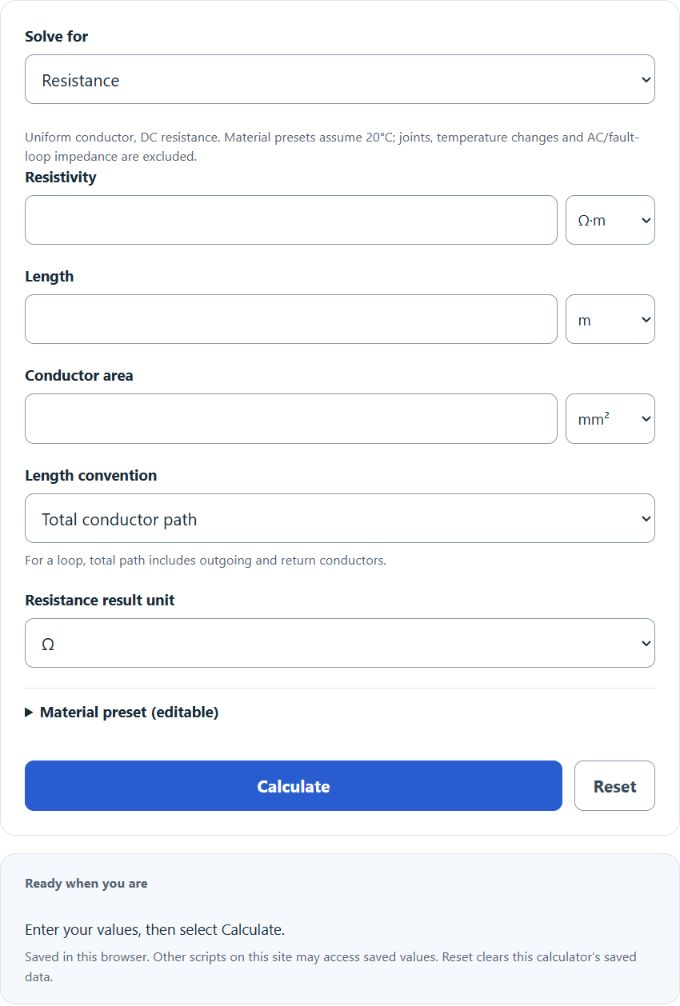
Calculate loop resistance, resistivity, length or cross-sectional area from any three values, or estimate resistance from AWG wire size and material.
Loop Resistance Formula
The following formula is used to calculate the loop resistance for a given resistivity, total conductor path length, and cross-sectional area. For two identical outgoing and return wires, total path length is twice the one-way cable distance.
Variables:
- R is the loop resistance
- ρ is the resistivity in Ω·m at the conductor temperature
- L is the total conductor path length in metres, including outgoing and return conductors for a loop
- A is one conductor’s cross-sectional area in m²
To calculate the loop resistance, multiply the resistivity by the length and divide by the cross-sectional area. This estimates uniform DC conductor resistance; it excludes connections and AC or earth-fault loop impedance. Material presets use approximate 20°C values from OpenStax. AWG estimates use nominal equivalent solid-round area.
What is Loop Resistance?
Loop resistance is the total resistance encountered by an electrical current as it travels through a loop of conductive material. This resistance is influenced by the material’s resistivity, the length of the loop, and the cross-sectional area of the conductor. Loop resistance is a critical factor in the design and performance of electrical circuits, as it affects the efficiency and heat generation within the system.
How to Calculate Loop Resistance?
The following steps outline how to calculate the Loop Resistance.
- First, determine the resistivity of the material (ρ).
- Next, measure the total conductor length (L), or choose the two-wire convention and enter one-way cable distance.
- Next, measure the cross-sectional area of the conductor (A).
- Finally, calculate the loop resistance using the formula R = (ρ * L) / A.
- After inserting the values and calculating the result, check your answer with the calculator above.
Example Problem :
Use the following variables as an example problem to test your knowledge.
Resistivity (ρ) = 1.68 x 10^-8 Ω·m
Total conductor path length (L) = 10 m (5 m out and 5 m return)
Cross-sectional Area (A) = 2 x 10^-6 m². Resistance = 0.084 Ω.