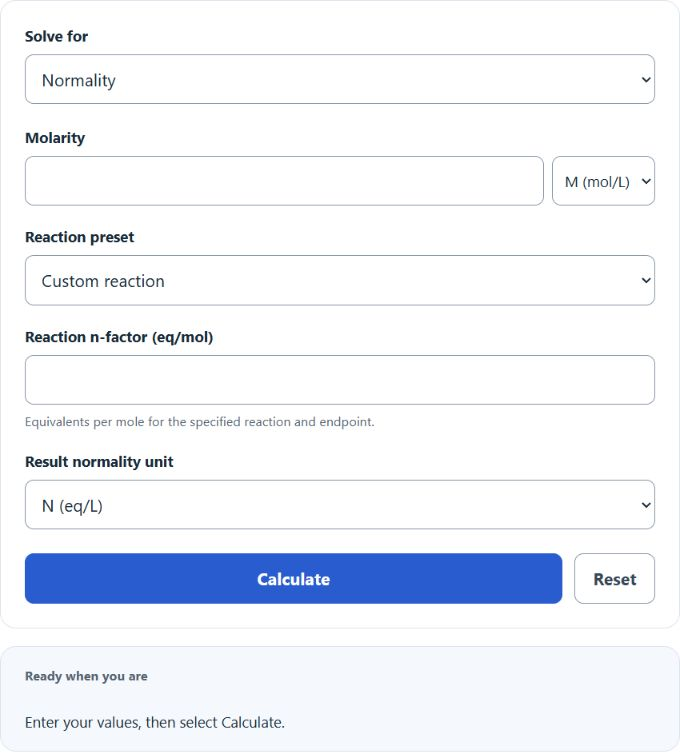
Convert molarity to normality or reverse it with reaction n-factor presets, solve the n-factor, or calculate solute mass for solution preparation.
Related Calculators
- N to Mass Calculator
- Molar To mg/mL Calculator
- mol/L To ppm Calculator
- Mass to Concentration Calculator
- All Chemistry Calculators
Molarity to Normality Formula
The following formula is used to calculate the normality for a given molarity and reaction-specific equivalents per mole.
Variables:
- N is the normality
- M is the molarity
- E is the reaction n-factor in equivalents per mole (eq/mol), for a specified reaction and endpoint
To calculate normality in eq/L, multiply molarity in mol/L by the reaction-specific equivalents per mole.
| Molarity (M, mol/L) | Normality (N, eq/L) |
|---|---|
| 0.001 | 0.001 |
| 0.005 | 0.005 |
| 0.010 | 0.010 |
| 0.020 | 0.020 |
| 0.050 | 0.050 |
| 0.100 | 0.100 |
| 0.200 | 0.200 |
| 0.250 | 0.250 |
| 0.500 | 0.500 |
| 0.750 | 0.750 |
| 1.000 | 1.000 |
| 1.500 | 1.500 |
| 2.000 | 2.000 |
| 2.500 | 2.500 |
| 3.000 | 3.000 |
| 4.000 | 4.000 |
| 5.000 | 5.000 |
| 6.000 | 6.000 |
| 8.000 | 8.000 |
| 10.000 | 10.000 |
| Assumes a specified reaction with n-factor = 1 eq/mol. In this case, 1 M = 1 N. For other reactions, N = M × reaction n-factor; charge or compound identity alone may not determine it. | |
What is Normality?
Normality (N) is the reactive equivalent concentration in eq/L for a specified reaction. It equals molarity multiplied by that reaction’s equivalents per mole and is used in titration calculations. State the reaction and endpoint: the same solution can have different normalities for different reactions.
How to Calculate Normality?
The following steps outline how to calculate the Normality.
- First, determine the molarity (M) of the solution.
- Next, determine equivalents per mole (E) from the specified reaction and endpoint.
- Finally, calculate the normality using the formula N = M * E.
- After inserting the values and calculating the result, check your answer with the calculator above.
Example Problem :
Use the following variables as an example problem to test your knowledge.
Molarity (M) = 2 M
Reaction n-factor (E) = 3 eq/mol. For this specified reaction, normality = 2 × 3 = 6 N.