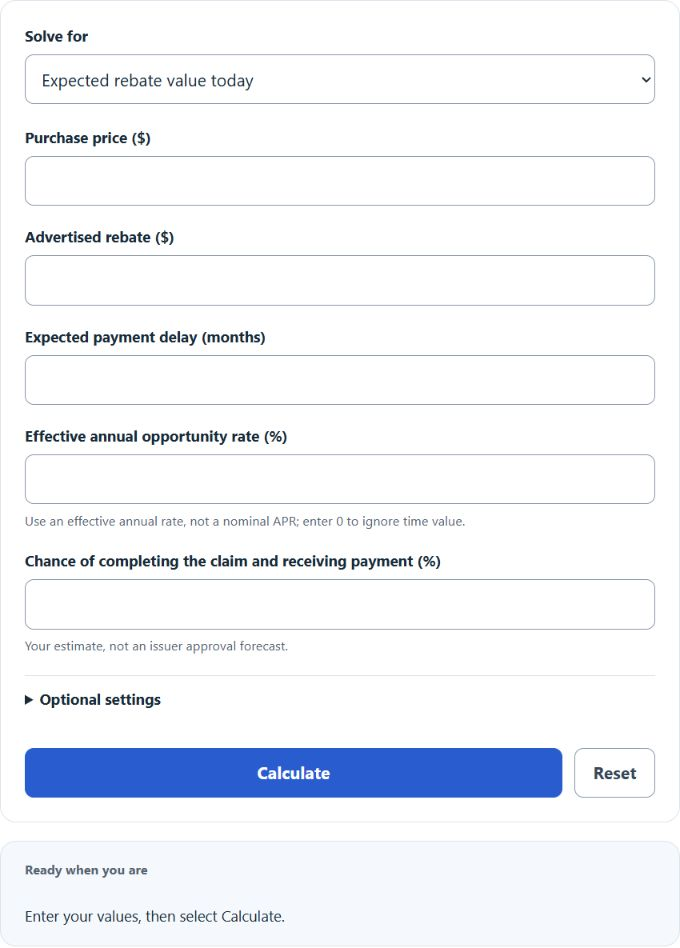
Find a mail-in rebate’s expected present value after delay, approval risk, and costs, then compare it with an immediate discount on the same purchase.
Mail-In Rebate Value Formula
At a positive discount rate, a delayed rebate is worth less today than the same amount received immediately. The model uses an effective annual opportunity rate and costs paid now whether or not the claim succeeds. Enter Annual Rate and Approval Probability as decimals in the formula below (5% = 0.05 and 90% = 0.90):
Expected Rebate Value =
 [Rebate * Approval Probability] / (1 + Annual Rate)^(Months / 12)
 - Submission Cost
The expected effective rebate percentage and expected net purchase cost are:
Effective Rebate (%) = Expected Rebate Value / Purchase Price * 100
 Expected Net Cost = Purchase Price - Expected Rebate Value
Variables:
- Rebate is the advertised amount paid after a successful submission
- Approval Probability is your estimate of the chance the claim is approved and paid
- Annual Rate is the opportunity cost or discount rate for delayed money
- Months is the expected time until payment arrives
- Submission Cost includes postage, printing, and other direct costs
The approval adjustment captures the expected value of a claim that may be rejected or forgotten. It does not predict the issuer’s actual approval rate. Use a conservative probability when the offer requires strict documentation or has a short deadline.
Present Value of a $100 Rebate
Values are rounded. The second column isolates the time value of money; the third also applies a 90% approval probability and a $1 submission cost.
| Expected delay | 100% approval, 5% annual rate | 90% approval, less $1 cost |
|---|---|---|
| Immediate | $100.00 | $89.00 |
| 3 months | $98.79 | $87.91 |
| 6 months | $97.59 | $86.83 |
| 12 months | $95.24 | $84.71 |
Example Problems
Example 1: Expected value of a delayed rebate.
A $500 purchase includes a $75 rebate expected in eight months. Submission costs $1, the annual opportunity rate is 5%, and approval probability is 90%. The present value if approved is about $72.60. After multiplying by 90% and subtracting $1, the expected rebate value is about $64.34, or 12.87% of the purchase price.
Example 2: Compare with an instant discount.
Using the same assumptions, suppose the store offers a $60 instant discount instead. The expected rebate value of about $64.34 is only $4.34 higher. A shopper who prefers certainty or wants to avoid paperwork may reasonably choose the instant discount despite the slightly lower modeled value.
Frequently Asked Questions
Why discount a rebate for time?
Money received later cannot be used, saved, or invested today. The discount rate converts a future payment into an equivalent present value, making it comparable with an immediate discount.
How do I choose an approval probability?
Use 100% only when you are confident the submission will be completed correctly and paid. Lower the estimate for complicated forms, missing documentation risk, strict deadlines, or uncertainty about whether you will follow through.
Is an instant discount always better?
No. A larger rebate can still have a higher expected value after delay and risk. The comparison mode shows the dollar advantage, but convenience, certainty, and the value of your time remain personal considerations.