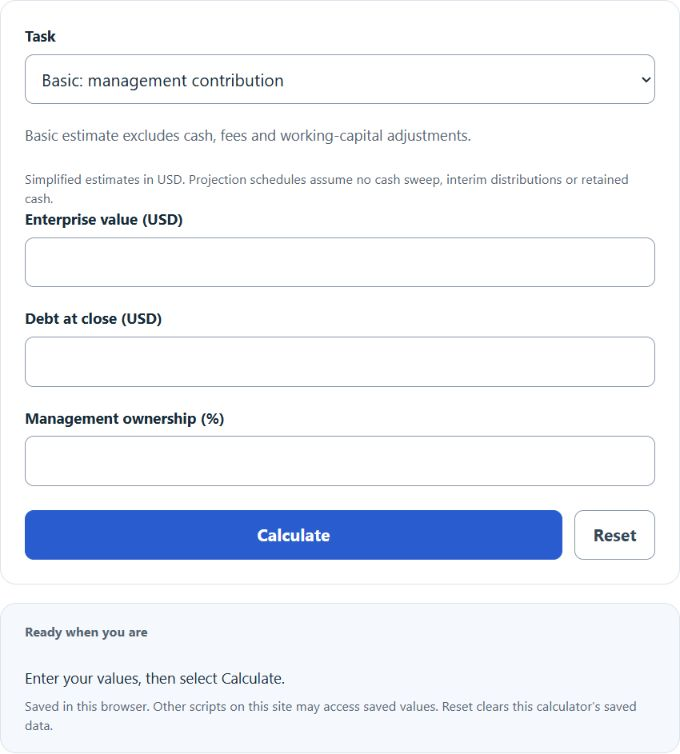
Calculate basic management equity contributions, closing sources and uses, and simplified debt schedules, covenant checks, equity MOIC and annualized returns. Projections assume no cash sweep, interim equity distributions or retained cash.
Related Calculators
- Promissory Note Value Calculator
- Net Profit Margin Calculator
- Asset Turnover Ratio Calculator
- Return on Revenue Calculator
- All Business Calculators
Management Buyout Formula
The following equations are commonly used to estimate the equity value at closing and whether an MBO is fully funded at closing (a sources & uses view). Note: projected cash flows are typically used to evaluate debt capacity and repayment over time, not subtracted from the purchase price.
- Where EV is Enterprise Value ($) (often estimated as EBITDA × EV/EBITDA multiple)
- D is debt at close ($) and C is cash used at close ($)
- F is transaction fees & taxes ($)
- WC is the working capital adjustment ($)
- SD is senior debt ($), MD is mezzanine/unitranche debt ($), SN is a seller note ($)
- MR is management rollover equity ($), MN is management new cash ($), and OE is outside investor equity ($)
Closing sources and uses balance when the Funding Gap is $0. A negative gap indicates additional financing is required; a positive gap is excess funding whose use must be specified. This closing arithmetic alone does not establish debt-service capacity or transaction feasibility.
What is a Management Buyout?
Definition:
A management buyout is a transaction where a management team acquires all or part of a company’s ownership, typically financed through a combination of personal funds, external funding, and debt, leveraging the business’s future cash flows and assets.
How to Calculate Management Buyout?
Example Problem:
The following example outlines the steps and information needed to estimate an at-close funding picture for a management buyout.
First, estimate the enterprise value (EV). In this example, EV is $1,000,000.
Next, determine the cash and debt at close. Assume cash at close is $0 and debt at close is $200,000.
Then, estimate fees and any working capital adjustment. Assume fees are $0 and the working capital adjustment is $0.
Now, calculate Equity Value at close:
Equity Value = EV − (D − C)
Equity Value = $1,000,000 − ($200,000 − $0) = $800,000
Compute total Uses at closing:
Uses = Equity Value + D + F + WC = $800,000 + $200,000 + $0 + $0 = $1,000,000
Finally, compare Sources to Uses. For example, if senior debt is $700,000 and total equity sources (management rollover/new cash and/or outside equity) are $300,000, then Sources = $1,000,000 and the Funding Gap is $0 (fully funded at close).
FAQ
What factors can affect the feasibility of a management buyout?
The feasibility of a management buyout can be influenced by the company’s valuation, available financing, the stability and predictability of cash flows, and the perceived risk by potential lenders or investors. Lack of sufficient collateral or overly high liabilities can also impact the likelihood of a successful buyout.
How is the management team’s equity stake determined?
The equity stake is typically determined by how much capital each member contributes and the amount of external funding or debt involved. Negotiations often reflect the management team’s experience, future role, and the level of financial risk undertaken.
Is external financing necessary for all management buyouts?
Not necessarily. While many MBOs do rely on external loans or investor funding, some can be financed through the team’s personal assets or the company’s cash flows. However, external financing is common because it helps spread out the financial burden and leverage resources for a larger purchase price.