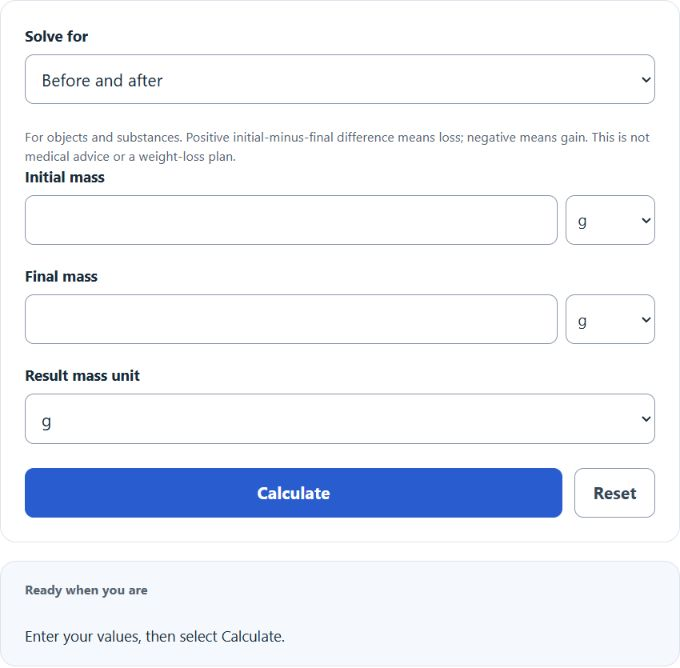
Choose before-and-after mass change or average rate over time, then enter the measurements and select result units. The signed difference is positive for loss and negative for gain.
Note: This calculator is intended for mass changes of objects/substances (e.g., experiments, manufacturing, evaporation) and is not medical advice or a weight-loss plan. If you’re concerned about body-weight change—especially rapid or unexplained changes—seek guidance from a qualified healthcare professional.
Mass Difference Formula
The following formula is used to calculate the mass difference for a given initial and final mass.
Variables:
- ML is the mass difference (positive = loss, negative = gain)
- M_i is the initial mass
- M_f is the final mass
To calculate the mass difference, subtract the final mass from the initial mass.
What is Mass Difference?
Mass difference refers to the change in mass of an object or substance between two measurements. This can occur due to processes such as evaporation, erosion, combustion, or chemical reactions. Understanding mass change is important in fields such as physics, chemistry, engineering, and environmental science, as it helps analyze the efficiency, stability, and sustainability of different systems and processes.
How to Calculate Mass Difference?
The following steps outline how to calculate the mass difference.
- First, determine the initial mass (M_i).
- Next, determine the final mass (M_f).
- Finally, calculate the mass difference using the formula ML = M_i – M_f.
- After inserting the values and calculating the result, check your answer with the calculator above.
Example Problem :
Use the following variables as an example problem to test your knowledge.
Initial Mass (M_i) = 10 kg
Final Mass (M_f) = 7 kg