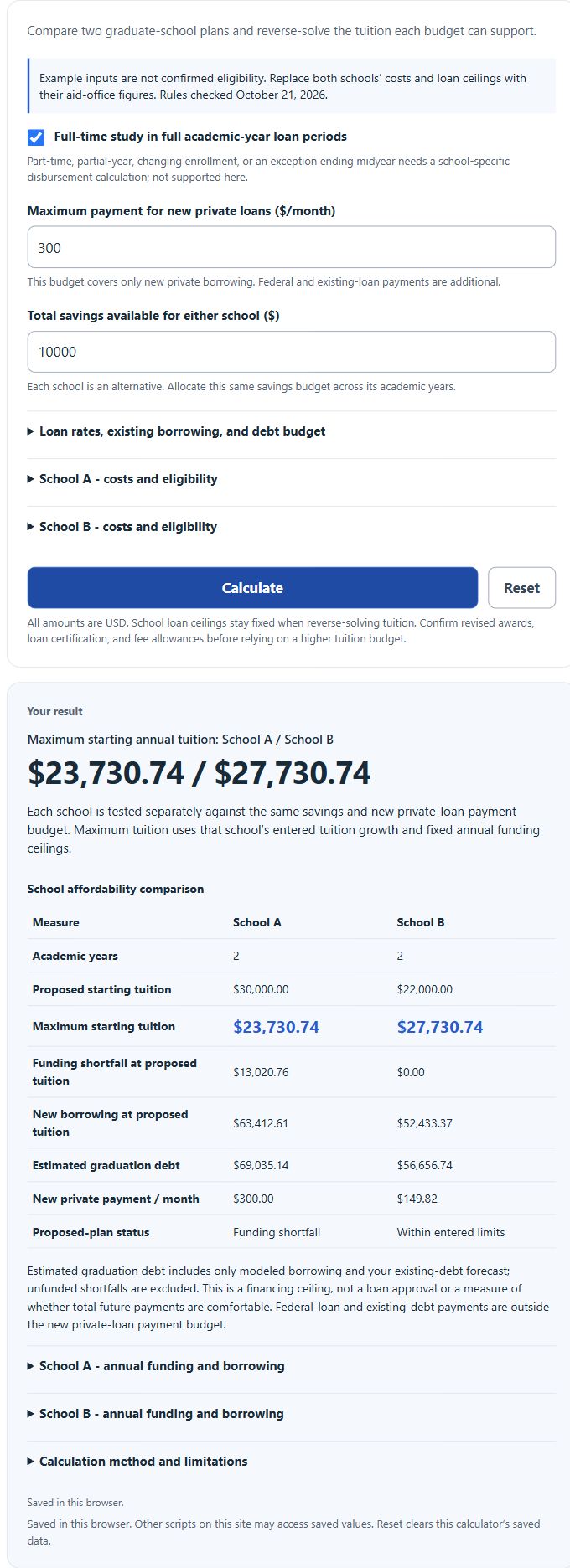
Compare graduate schools, estimate funding gaps and graduation debt, and work backward to find the maximum tuition your student loan budget can support.
Related Calculators
- Student Loan Repayment Calculator
- Cost Per Credit Hour Calculator
- Loan Capitalization Calculator
- Loan Calculator With Interest
- All Loans and Debt Calculators
Maximum Affordable Tuition Formula
The calculator tests each academic year, then works backward to find the highest starting annual tuition that fits the entered funding and debt limits:
Variables:
- T is first-year tuition; g is annual tuition growth as a decimal; i starts at 1. power(x, y) means x raised to y.
- Attendance costs equal tuition plus the entered non-tuition expenses. Gifts are usable scholarships and assistantship funding.
- M is the monthly budget for new private loans; r is private APR divided by 1,200; n is repayment years multiplied by 12. At zero APR, the balance limit is M × n.
- P is each new loan principal, a is its annual interest rate as a decimal, and t is years from the assumed disbursement midpoint to graduation.
Funding is applied in order: gifts, allocated savings, Direct Unsubsidized Loans, eligible legacy Grad PLUS, and private loans. Federal principal is limited by the school-confirmed ceiling and applicable annual, aggregate, and lifetime room. Loan fees reduce available cash; the gross loan still increases borrowing and debt. Enter non-tuition costs without these modeled loan fees and confirm that the school’s certified cost of attendance accommodates them.
The reverse calculation holds annual awards, non-tuition costs, savings allocations, school loan ceilings, interest assumptions, and tuition growth constant. It finds the highest first-year tuition with no annual shortfall, a new-private-loan payment within budget, and graduation debt within any optional ceiling. If zero tuition still leaves an unaffordable plan, the result says so. Savings are fixed allocations: unused amounts do not automatically move to another year.
What Is Maximum Affordable Tuition?
Maximum affordable tuition is the tuition compatible with a specified multiyear funding plan. Comparing two schools shows how program length, living costs, awards, federal eligibility, and private borrowing change that maximum. Each school is an alternative use of the same savings. A fully funded result is not loan approval or a complete assessment of affordability from future income. Federal and existing-loan payments are additional to the entered payment budget for new private borrowing.
Federal guidance checked October 21, 2026. This calculator models full-time enrollment in complete academic-year rows. Part-time or mixed enrollment, partial academic years, and a legacy exception expiring midyear require a school-specific disbursement schedule. Federal enrollment reductions interact with cost of attendance, other aid, aggregate and lifetime limits, and disbursement timing.
For borrowing under the rules effective July 1, 2026, keep these limits separate:
- Annual: ordinarily $20,500 in Direct Unsubsidized Loans for graduate students or $50,000 for professional students, per academic year. School limits and individual eligibility can be lower. Grad PLUS is unavailable outside a qualifying legacy exception.
- Graduate/professional aggregate: $100,000 for a graduate borrower who was never a professional student, or $200,000 combined for a professional borrower or graduate borrower who was previously professional. This counter excludes undergraduate borrowing, Grad PLUS, and capitalized interest.
- Lifetime: $257,500 of counted historical student borrowing, including undergraduate loans, graduate/professional loans, Grad PLUS, FFEL, and Perkins. Parent PLUS and loans made under the Public Health Service Act, such as HEAL, are excluded. Consolidation must not count the same underlying borrowing twice.
Use school-confirmed counters from your federal loan records. An aggregate counter tracks relevant outstanding principal; ordinary principal repayment can restore room. The lifetime counter tracks counted disbursements, so ordinary repayment does not restore room. Existing debt at graduation is a separate forecast of what you expect to owe, including applicable interest. The calculator does not infer these eligibility counters from that debt forecast. See FSA’s NSLDS eligibility guidance and loan-limit FAQs.
Legacy exceptions: the school must confirm enrollment in the same program and institution as of June 30, 2026, with a Direct Loan disbursed for that program before July 1, 2026. The exception lasts for the lesser of three academic years or the published program length minus the portion completed before July 1, 2026, subject to continued eligibility. Standard legacy limits are $20,500 annually and $138,500 aggregate including undergraduate loans. Eligible legacy health-profession borrowers may retain higher school-confirmed annual limits and a $224,000 aggregate. Eligible legacy Grad PLUS requires a school-confirmed annual ceiling. The lifetime cap is temporarily inapplicable, but borrowing is still tracked; new limits apply after the exception ends. Eligible borrowers cannot simply opt out for a higher new annual limit.
Do not choose professional eligibility from a degree’s name. Ask the financial aid office to confirm the classification and available amount under FSA’s court-order guidance and interim program list. Classification may change as litigation proceeds. Reconfirm eligibility whenever the school, program, attendance pattern, costs, or awards change.
Default federal rates are 8.07% for graduate/professional Unsubsidized and 9.07% for PLUS first disbursed July 1, 2026 through June 30, 2027. Default fees are 1.057% and 4.228% for first disbursements October 1, 2020 through September 30, 2027. Later-year rates and fees are editable planning assumptions, not predictions.
Graduation debt uses simple interest and an average midpoint disbursement in each academic year, with no in-school payments or grace-period interest. Private origination fees are excluded. Actual dates, fee rounding, capitalization, and repayment terms can change balances. Cumulative borrowing means new gross principal; graduation debt also includes modeled interest and the existing-debt forecast. An unfunded shortfall is not silently added to debt.
How to Calculate Maximum Affordable Tuition?
Use these steps to compare a proposed tuition with the maximum supported by your plan.
- Confirm full-time academic-year planning, federal classification, legacy eligibility, remaining exception years, and borrowing counters with each school’s financial aid office.
- Enter available savings, the monthly budget and terms for new private borrowing, federal rate and fee assumptions, and any graduation-debt ceiling.
- For each school, enter program years, first-year tuition and growth, and an existing-debt forecast at that school’s graduation date.
- Complete each year’s non-tuition costs, scholarships, assistantships, savings allocation, and school-confirmed gross loan ceilings. Avoid counting a tuition waiver both as reduced tuition and as an award.
- Calculate and compare yearly shortfalls, cumulative borrowing, graduation debt, and maximum starting annual tuition. Recheck school eligibility before relying on a changed tuition or award scenario.
Example Problem:
Compare two full-time, two-year graduate programs with no tuition growth, prior borrowing, legacy exception, or debt ceiling. Allocate $5,000 of savings each year from $10,000 available. Assume each school confirms $20,500 in annual Unsubsidized eligibility, with 8.07% interest and a 1.057% fee. Set new private borrowing to 8% over 10 years and a $300 monthly budget. These inputs illustrate the model, not an eligibility determination.
School A has $30,000 annual tuition, $18,000 other costs, and a $5,000 scholarship. School B has $22,000 tuition, $16,000 other costs, a $3,000 scholarship, and a $4,000 assistantship each year. Annual net federal proceeds are approximately $20,283.32.
At the proposed tuition, School A has no first-year shortfall but a $13,020.76 second-year shortfall. Its modeled new borrowing totals $63,412.61, and graduation debt is $69,035.14; that debt does not finance the remaining shortfall. School B has no annual shortfall, new borrowing of $52,433.37, and graduation debt of $56,656.74.
Working backward, maximum starting annual tuition is $23,730.74 for School A and $27,730.74 for School B. At either maximum, estimated graduation debt is $69,035.14, including a private graduation balance of $24,726.44 supported by the $300 payment budget. Federal-loan payments remain additional. Totals use unrounded intermediate values.