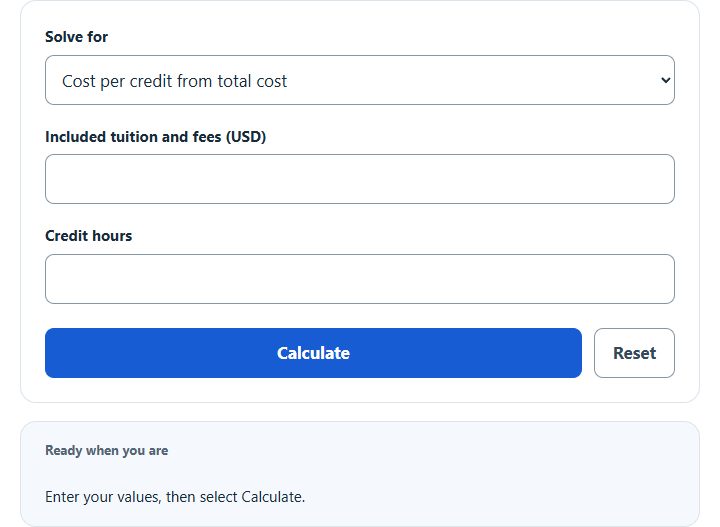
Calculate cost per credit hour from tuition and fees, estimate net semester cost, find affordable credits, or compare two schools after aid.
Calculator Functions
| Function | What it does | What it requires |
|---|---|---|
| Cost per credit from total cost | Finds the average cost of one credit hour from a tuition and fee total | Requires the included tuition and fees and the credit hours they cover |
| Semester cost from credit rates | Finds the out-of-pocket cost of a term from per-credit rates, flat fees and gift aid | Requires the tuition per credit and the credit hours; fees per credit, flat term fees and gift aid are optional and count as $0 when blank |
| Whole credits within a budget | Finds the largest whole number of credits a set budget covers | Requires the out-of-pocket budget and the tuition per credit; fees per credit, flat term fees and gift aid are optional |
| Compare two schools | Compares the term cost of the same credit load at two schools and names the lower one | Requires the credit hours and each school’s tuition per credit; each school’s fees per credit, flat fees and gift aid are optional |
All amounts are in US dollars and cents. Gift aid means grants, scholarships or employer support, not loans. Three of the functions also list the cost at other credit loads, such as 9, 12 and 15 credits, using the same rates.
Cost Per Credit Hour Formulas
| CPCH | Cost per credit hour ($ per credit) |
| TC | Total tuition and fees included ($) |
| CH | Credit hours. Federal rules describe one semester credit hour as about one hour of class plus at least two hours of outside work each week for roughly fifteen weeks [1] |
Cost per credit from total cost
The total is divided by the credit hours it pays for. A term billed at $6,000 for 15 credits costs 6,000 ÷ 15 = $400 per credit. The result is an average, and the table under it spreads that average over 3, 9, 12 and 15 credits.
Semester cost from credit rates
T is tuition per credit, F is fees per credit, FF is flat term fees and GA is gift aid. Grants are aid that does not have to be repaid, which is why they reduce the cost and loans do not [2]. Fifteen credits at $400 tuition and $25 fees per credit, with $500 of flat fees and $2,000 of gift aid, cost 425 × 15 + 500 − 2,000 = $4,875, or $325 per credit. The result stops at $0: aid above the charges is not counted as a refund.
Whole credits within a budget
(T + F), rounded down
B is the out-of-pocket budget. Flat fees come off the budget first, gift aid is added, and the remainder is divided by the full per-credit charge. A $5,000 budget with $1,000 of gift aid, $500 of flat fees and $425 per credit gives 5,500 ÷ 425 = 12.94, so 12 whole credits, which cost $4,600 out of pocket and leave $400.
Compare two schools
Each school is priced with the semester formula at the same credit load, and the school with the lower result is named along with the dollar difference and each school’s cost per credit. The comparison covers tuition and fees only.
How to Calculate Tuition per Credit Hour
Divide the tuition and fees billed for a term by the credit hours taken in that term. A bill of $4,200 for 12 credits is $350 per credit hour. To go the other way, multiply the per-credit rate by the credits: a 3-credit class at $365 per credit hour is $1,095 before flat fees, and 60 credits at $650 per credit hour is $39,000.
Limits of This Estimate
- An average cost per credit is not the price of a different course load. Schools that charge one flat rate for a range of credits, or that add flat fees, bill differently at each load.
- Only tuition and fees are counted. Housing, books, transport and loan costs are left out. To compare complete graduate-school funding plans with living costs and loans, use the Maximum Affordable Tuition Calculator.
- Gift aid rules vary. Some awards require a minimum number of credits, so confirm billing and aid rules with the school for the intended load.
Sources
- U.S. Department of Education, 34 CFR 600.2, Definitions: Credit hour (Legal Information Institute text): what one credit hour represents
- Federal Student Aid, Types of Financial Aid: grants as aid that does not have to be repaid