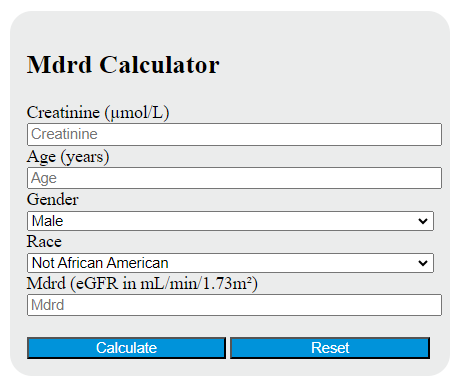
Estimate adult eGFR with the IDMS MDRD equation or reverse-solve serum creatinine, with mg/dL and µmol/L conversion, G-stage context, and optional BSA de-indexing.
- All Health and Medical Calculators
- GFR to Creatinine Clearance Calculator
- BUN Creatinine Ratio Calculator
- Creatinine mmol/L to mg/dL Converter
- CKD Protein Calculator
- Potassium to Creatinine Ratio Calculator
MDRD Formula
The MDRD calculator estimates glomerular filtration rate (eGFR), which is a standardized measure of kidney filtration expressed in mL/min/1.73 m2. It uses serum creatinine, age, sex, and the coefficient built into the classic MDRD equation to generate a fast estimate of renal function.
If you enter creatinine in µmol/L, the calculator first converts it to mg/dL and then applies the equation. The result is normalized to a body surface area of 1.73 m2, which is why the output is reported as mL/min/1.73 m2.
Variable Definitions
| Input | Meaning | Why It Matters |
|---|---|---|
| Serum Creatinine | The concentration of creatinine in blood, entered in mg/dL or µmol/L. | Higher creatinine generally lowers the estimated GFR. |
| Age | The patient’s age in years. | The equation adjusts downward with increasing age. |
| Sex | Used to apply the sex coefficient in the classic MDRD equation. | Changes the estimate to account for average differences in creatinine generation. |
| Race Coefficient | The classic MDRD formula includes a multiplier for African American patients. | This affects the calculated eGFR when that coefficient is selected. |
How to Use the MDRD Calculator
- Select the creatinine unit that matches the lab value you have.
- Enter the serum creatinine result.
- Enter age in years.
- Select sex.
- Select the race coefficient option shown in the calculator.
- Click calculate to return the estimated GFR.
Because the formula is very sensitive to creatinine, even a small change in the lab value can materially change the eGFR result. Double-check the unit before calculating.
Example Calculation
Using a creatinine of 100 µmol/L, age 60 years, female, and not African American:
That gives an estimated GFR of approximately 52.1 mL/min/1.73 m2.
How to Interpret the Result
The MDRD result is an estimate of filtration, not a diagnosis by itself. Kidney disease staging depends on the eGFR value, whether the finding persists over time, and whether other signs of kidney damage are present.
| eGFR Range | General Interpretation |
|---|---|
| 90 or higher | Normal or high filtration. This alone does not confirm kidney disease. |
| 60 to 89 | Mildly reduced filtration; significance depends on persistence and other kidney findings. |
| 45 to 59 | Mild to moderate reduction in kidney filtration. |
| 30 to 44 | Moderate to severe reduction in kidney filtration. |
| 15 to 29 | Severely reduced kidney filtration. |
| Below 15 | Very severe reduction in kidney function that usually requires urgent medical evaluation. |
When the MDRD Estimate Can Be Less Reliable
- Rapidly changing kidney function or suspected acute kidney injury
- Pregnancy
- Children and adolescents
- Very low muscle mass or very high muscle mass
- Amputation, paralysis, severe malnutrition, or other situations where creatinine production is atypical
- Cases where lab methods or reporting standards differ from the classic MDRD structure
Practical Notes
- MDRD estimates kidney filtration from a blood test; it is not the same as a measured creatinine clearance study.
- The output is indexed to 1.73 m2 of body surface area, so it is standardized rather than individualized to body size.
- Different labs may report eGFR using a different equation, which can lead to slightly different results from the same creatinine value.
- This calculator is most useful for quick estimation, trend review, and educational understanding of how creatinine, age, sex, and the classic race coefficient influence eGFR.
Frequently Asked Questions
What does a higher MDRD value mean?
A higher eGFR usually indicates better kidney filtration, while a lower eGFR suggests reduced kidney function.
Why can two calculators give different answers?
Differences in unit conversion, rounding, creatinine calibration, and the exact equation used can all change the final estimate.
Is one low result enough to diagnose chronic kidney disease?
No. A single estimate should be interpreted with the full clinical picture, repeat testing, and other kidney markers.
Does this calculator replace medical advice?
No. It is a screening and educational tool. Clinical decisions should be made using a full medical assessment and the reporting standard used by the treating clinician or laboratory.