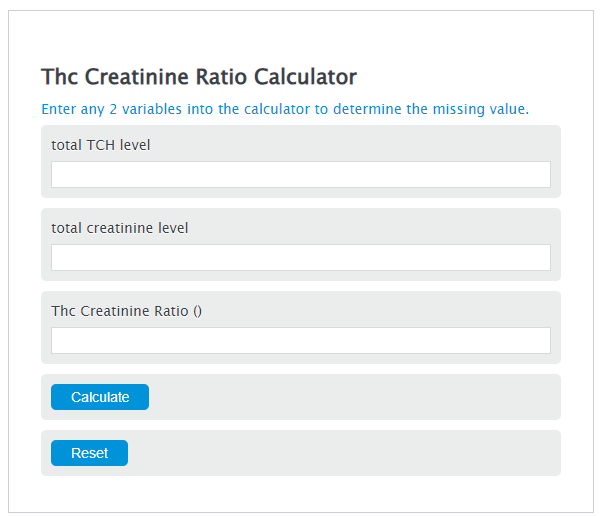
Calculate urine THC-COOH/creatinine ratios for a single sample or compare two specimens to assess normalized changes over time in urine.
Disclaimer: Educational use only—this is not medical, toxicology, legal, or employment advice. Urine testing typically detects THC-COOH (not active THC) and a single creatinine-normalized result cannot determine impairment, fitness to drive/work, or timing of use. For interpretation, consult the testing laboratory/Medical Review Officer (MRO) and/or a licensed clinician.
Limitations
- This calculator only normalizes a measured urine THC-COOH (cannabinoid metabolite) concentration to creatinine; it does not determine “new use vs residual” from one sample.
- Specimen validity/dilution criteria and reporting conventions can vary by lab/testing program; follow the laboratory’s guidance.
- Meaningful interpretation often requires serial samples plus chain-of-custody/testing context and professional review.
References and further guidance
- Look for workplace drug testing guidance from U.S. HHS/SAMHSA (if applicable to your setting) and follow your program’s policies.
- For personal/clinical questions, ask the ordering clinician and/or the performing laboratory for interpretation notes.
- All Health and Medical Calculators
- Potassium to Creatinine Ratio Calculator
- Bun Creatinine Ratio Calculator
THC-COOH / Creatinine Ratio Formula
The calculator normalizes urine THC-COOH to urine creatinine. This helps adjust for urine dilution or concentration.
- Normalized Ratio is the creatinine-normalized THC-COOH result, reported as ng/mg.
- THC-COOH is the urine THC metabolite concentration, converted to ng/mL.
- Creatinine is the urine creatinine concentration, converted to mg/mL.
For the two-sample comparison, the calculator first finds the normalized ratio for each sample. Then it compares Sample 2 to Sample 1.
- Sample 1 Ratio is the normalized THC-COOH/creatinine result for the first specimen.
- Sample 2 Ratio is the normalized THC-COOH/creatinine result for the second specimen.
- Change Ratio shows how many times larger or smaller Sample 2 is compared with Sample 1.
- Percent Change shows the increase or decrease from Sample 1 to Sample 2 as a percentage.
The single-sample function reports one normalized value and a creatinine status. The comparison function reports two normalized values, the Sample 2/Sample 1 ratio, and the percent change. The calculator also checks whether creatinine is low, typical, or high because unusual creatinine values can affect interpretation.
Creatinine Status and Unit Reference
Creatinine status is based on the creatinine value after conversion to mg/dL.
| Creatinine in mg/dL | Status | Meaning for interpretation |
|---|---|---|
| Less than 20 | Low | The specimen may be dilute. |
| 20 to 300 | Typical | The creatinine value is in a more typical urine concentration range. |
| Greater than 300 | High | The specimen may be concentrated. |
Use these conversions if your report uses a different creatinine unit.
| Input unit | Conversion used | Example |
|---|---|---|
| mg/dL creatinine | mg/mL = mg/dL × 0.01 | 100 mg/dL = 1 mg/mL |
| mg/L creatinine | mg/mL = mg/L × 0.001 | 1000 mg/L = 1 mg/mL |
| g/L creatinine | mg/mL = g/L × 1 | 1 g/L = 1 mg/mL |
| µg/L THC-COOH | Same numeric value as ng/mL | 50 µg/L = 50 ng/mL |
Example THC-COOH / Creatinine Ratio Calculations
Example 1: Single sample
You have a urine THC-COOH value of 80 ng/mL and urine creatinine of 100 mg/dL.
Convert creatinine:
Calculate the normalized ratio:
The normalized THC-COOH/creatinine ratio is 80 ng/mg.
Example 2: Compare two samples
Sample 1 has THC-COOH of 120 ng/mL and creatinine of 150 mg/dL. Sample 2 has THC-COOH of 60 ng/mL and creatinine of 100 mg/dL.
Calculate Sample 1:
Calculate Sample 2:
Compare the two normalized values:
Sample 2 is 25% lower than Sample 1 after creatinine normalization.
FAQ
What does a THC-COOH/creatinine ratio mean?
It is a urine THC-COOH result adjusted for urine creatinine. Raw urine drug concentrations can change when urine is dilute or concentrated. Dividing THC-COOH by creatinine gives a normalized value in ng/mg, which can make serial results easier to compare.
Does a higher second ratio prove new cannabis use?
No. A higher second normalized ratio can suggest additional exposure or a changing excretion pattern, but it does not prove new use by itself. Timing, collection conditions, lab methods, cutoff rules, and individual metabolism all matter.
Why does low creatinine matter?
Low creatinine can mean the urine specimen is dilute. Dilution can lower the raw THC-COOH concentration and make results harder to interpret. Creatinine normalization helps adjust for this, but very low or very high creatinine still deserves caution.