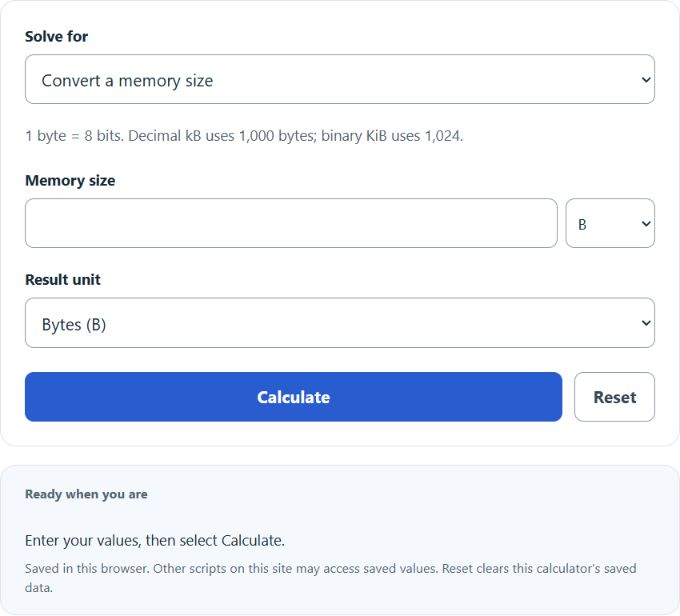
Convert memory sizes between bits, bytes, KB, MB, GB, and TB, or estimate storage from data rate, duration, overhead, and compression using decimal or binary units.
Memory Size Formula
The unit-count mode uses the formula below. The converter also supports decimal and binary units, plus storage estimation from data rate and duration.
Variables:
- MS is the memory size (bytes)
- N is the number of units
- B is the size of each unit in bytes
To calculate the memory size, multiply the number of units by the size of each unit in bytes. The result will be the total memory size in bytes.
What is a Memory Size?
Memory size refers to the amount of data that a computer or device can store and retrieve. It is typically measured in units like bytes, kilobytes, megabytes, gigabytes, and terabytes. The memory size determines how much information, such as files, documents, images, videos, and applications, can be stored on a device at any given time. Larger capacities can store more data; capacity alone does not determine performance.
How to Calculate Memory Size?
The following steps outline how to calculate the Memory Size using the formula MS = N * B.
- First, determine the number of units (N).
- Next, determine the size of each unit in bytes (B).
- Next, gather the formula from above: MS = N * B.
- Finally, calculate the Memory Size (MS).
- After inserting the variables and calculating the result, check your answer with the calculator above.
Example Problem:
Use the following variables as an example problem to test your knowledge.
Number of units (N) = 5
Size of each unit in bytes (B) = 1024. Select the unit-count mode: 5 × 1024 = 5120 bytes = 5 KiB. Decimal kB = 1000 bytes; binary KiB = 1024 bytes. For constant-rate storage, bytes = rate (bytes/s) × duration (s) × (1 + overhead/100) ÷ compression ratio. Blank optional overhead and compression mean 0% and 1:1.