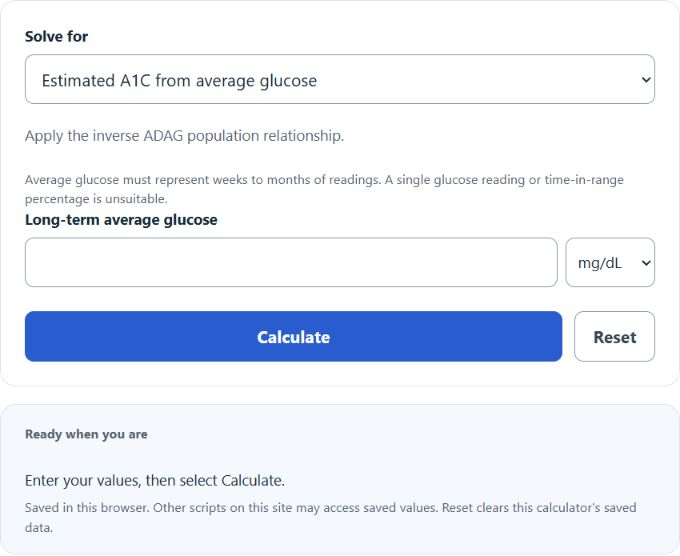
Convert average glucose in mg/dL or mmol/L to estimated A1C, or convert A1C back to eAG, with NGSP and IFCC units plus interpretation guidance.
Related Calculators
- All Unit Converters
- mmol/L to mg/dl Calculator
- nmol/L to mg/dL Calculator
- Glucose to A1C Calculator
- HbA1c to mg/dL Calculator
Formula
The calculator uses the ADAG population regression (Nathan et al., 2008). The glucose-to-A1C direction is its algebraic inverse, not a laboratory measurement or GMI. Reporting units follow the NGSP/IFCC master equation.
mg/dL → A1C: A1C = (eAG + 46.7) / 28.7
A1C → mg/dL: eAG = 28.7 × A1C − 46.7
where eAG = estimated average glucose (mg/dL), A1C in %.
Unit conversions used here: glucose mg/dL = mmol/L × 18.0182
NGSP A1C (%) = 0.09148 × IFCC (mmol/mol) + 2.152
IFCC (mmol/mol) = (NGSP A1C% − 2.152) / 0.09148. Values are rounded only for display.
Interpretation
Laboratory A1C reflects preceding months, weighted toward recent weeks. eAG is a population estimate of long-term mean glucose, not a single daily meter reading. The following are laboratory A1C references; a glucose-derived estimate cannot diagnose diabetes. Appropriate testing and clinical confirmation are needed.
- Below the prediabetes laboratory threshold: measured A1C below 5.7%.
- Prediabetes laboratory reference: measured A1C from 5.7% to below 6.5% (commonly reported as 5.7%–6.4% at one decimal place).
- Diabetes laboratory threshold: measured A1C of 6.5% or higher, with confirmation as clinically appropriate.
- Common treatment target for many nonpregnant adults with diabetes: A1C below 7.0%; individual targets are set with a clinician.
Individual A1C can differ from a population prediction. Red-cell turnover, anemia, kidney disease, pregnancy, transfusion, and hemoglobin variants can affect agreement. No fixed personal error interval follows from this equation. See NIDDK guidance on A1C testing and limitations.
Conversion Reference Table
| A1C (%) | eAG (mg/dL) | eAG (mmol/L) | IFCC (mmol/mol) |
|---|---|---|---|
| 5.0 | 97 | 5.4 | 31 |
| 5.7 | 117 | 6.5 | 39 |
| 6.0 | 126 | 7.0 | 42 |
| 6.5 | 140 | 7.8 | 48 |
| 7.0 | 154 | 8.6 | 53 |
| 7.5 | 169 | 9.4 | 58 |
| 8.0 | 183 | 10.2 | 64 |
| 9.0 | 212 | 11.7 | 75 |
| 10.0 | 240 | 13.3 | 86 |
| 12.0 | 298 | 16.5 | 108 |
FAQ
Should I enter a single fasting glucose or an average?
Use a representative mean glucose across times of day over the preceding weeks to months, rather than one fasting, random, or post-meal reading. CGM mean glucose is an average concentration; time-in-range is a percentage and is not an input for this formula. A brief or selectively sampled average may not represent the months reflected by laboratory A1C.
Why doesn't my estimated A1C match my lab A1C?
This is a population relationship, and individual results can differ. Iron deficiency can falsely raise A1C; shortened red-cell survival, such as hemolysis or recovery from blood loss, can falsely lower it. Transfusion, pregnancy, kidney disease, and hemoglobin variants have condition- or assay-dependent effects. No universal correction or fixed difference is assumed. See NGSP factors affecting A1C results.
What's the difference between A1C (%) and IFCC (mmol/mol)?
They measure the same thing on different scales. NGSP percent is standard in the US; IFCC mmol/mol is standard in most of Europe and Australia. The calculator shows both.
Can I use this if I'm not diabetic?
The ADAG study included people with and without diabetes. This tool does not diagnose either group. The NGSP example table spans 5%–12% A1C; that span is not proof of the original study's exact limits. Outside it, this tool labels the arithmetic without claiming individual validity. Software bounds of 2.152%–30% NGSP (about 15.0624–814.3 mg/dL) keep IFCC nonnegative and apply the same upper cap in both directions; they are not a clinically validated range.