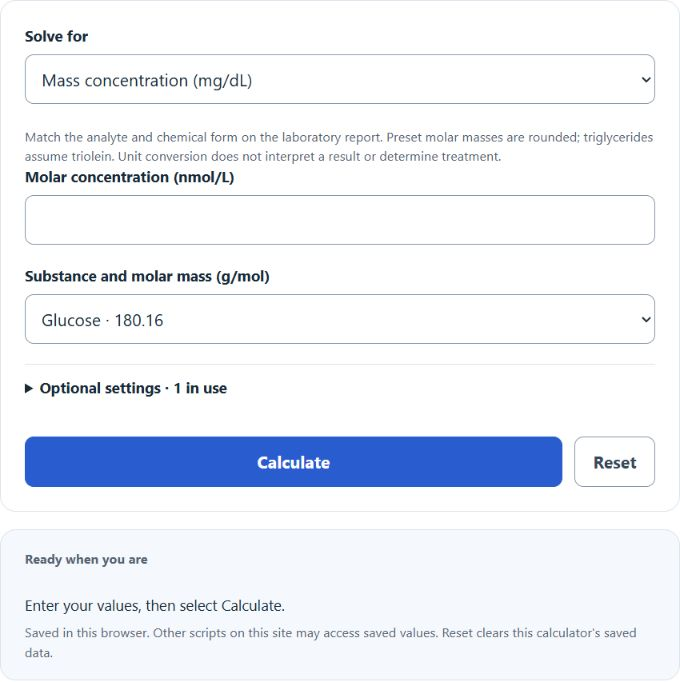
Enter a lab value in nmol/L (or mg/dL for the reverse direction) and choose the matching chemical form so the calculator can apply its molar mass and convert between molar and mass concentration units.
Related Calculators
- All Unit Converters
- mmol/L to mg/dl Calculator
- umol/l to mg/dl Calculator
- mg/dl to umol/l Calculator
Formula
mg/dL = (nmol/L × MW) ÷ 10,000,000
where MW is the molar mass in g/mol
nmol/L = (mg/dL × 10,000,000) ÷ MW
The factor follows from 1 nmol = 10−9 mol, 1 g = 1,000 mg and 1 L = 10 dL: 10−9 × 1,000 ÷ 10 = 10−7.
Interpretation
The output is the same concentration expressed in a different unit system. nmol/L expresses amount of substance per volume. mg/dL is a mass unit common in US clinical reports. Because the conversion depends on the molecular weight of the specific substance, the same nmol/L value produces very different mg/dL values for different analytes — a vitamin D reading and a cholesterol reading with identical nmol/L numbers will not have the same mg/dL result.
Unit-conversion examples only; these are not reference ranges or diagnostic thresholds. Values in mmol/L must be multiplied by 1,000,000 before entry in the nmol/L field:
- 25-hydroxyvitamin D₃: 75 nmol/L ≈ 30.05 ng/mL (0.003005 mg/dL), using 400.64 g/mol. This factor is specific to D₃, not D₂ or an unspecified total D₂+D₃ result.
- Cholesterol: 5.17 mmol/L = 5,170,000 nmol/L ≈ 199.90 mg/dL.
- Glucose: 5.55 mmol/L = 5,550,000 nmol/L ≈ 99.99 mg/dL.
- Testosterone: 10–35 nmol/L ≈ 288.42–1,009.47 ng/dL; this is a conversion illustration, not a clinical interval.
Common Molar Masses
| Substance | MW (g/mol) | Example conversion |
|---|---|---|
| 25-hydroxyvitamin D₃ | 400.64 | 75 nmol/L = 30.05 ng/mL |
| Cholesterol | 386.65 | 5.17 mmol/L ≈ 199.90 mg/dL |
| Glucose | 180.16 | 5.55 mmol/L ≈ 99.99 mg/dL |
| Testosterone | 288.42 | 20 nmol/L = 576.8 ng/dL |
| Cortisol | 362.46 | 500 nmol/L = 18.1 µg/dL |
| Estradiol | 272.38 | 100 pmol/L = 27.2 pg/mL |
| Uric acid | 168.11 | 360 µmol/L = 6.05 mg/dL |
| Creatinine | 113.12 | 88.4 µmol/L = 1.0 mg/dL |
FAQ
Why does the answer change when I pick a different substance?
Molar units (nmol/L) and mass units (mg/dL) are linked by molecular weight. A heavier molecule weighs more per mole, so the same nmol/L produces a larger mg/dL value. You must match the substance to the analyte your lab reported.
My vitamin D result is reported in ng/mL, not mg/dL. How do I convert?
1 ng/mL equals 0.0001 mg/dL, or equivalently, 100 ng/mL = 0.01 mg/dL. For 25-hydroxyvitamin D₃, nmol/L × 0.40064 ≈ ng/mL. D₂ has a different molar mass; use the laboratory convention for combined results. Most US vitamin D reports use ng/mL rather than mg/dL.
What if I don’t know the molecular weight?
Select the substance from the dropdown — the calculator uses the displayed rounded molar mass. Triglycerides assume triolein (885.4 g/mol), not a universal mixture composition. The vitamin D preset is 25-hydroxyvitamin D₃ (400.64 g/mol); calcium is elemental calcium and urea is not BUN. Use a custom molar mass for another specified chemical form, including salts or hydrates, and follow the laboratory conversion convention for mixtures.
Can I use this for mmol/L or µmol/L instead of nmol/L?
Not directly in this field, but the result panel shows µmol/L and mmol/L equivalents after calculation. To go the other way, multiply mmol/L by 1,000,000 or µmol/L by 1,000 to get nmol/L before entering.