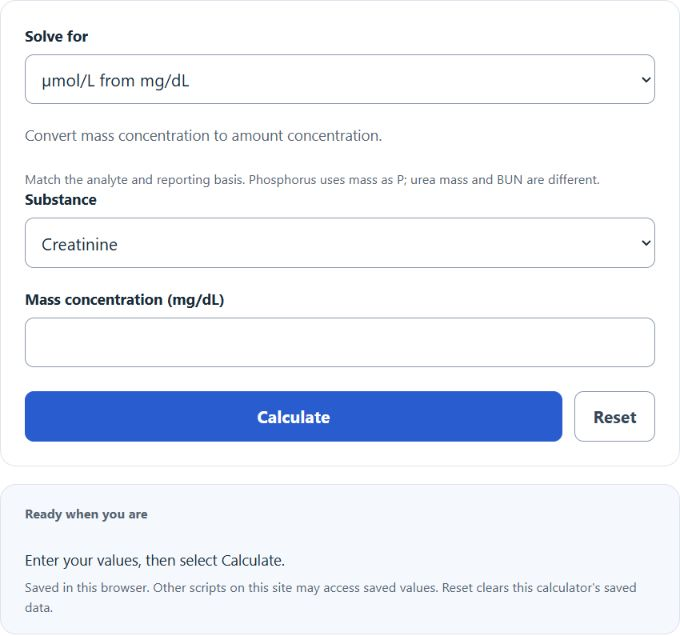
Select the analyte, enter a concentration in mg/dL (or µmol/L for the reverse), and the calculator returns the SI-unit equivalent using the substance’s molecular weight.
Related Calculators
- All Unit Converters
- mmol/L to mg/dl Calculator
- µmol/L to mg/dL Calculator
- nmol/L to mg/dL Calculator
Formula
µmol/L = mg/dL × 10,000 ÷ MW
where MW = molecular weight of the substance in g/mol.
Reverse: mg/dL = µmol/L × MW ÷ 10,000
The dimensional chain is 1 mg/dL = 10 mg/L = 0.01 g/L. Divide mass concentration in g/L by molar mass in g/mol to obtain mol/L, then multiply by 1,000,000 µmol/mol. Thus the combined factor from mg/dL is 0.01 × 1,000,000 = 10,000.
Common Conversion Factors
Multiply mg/dL by the rounded factor below to get µmol/L. Divide µmol/L by that factor for the reverse. The calculator uses 10,000 divided by the listed molar mass without rounding the factor internally. These are conversion conventions, not laboratory reference intervals. See NIST molar-mass guidance.
| Analyte | MW (g/mol) | mg/dL → µmol/L factor | Reporting basis |
|---|---|---|---|
| Creatinine | 113.12 | 88.4 | Creatinine; µmol/L |
| Bilirubin (total) | 584.66 | 17.1 | Total bilirubin equivalents; µmol/L |
| Uric acid | 168.11 | 59.5 | Uric acid; µmol/L |
| Urea | 60.06 | 166.5 (as µmol/L) | Urea mass, not BUN; µmol/L ÷ 1,000 gives mmol/L |
| Glucose | 180.16 | 55.5 (use mmol/L) | Glucose; µmol/L ÷ 1,000 gives mmol/L |
| Cholesterol | 386.65 | 25.9 (use mmol/L) | Cholesterol equivalents; µmol/L ÷ 1,000 gives mmol/L |
| Calcium | 40.08 | 249.5 (use mmol/L) | Elemental calcium; µmol/L ÷ 1,000 gives mmol/L |
Interpretation
The µmol/L value is amount concentration: micromoles of the specified analyte per liter. At the same mass concentration, a larger molar mass gives a smaller amount concentration. This calculator converts units and does not flag results as below, within, or above a clinical range. Compare matching analytes and units using the reference interval on your own laboratory report.
- Match the analyte: use the same substance and reporting basis as the laboratory result.
- Match the units: mg/dL, µmol/L, and mmol/L have different numeric scales.
- Use laboratory context: the unit conversion alone does not determine clinical significance.
Reference intervals vary by lab, age, sex, and method. Use the posted range from your own lab report for clinical decisions.
FAQ
Why does each analyte need a different conversion factor?
Because mg measures mass and µmol measures moles. Converting between them requires dividing by molecular weight, which is unique to each compound.
When should I use mmol/L instead of µmol/L?
For glucose, cholesterol, urea, and calcium, SI results are conventionally reported in mmol/L (µmol/L ÷ 1000). The calculator shows the mmol/L equivalent below the main result.
What if my lab reports a value I don’t see listed?
Choose “Custom molar mass” and enter g/mol for the same chemical entity and reporting basis as the mass result. An unspecified mixture or a mass reported as a different moiety cannot use an unrelated molar mass. Phosphorus uses mass as P; calcium and magnesium use elemental mass. The urea preset is whole urea, not blood urea nitrogen (BUN).
Is mg/dL the same as mg%?
Yes. “mg%” is an older notation for milligrams per 100 mL, which equals mg/dL. Use the value directly without additional conversion.