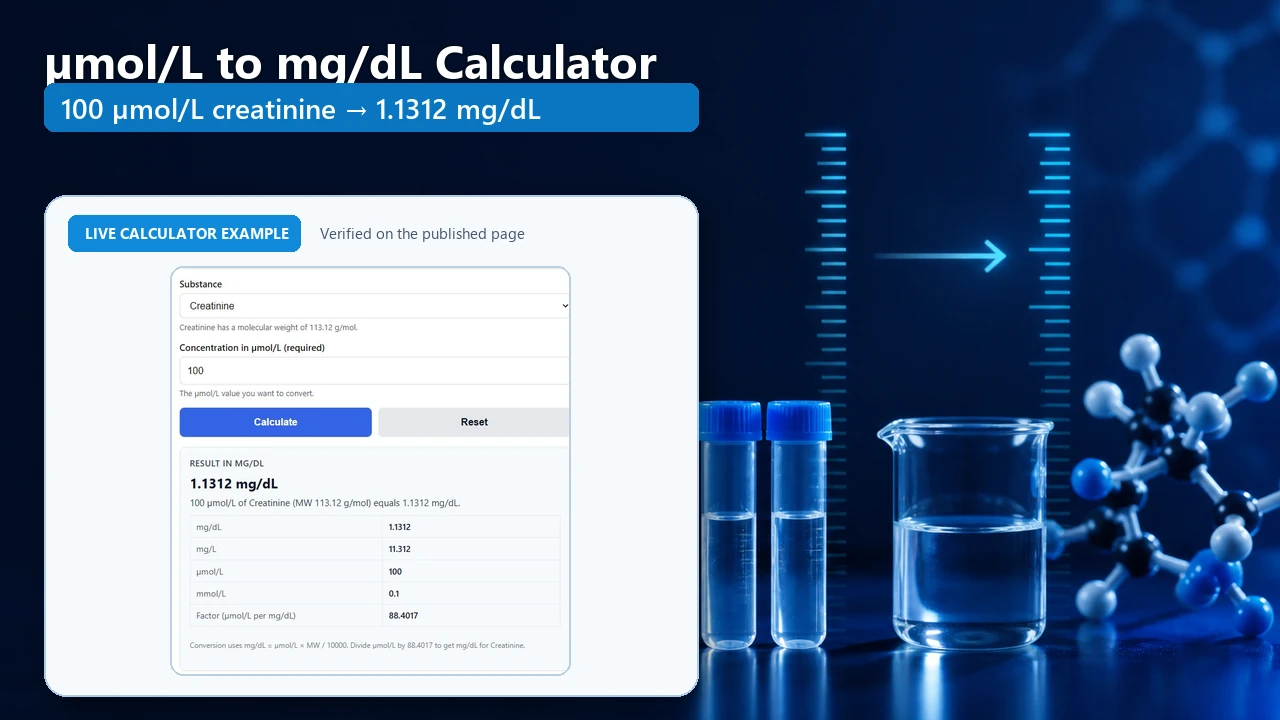
Pick the substance (or enter a custom molecular weight), type the value in µmol/L, and the calculator returns the equivalent in mg/dL using that substance’s molar mass.
Related Calculators
- All Unit Converters
- mmol/L to mg/dl Calculator
- mg/dl to umol/l Calculator
- nmol/l to mg/dl Calculator
- HbA1c to mg/dl Calculator
Formula
mg/dL = (µmol/L × MW) / 10,000
where MW = molecular weight of the substance in g/mol. The factor 10,000 converts µmol/L (per liter, micromoles) to mg/dL (per deciliter, milligrams).
Reverse form: µmol/L = (mg/dL × 10,000) / MW
Common Molecular Weights
| Substance | MW (g/mol) | 1 µmol/L = |
|---|---|---|
| Creatinine | 113.12 | 0.01131 mg/dL |
| Bilirubin | 584.67 | 0.05847 mg/dL |
| Glucose | 180.16 | 0.01802 mg/dL |
| Cholesterol | 386.65 | 0.03867 mg/dL |
| Urea | 60.06 | 0.00601 mg/dL |
| Uric acid | 168.11 | 0.01681 mg/dL |
| Lactate | 88.54 | 0.00885 mg/dL |
| Calcium | 40.08 | 0.00401 mg/dL |
Interpretation
The result tells you the mass concentration (mg per 100 mL) that matches the molar concentration you entered. Whether that number is normal, high, or low depends entirely on the substance. A few common reference ranges in mg/dL:
- Creatinine: 0.6–1.3 mg/dL (adult)
- Total bilirubin: 0.1–1.2 mg/dL
- Fasting glucose: 70–99 mg/dL
- Uric acid: 3.5–7.2 mg/dL
- Total calcium: 8.5–10.5 mg/dL
Lab reference intervals vary by assay, age, and sex — always compare against the range printed on your specific lab report rather than a generic value.
FAQ
Why divide by 10,000 instead of 1,000?
Two conversions stack: µmol to mmol (÷1,000) and per-liter to per-deciliter (÷10). 1,000 × 10 = 10,000.
Does this work for mmol/L too?
Not directly. If your value is in mmol/L, multiply by 1,000 first to convert to µmol/L, or use a mmol/L → mg/dL converter. Glucose and cholesterol labs usually report mmol/L, not µmol/L.
What if I don’t know the molecular weight?
Use the dropdown presets for common analytes. For anything else, look up the MW in g/mol (same as Da) on the substance’s spec sheet or a chemistry reference, then use the Custom MW tab.
Can I use this for creatinine converting between µmol/L and mg/dL?
Yes — creatinine is the most common use case. With MW 113.12, 88 µmol/L ≈ 1.0 mg/dL, which is why labs in SI units commonly report creatinine around 60–115 µmol/L for adults.