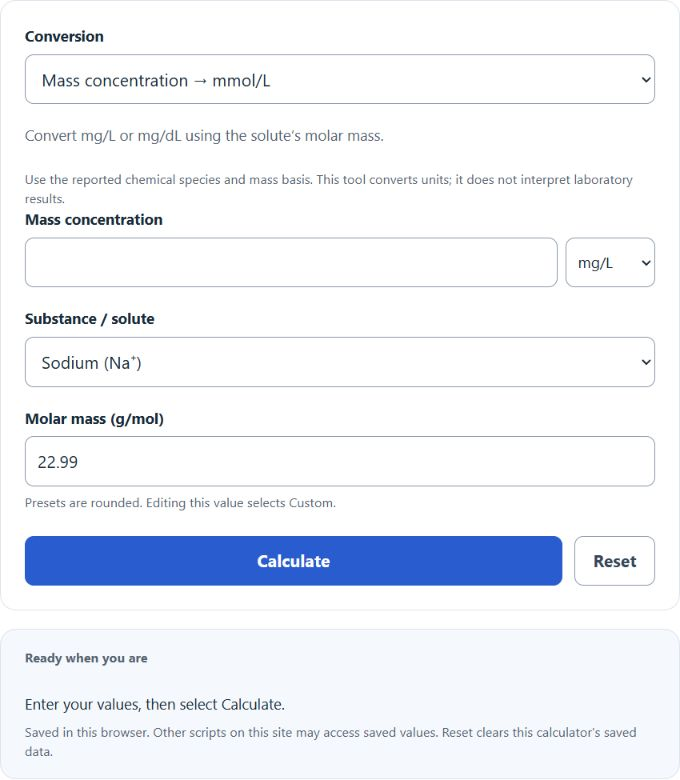
This page shows how to turn a concentration reported in milligrams per liter (mg/L) into millimoles per liter (mmol/L). mg/L is a mass-based unit, whereas mmol/L measures the amount of the specified chemical entity per liter. To move between them you need the substance’s molar mass in g/mol.
Unit definitions and chemical basis: IUPAC amount concentration, CIAAW atomic weights, and PubChem entries for lactate and lactic acid.
mg/L to mmol/L Formula
For a given substance with molar mass M in g/mol, the connection between mg/L and mmol/L is:
- mg/L = mmol/L × M
- mmol/L = mg/L ÷ M
Here, M is the molar mass of the specified chemical entity in grams per mole. These are rounded conventional values, not exact constants:
- Sodium (Na⁺): M ≈ 22.99 g/mol
- Potassium (K⁺): M ≈ 39.10 g/mol
- Calcium (Ca²⁺): M ≈ 40.08 g/mol
- Magnesium (Mg²⁺): M ≈ 24.31 g/mol
- Chloride (Cl⁻): M ≈ 35.45 g/mol
- Glucose: M ≈ 180.16 g/mol
- Urea: M ≈ 60.06 g/mol
Once the molar mass is known, the arithmetic is simple. For example, 90 mg/L of sodium corresponds to 90 ÷ 22.99 ≈ 3.91 mmol/L. Likewise, 40 mg/L of calcium is roughly 40 ÷ 40.08 ≈ 1.00 mmol/L, and 540 mg/L of glucose is about 540 ÷ 180.16 ≈ 3.00 mmol/L.
mg/L to mmol/L conversion table
The table below lists example conversions for a 100 mg/L concentration using mmol/L = mg/L ÷ M.
| Substance | Molar mass (g/mol) | 100 mg/L in mmol/L |
|---|---|---|
| Sodium (Na⁺) | 22.99 | 4.35 mmol/L |
| Potassium (K⁺) | 39.10 | 2.56 mmol/L |
| Chloride (Cl⁻) | 35.45 | 2.82 mmol/L |
| Calcium (Ca²⁺) | 40.08 | 2.50 mmol/L |
| Magnesium (Mg²⁺) | 24.31 | 4.11 mmol/L |
| Glucose | 180.16 | 0.56 mmol/L |
| Urea | 60.06 | 1.67 mmol/L |
In practice, some laboratories report results in mg/L while others use mmol/L. Convert only when the same analyte and reporting basis are used: phosphate as PO₄ differs from phosphorus, urea differs from urea nitrogen, and lactate ion differs from lactic-acid equivalent. Preset masses are rounded, and triglyceride mixtures have no single molar mass; the calculator’s875 g/mol row is an explicitly assumed mean, not a universal clinical factor. Unit conversion does not interpret a result or replace the laboratory’s own reference interval.
Related conversions:
Related Calculators
- weight to molarity Converter
- ng/dL To nmol/L Calculator
- ug/kg to ppm Converter
- Specific Volume to Density Calculator
- All Unit Converters