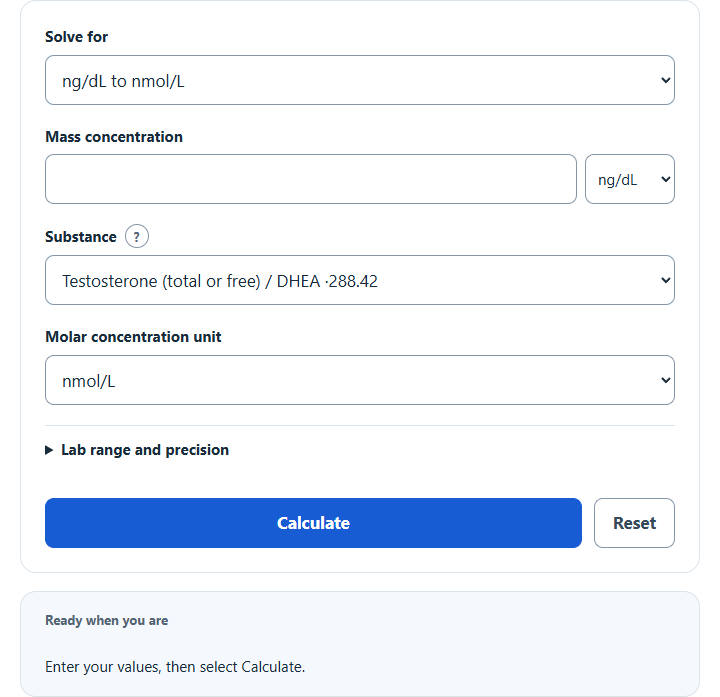
Convert ng/dL to nmol/L for testosterone and other hormones by picking the substance, or convert nmol/L back to ng/dL and see the value in ng/mL.
ng/dL to nmol/L Conversion Formula
The following formula is used to convert ng/dl to nmol/L.
Variables:
- C (nmol/L) is the concentration in nanomoles per liter
- C (ng/dl) is the concentration in nanograms per deciliter
- MW (g/mol) is the molecular weight of the substance in grams per mole
To convert ng/dl to nmol/L, divide the concentration in ng/dl by the molecular weight and then multiply by 10.
| ng/dL | nmol/L (Glucose, 180.16 g/mol) | nmol/L (Cholesterol, 386.65 g/mol) | nmol/L (Hypothetical molecule, assumed 800 g/mol) | nmol/L (Insulin, 5808 g/mol) | nmol/L (Hemoglobin tetramer, approximate 64500 g/mol) |
|---|---|---|---|---|---|
| 1 | 0.05551 | 0.02586 | 0.0125 | 0.001722 | 0.000155 |
| 5 | 0.2775 | 0.1293 | 0.0625 | 0.008609 | 0.0007752 |
| 10 | 0.5551 | 0.2586 | 0.125 | 0.01722 | 0.00155 |
| 20 | 1.11 | 0.5173 | 0.25 | 0.03444 | 0.003101 |
| 25 | 1.388 | 0.6466 | 0.3125 | 0.04304 | 0.003876 |
| 30 | 1.665 | 0.7759 | 0.375 | 0.05165 | 0.004651 |
| 40 | 2.22 | 1.035 | 0.5 | 0.06887 | 0.006202 |
| 50 | 2.775 | 1.293 | 0.625 | 0.08609 | 0.007752 |
| 60 | 3.33 | 1.552 | 0.75 | 0.1033 | 0.009302 |
| 75 | 4.163 | 1.94 | 0.9375 | 0.1291 | 0.01163 |
| 80 | 4.44 | 2.069 | 1 | 0.1377 | 0.0124 |
| 90 | 4.996 | 2.328 | 1.125 | 0.155 | 0.01395 |
| 100 | 5.551 | 2.586 | 1.25 | 0.1722 | 0.0155 |
| 150 | 8.326 | 3.879 | 1.875 | 0.2583 | 0.02326 |
| 200 | 11.1 | 5.173 | 2.5 | 0.3444 | 0.03101 |
| 250 | 13.88 | 6.466 | 3.125 | 0.4304 | 0.03876 |
| 300 | 16.65 | 7.759 | 3.75 | 0.5165 | 0.04651 |
| 400 | 22.2 | 10.35 | 5 | 0.6887 | 0.06202 |
| 500 | 27.75 | 12.93 | 6.25 | 0.8609 | 0.07752 |
| 1000 | 55.51 | 25.86 | 12.5 | 1.722 | 0.155 |
| * Illustrative values rounded to four significant digits; small nonzero values remain visible. nmol/L =10 × ng/dL ÷ molar mass(g/mol). Assumed masses: glucose180.16; cholesterol386.65; hypothetical molecule800; human insulin≈5808; hemoglobin tetramer≈64500g/mol. The hypothetical mass is not a universal triglyceride conversion; hemoglobin reporting may use a different entity basis. | |||||
What is the significance of converting ng/dL to nmol/L?
Conversion relates mass concentration and amount concentration for the same measured substance, using its molar mass and chemical form. It does not make different substances clinically interchangeable or identify a substance from molar mass. For lab results, use the interval on the matching laboratory report; this calculator supplies no universal clinical range.
How to Use the ng/dL to nmol/L Calculator?
The following steps outline how to use the calculator to convert ng/dl to nmol/L.
- Enter the concentration in ng/dl.
- Choose the substance (testosterone is preselected), or pick Custom molar mass and enter it in g/mol. Use the unit selectors for other units. Optional reference limits must come from your own matching lab report, in nmol/L. Batch mode accepts up to40 values separated by commas, spaces or new lines; omit thousands separators.
- Click the “Calculate” button to get the result in nmol/L.
- Use Reset to clear fields, results and this calculator’s saved data. Conversion, inverse-molar-mass and both batch directions are selected explicitly; conversion alone is not clinical interpretation.
Example Problem:
Convert a concentration of 200 ng/dl to nmol/L for a substance with a molecular weight of 300 g/mol.
Using the formula: C (nmol/L) = (C (ng/dl) / MW (g/mol)) * 10
Concentration in nmol/L = (200 / 300) * 10 = 6.67 nmol/L