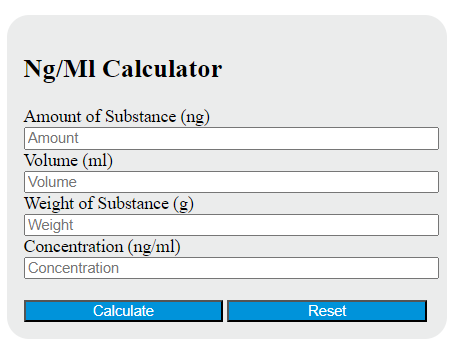
Calculate nanomolar concentration from ng/mL and molecular weight, reverse nM to ng/mL, or solve for molecular weight with common lab units.
Disclaimer: This calculator is for educational unit conversion/math only and is not medical advice. Do not use it to diagnose conditions, interpret lab results, or determine medication dosing—verify units and consult a qualified clinician, pharmacist, or laboratory professional.
- All Unit Converters
- ng/mL To Molarity Calculator
- ng/mL To nmol/L Calculator
- uM To ug/mL Calculator
- mL to mg
ng/mL Formula
ng/mL expresses concentration as nanograms of substance per milliliter of solution. It is commonly used for trace-level measurements where the amount of material is very small relative to the liquid volume.
For this calculator:
- C = concentration
- A = amount of substance
- V = volume
If you need to solve for a different variable, use the rearranged forms below.
When A is entered in nanograms and V is entered in milliliters, the result is returned in ng/mL. If you choose other supported units, the calculator converts them first and then performs the same concentration calculation.
How to Calculate ng/mL
- Enter the amount of substance.
- Select the mass unit that matches your value.
- Enter the solution volume.
- Select the volume unit that matches your value.
- Calculate the result to obtain the concentration in ng/mL or an equivalent selected output unit.
This is especially useful in laboratory prep, assay interpretation, environmental testing, and any workflow where concentrations are reported at very small scales.
Example 1
A sample contains 50 ng of material in 10 mL of solution.
Example 2
A solution contains 0.25 µg in 2 mL. Convert the mass first, then calculate the concentration.
Example 3
If a target concentration is known, you can solve for the required amount of substance.
Common Unit Conversions
The calculator supports multiple mass and volume units. These reference conversions explain how the result is standardized.
| Mass Conversion | Equivalent |
|---|---|
| Nanograms and micrograms | 1 μg = 1000 ng |
| Nanograms and milligrams | 1 mg = 1,000,000 ng |
| Nanograms and grams | 1 g = 1,000,000,000 ng |
| Volume Conversion | Equivalent |
|---|---|
| Microliters and milliliters | 1 mL = 1000 μL |
| Liters and milliliters | 1 L = 1000 mL |
Equivalent Concentration Units
ng/mL is often converted to other concentration units for reporting or comparison.
| Relationship | Equivalent Expression |
|---|---|
| ng/mL to µg/L | 1 ng / mL = 1 μg / L |
| µg/mL to ng/mL | 1 μg / mL = 1000 ng / mL |
| mg/L to ng/mL | 1 mg / L = 1000 ng / mL |
| g/L to ng/mL | 1 g / L = 1,000,000 ng / mL |
Tips for Accurate Results
- Match the units to the value entered. A wrong unit selection can shift the result by factors of 1,000 or more.
- Convert tiny volumes carefully. Confusing µL and mL is one of the most common concentration errors.
- Use the total amount in the sample. The calculator needs substance amount and total volume, not another concentration value.
- Round at the end. Keeping extra decimal places during conversion reduces avoidable rounding error.
- Check whether you need concentration, amount, or volume. The same relationship can solve for any one missing variable.
What ng/mL Means in Practice
A result in ng/mL tells you how much material is present in each milliliter of liquid. Larger ng/mL values indicate a more concentrated sample, while smaller values indicate a more dilute sample. Because the unit is very small, it is useful whenever trace quantities matter and the difference between samples may be only a few nanograms per milliliter.
Frequently Asked Questions
Is ng/mL the same as ppb?
They are sometimes numerically similar in dilute water-based systems, but they are not universally interchangeable because concentration by mass per volume and parts-per notation depend on the sample medium and assumptions about density.
Can this formula be used to solve for volume?
Yes. If you know the concentration and the total amount of substance, solve for volume using the rearranged volume equation shown above.
Why did my result change so much after switching units?
Small units scale quickly. Moving between ng, µg, mg, µL, mL, and L changes the magnitude by powers of 10, so the selected unit has a major effect on the displayed number even when the underlying concentration is the same.