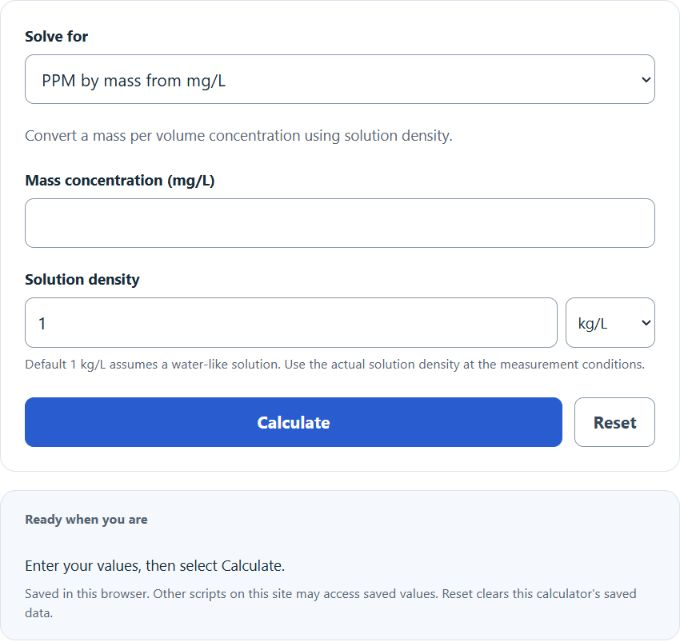
Convert between milligrams per litre and parts per million by mass using the solution density. For dilute water solutions near 1 kg/L, mg/L and ppm are approximately equal.
Milligrams per litre is a mass-per-volume concentration. Parts per million by mass is a mass fraction, so solution density is required to convert precisely between the two bases.
How to Use This Calculator
- Choose whether to convert mg/L to ppm or ppm to mg/L.
- Enter the concentration on the selected basis.
- Enter solution density in kg/L.
- Calculate and state the mass basis when reporting the result.
After a successful calculation, its input snapshot is saved in this browser. Returning to the page recomputes and labels that last successful result; unsaved edits do not replace it. Select Reset to clear this calculator’s saved values. The density default of 1 kg/L is an assumption, not a measured property.
How the mg/L to PPM Calculator Works
For a dilute water solution with density close to 1 kg/L, the numeric values are approximately equal. That shortcut is not universal for concentrated, saline, or non-water solutions.
The primary relationship is ppm by mass = mg/L ÷ density (kg/L); mg/L = ppm × density. Calculations retain full available precision internally; displayed values are rounded for readability.
Formula Variables and Input Guide
Enter the measured concentration and the solution density. Use 1 kg/L only when that approximation is appropriate.
| Variable or term | Meaning | Unit or note |
|---|---|---|
| C | Concentration | mg/L |
| ρ | Solution density | kg/L |
| ppm | Mass fraction | mg/kg |
| 1 ppm | One part per million | matching mass basis |
Choosing the Right Inputs
Choose whether the known measurement is milligrams per litre or ppm by mass. The two forms use different bases: mg/L relates solute mass to solution volume, while ppm by mass is numerically equivalent to milligrams per kilogram. The density input connects those bases and must describe the whole solution rather than the isolated solute.
Use density in kilograms per litre at conditions reasonably close to the concentration measurement. Entering 1 kg/L is appropriate only when the dilute-water approximation is justified. Saline water, concentrated solutions, solvents, and temperature-sensitive mixtures can differ enough that the density correction matters, especially in regulatory or laboratory reporting.
Practical Uses
- Reporting water-quality or laboratory concentrations.
- Adjusting the common water approximation for actual density.
- Converting formulation data onto a mass-fraction basis.
- Checking whether a ppm result uses the correct basis.
Ten mg/L at different densities
| Density | PPM by mass |
|---|---|
| 0.8 kg/L | 12.5 ppm |
| 1.0 kg/L | 10 ppm |
| 1.2 kg/L | 8.333 ppm |
Understanding Your Results
The selected mode returns ppm by mass or mg/L, with the density adjustment and original concentration shown for context.
If density is close to 1 kg/L, the adjustment is small. Record the density and basis whenever accuracy or regulatory reporting matters.
Worked Example
10 mg/L in a solution with density 1 kg/L is 10 ppm by mass.
A 25 mg/L concentration in a solution with density 1.25 kg/L equals 25 ÷ 1.25 = 20 ppm by mass.
Checking the Result by Hand
Divide mg/L by solution density in kg/L to obtain mg/kg, which is numerically ppm by mass. For the reverse direction, multiply ppm by density to recover mg/L. A 25 mg/L solution at 1.25 kg/L should therefore give 20 ppm, and 20 × 1.25 returns 25 mg/L.
At exactly 1 kg/L, the mg/L and ppm numbers should match. Increasing density while holding mg/L fixed must reduce ppm by mass because the same litre contains more total solution mass.
Common Mistakes to Avoid
- Assuming 1 mg/L always equals 1 ppm.
- Mixing ppm by mass with ppm by volume.
- Using pure-water density for a concentrated solution.
- Ignoring temperature or salinity effects on density.
Assumptions and Limitations
The common 1 mg/L ≈ 1 ppm shortcut is density-dependent. Specify whether ppm is by mass, volume, or another basis in technical work. This calculator uses mass fraction only: 1 ppm by mass = 1 mg/kg. A physical mass fraction cannot exceed 1,000,000 ppm (100%); solution density must be positive.
Frequently Asked Questions
Is 1 mg/L equal to 1 ppm?
Approximately for dilute water near 1 kg/L; otherwise divide by density.
Is this ppmv?
No. The calculator returns ppm by mass.
How do I convert ppm back to mg/L?
Multiply ppm by the solution density in kg/L.
How does ppb relate?
One ppm equals 1,000 ppb on the same basis.
Sources