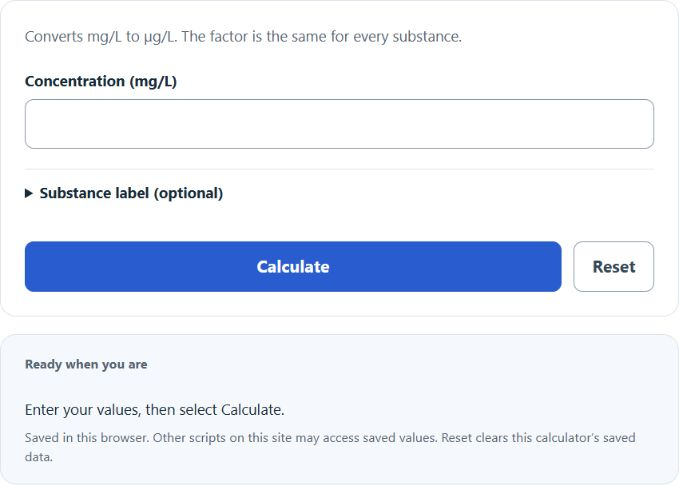
Convert mg/L to µg/L and get the equivalent concentration for selected substances such as lead, nitrate, phosphate, chloride, fluoride, or iron.
Quick Overview: mg/L to µg/L
Milligrams per liter (mg/L) and micrograms per liter (µg/L) measure the same type of concentration, but on different scales. Since 1 milligram = 1000 micrograms, the conversion is always:
µg/L = mg/L × 1000
- 1 mg/L = 1000 µg/L
- 0.1 mg/L = 100 µg/L
- 0.005 mg/L = 5 µg/L
- 2.5 mg/L = 2500 µg/L
This is especially useful when comparing laboratory results with regulatory standards, since some references report concentrations in mg/L while others use µg/L.
- All Unit Converters
- mEq/L To mg/L Calculator
- ppb to ug/m3 Converter
- mg/g to g/kg Converter
- ppb (Parts Per Billion) Calculator
mg/L to µg/L Formula
The following formula is used to convert milligrams per liter to micrograms per liter.
The reverse formula is:
Variables:
- µg/L is the concentration in micrograms per liter
- mg/L is the concentration in milligrams per liter
To convert mg/L to µg/L, multiply the concentration by 1000. To convert µg/L back to mg/L, divide by 1000.
What is mg/L to µg/L Conversion?
The mg/L to µg/L conversion changes a concentration from milligrams per liter to micrograms per liter. Both units describe the mass of a substance dissolved in one liter of liquid, but a microgram is much smaller than a milligram. Because 1 milligram equals 1000 micrograms, every value in mg/L can be converted to µg/L by multiplying by 1000.
This conversion is widely used in environmental science, drinking water analysis, wastewater treatment, toxicology, chemistry, and laboratory reporting. Trace contaminants are often listed in µg/L because the values are easier to read and compare at very low concentrations.
How to Calculate mg/L to µg/L?
The following steps outline how to convert milligrams per liter to micrograms per liter.
- First, determine the concentration in milligrams per liter (mg/L).
- Next, multiply that value by 1000.
- The result is the equivalent concentration in micrograms per liter (µg/L).
- After calculating the result, verify your answer with the converter above.
Example Problem:
Use the following variables as an example problem to test your knowledge.
Concentration in mg/L = 2.5
Equivalent concentration in µg/L = 2.5 × 1000 = 2500
mg/L to µg/L Conversion Table
The table below shows example conversions using the formula µg/L = mg/L × 1000.
| Example Value | mg/L | Equivalent in µg/L |
|---|---|---|
| Very low trace level | 0.001 | 1 µg/L |
| Low concentration | 0.01 | 10 µg/L |
| Moderate level | 0.1 | 100 µg/L |
| Reference value | 1 | 1000 µg/L |
| Higher concentration | 2.5 | 2500 µg/L |
| Elevated level | 5 | 5000 µg/L |
| Very high concentration | 10 | 10000 µg/L |
Understanding this conversion makes it easier to compare lab reports, regulatory thresholds, and reference values that may use different units for the same dissolved substance concentration.