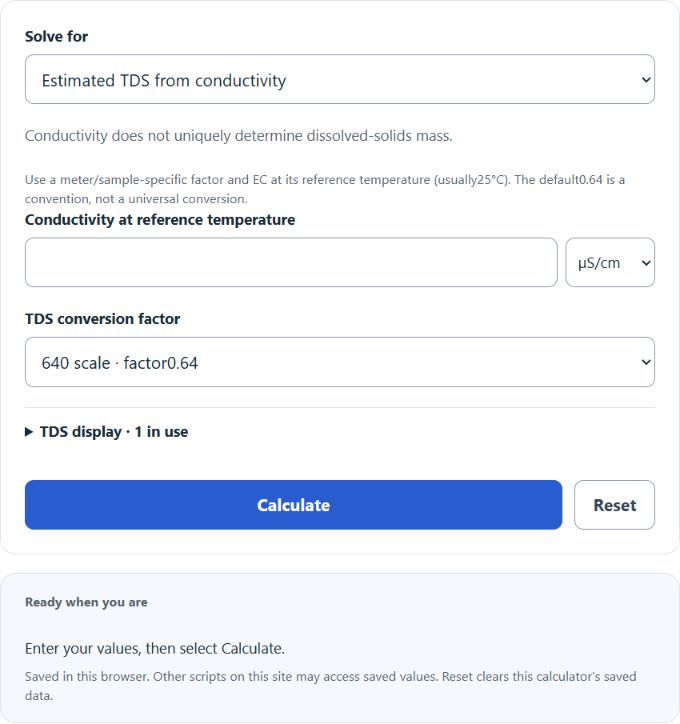
Convert microsiemens per centimeter to estimated ppm TDS—or reverse the calculation—with 500, 640, 700, and custom meter factors plus a scale comparison.
Quick overview: microsiemens (µS/cm) to ppm
Conductivity in µS/cm measures how well water conducts electricity, while ppm is an estimated total dissolved solids value. The usual relationship is ppm ≈ µS/cm × factor, where the factor is often between 0.50 and 0.70.
- At factor 0.50: 500 µS/cm ≈ 250 ppm
- At factor 0.55: 500 µS/cm ≈ 275 ppm
- At factor 0.64: 500 µS/cm ≈ 320 ppm
- At factor 0.70: 500 µS/cm ≈ 350 ppm
The converter multiplies your conductivity reading by the selected factor, which is how many handheld TDS meters estimate ppm from electrical conductivity.
- All Unit Converters
- mg/L To ppb Calculator
- Ratio To Volume Calculator
- m3/h to lpm Converter
- CFS to GPM Calculator
Microsiemens to PPM Formula
The following formula is used to convert conductivity in microsiemens per centimeter into an estimated total dissolved solids value in parts per million.
Variables:
- PPM is the estimated total dissolved solids in parts per million
- EC is the electrical conductivity in µS/cm
- F is the selected TDS conversion factor
To calculate ppm, multiply the conductivity reading in µS/cm by the conversion factor used for the water type or meter setting.
What is Microsiemens to PPM Conversion?
Microsiemens per centimeter (µS/cm) is a direct measurement of water conductivity, while ppm is an estimated measure of dissolved solids. Because different dissolved minerals conduct electricity differently, ppm is not measured directly from conductivity alone. Instead, a conversion factor is applied to estimate TDS from the conductivity reading.
This is why different TDS meters can display slightly different ppm values for the same water sample. One meter may use a factor of 0.50, while another may use 0.64 or 0.70. Higher factors generally produce higher ppm estimates for the same conductivity reading.
The values 0.50, 0.64 and 0.70 are meter-scale conventions; 0.55 is another example factor. Choose the documented meter setting or a sample-specific calibrated relation rather than inferring a factor from a general water label. Match the reference temperature, commonly25°C.
How to Convert Microsiemens to PPM?
The following steps outline how to convert microsiemens to ppm.
- First, determine the electrical conductivity of the water in µS/cm.
- Next, choose the appropriate TDS conversion factor from the meter documentation or a validated relation for the sample, at the matching reference temperature.
- Multiply the conductivity value by the factor using the formula PPM = EC × F.
- After calculating the result, compare your answer with the converter above.
Microsiemens to PPM Conversion Table
The table below shows how 100 µS/cm converts to ppm using several common TDS factors.
| TDS Factor | Factor basis | 100 µS/cm in PPM |
|---|---|---|
| 0.50 | 500-scale convention where specified by the meter | 50 ppm |
| 0.55 | Example custom factor; requires an appropriate basis | 55 ppm |
| 0.64 | 640-scale convention where specified by the meter | 64 ppm |
| 0.70 | 700-scale convention where specified by the meter | 70 ppm |
In practice, some instruments display only conductivity, while others show ppm using a fixed conversion factor. Understanding the formula makes it easier to compare results from different meters and reference sources.
Example Problem:
Use the following values as an example problem to test your understanding.
Electrical Conductivity (EC) = 500 µS/cm
Conversion Factor (F) = 0.64
Estimated TDS (PPM) = 500 × 0.64 = 320 ppm