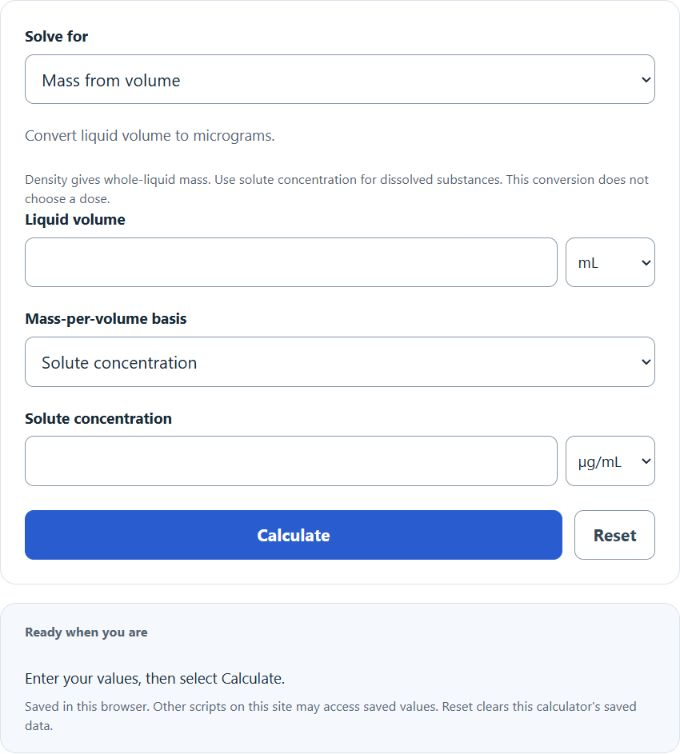
Convert milliliters to micrograms or reverse the calculation using solution concentration or whole-liquid density, with mass equivalents and transparent steps.
Quick overview: mL to µg
For whole-liquid mass from milliliters (mL) to micrograms (µg), multiply volume by density in g/mL, then convert grams to micrograms: µg = mL × density × 1,000,000.
- Water (1.000 g/mL): 1 mL ≈ 1,000,000 µg
- Ethanol (0.789 g/mL): 1 mL ≈ 789,000 µg
- Olive oil (0.915 g/mL): 1 mL ≈ 915,000 µg
- Blood plasma (1.025 g/mL): 1 mL ≈ 1,025,000 µg
- Seawater (1.028 g/mL): 1 mL ≈ 1,028,000 µg
These densities are illustrative assumptions, not fixed constants. Enter the density for your sample. For solute mass in a solution, use its solute concentration instead.
- Percentage To mL Calculator
- mg/ml to ug/ml Converter
- ug/ml to ng/ml Converter
- mcg to units Converter
- All Unit Converters
mL to µg Formula
The following density formula gives whole-liquid mass in micrograms. For a dissolved solute, use mass (µg) = solution volume (mL) × solute concentration (µg/mL) instead.
Variables:
- µg is the mass in micrograms
- mL is the volume in milliliters
- ρ is the density in grams per milliliter (g/mL)
To calculate micrograms from milliliters, multiply the volume by the density of the liquid in g/mL, then multiply by 1,000,000 to convert grams to micrograms.
What is mL to µg Conversion?
Converting milliliters (mL) to micrograms (µg) means converting a volume measurement into a mass measurement. Because mass depends on density, the conversion is not the same for every substance. For water, 1 mL is approximately 1 gram, which equals 1,000,000 micrograms. For lighter or heavier liquids such as ethanol, oil, blood plasma, or seawater, the result changes based on the representative density used.
How to Convert mL to µg?
The following steps outline how to convert milliliters to micrograms.
- First, determine the volume in milliliters (mL).
- Next, determine the density of the substance in grams per milliliter (g/mL).
- Multiply the volume by the density to find the mass in grams.
- Finally, multiply the result by 1,000,000 to convert grams to micrograms.
Mass is related to volume and density by mass = volume × density, where density is in g/mL when volume is in mL and mass is in grams. To express the result in micrograms, multiply grams by 1,000,000.
- mass (g) = volume (mL) × density (g/mL)
- mass (µg) = volume (mL) × density (g/mL) × 1,000,000
The following are illustrative density assumptions for the examples, not reference values for an unspecified sample:
- Water: ρ ≈ 1.000 g/mL
- Ethanol: ρ ≈ 0.789 g/mL
- Olive oil: ρ ≈ 0.915 g/mL
- Blood plasma: ρ ≈ 1.025 g/mL
- Seawater: ρ ≈ 1.028 g/mL
Once the density is known, the conversion is direct. For example, 2 mL of water corresponds to 2 × 1.000 × 1,000,000 = 2,000,000 µg, while 2 mL of ethanol is 2 × 0.789 × 1,000,000 ≈ 1,578,000 µg.
mL to µg Conversion Table
The table below lists whole-liquid mass for 1 mL using the stated illustrative densities and mass (µg) = mL × density × 1,000,000. Mixture density does not give the mass of an individual dissolved solute.
| Substance | Density (g/mL) | 1 mL in µg |
|---|---|---|
| Water | 1.000 | 1,000,000 µg |
| Ethanol | 0.789 | 789,000 µg |
| Olive oil | 0.915 | 915,000 µg |
| Blood plasma | 1.025 | 1,025,000 µg |
| Seawater | 1.028 | 1,028,000 µg |
In practice, densities vary slightly with temperature, composition, and concentration, so these conversions are approximate. If you have a more precise density for your sample, substitute that value into the formula for a more accurate result.
Example Problem:
Use the following variables as an example problem to test your knowledge.
Volume (mL) = 2
Density (ρ) = 1.000 g/mL
Mass (µg) = 2,000,000