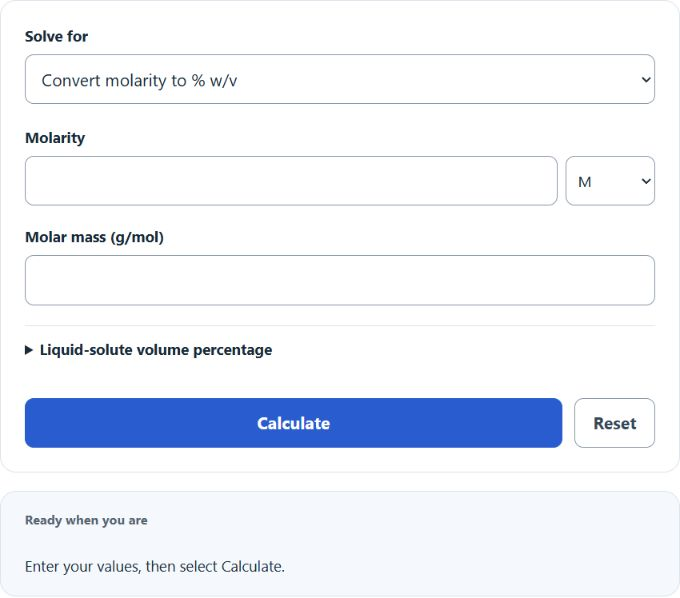
Convert molarity to % w/v or % w/v to molarity using the solute’s molar mass, with an optional solution density to get % w/w as well.
Related Calculators
- Percentage Strength Calculator
- mol/L To g/L Calculator
- µg/mL To µM Calculator
- amu To g/mol Calculator
- All Chemistry Calculators
- Molarity to Weight Percent Calculator (% w/w to molarity)
Calculator Functions
| Function | What it does | What it requires |
|---|---|---|
| Convert molarity to % w/v | Converts molarity to percent weight per volume | Requires the molarity and the molar mass |
| Convert % w/v to molarity | Converts percent weight per volume to molarity | Requires the % w/v concentration and the molar mass |
| Convert % v/v to molarity | Converts the volume percent of a liquid solute to molarity | Requires the % v/v concentration, the density of the pure liquid solute and the molar mass |
| Solution — solute mass | Finds the solute mass needed to make a solution | Requires the molarity, the solution volume and the molar mass |
| Solution — volume | Finds the solution volume a solute mass makes | Requires the solute mass, the molarity and the molar mass |
| Solution — molarity | Finds molarity from a weighed solute | Requires the solute mass, the solution volume and the molar mass |
| Stock dilution — stock concentration | Finds the stock concentration behind a dilution | Requires the final concentration, the stock volume and the final volume |
| Stock dilution — stock volume | Finds the stock volume to measure out | Requires the stock concentration, the final concentration and the final volume |
| Stock dilution — final concentration | Finds the concentration after a dilution | Requires the stock concentration, the stock volume and the final volume |
| Stock dilution — final volume | Finds the final volume to dilute to | Requires the stock concentration, the stock volume and the final concentration |
| Add solvent — initial concentration | Finds the concentration before solvent was added | Requires the final concentration, the initial volume and the solvent volume added |
| Add solvent — initial volume | Finds the starting volume of a solution | Requires the initial concentration, the final concentration and the solvent volume added |
| Add solvent — final concentration | Finds the concentration after solvent is added | Requires the initial concentration, the initial volume and the solvent volume added |
| Add solvent — volume to add | Finds how much solvent to add | Requires the initial concentration, the initial volume and the final concentration |
| Beer–Lambert — Absorbance | Finds absorbance from concentration | Requires the molar extinction coefficient, the optical path length and the molarity |
| Beer–Lambert — Molar extinction coefficient | Finds the molar extinction coefficient | Requires the absorbance, the optical path length and the molarity |
| Beer–Lambert — Optical path length | Finds the optical path length | Requires the absorbance, the molar extinction coefficient and the molarity |
| Beer–Lambert — Molarity from absorbance | Finds molarity from a measured absorbance | Requires the absorbance, the molar extinction coefficient and the optical path length |
Molarity can be entered in M, mM, µM, nM or pM. The two % w/v conversions take two optional densities: the solution density adds % w/w to the result, and the density of a pure liquid solute adds % v/v. The dilution functions accept molar units, % w/v, g/L or mg/mL, and need a molar mass only when molar and mass units are mixed.
Molar to W/V Formulas
| w/v | Percent weight per volume: grams of solute per 100 mL of solution |
| M | Molarity (mol/L) |
| MM | Molar mass of the solute (g/mol) |
Convert molarity to % w/v
Molarity times molar mass is the mass concentration in g/L [1], and 1% w/v is 1 g per 100 mL, which is 10 g/L. A 0.5 M sodium chloride solution (58.44 g/mol) holds 0.5 × 58.44 = 29.22 g/L, so it is 2.922% w/v. No density is needed for this conversion. With a solution density ρ in g/mL, % w/w = % w/v ÷ ρ. With the density of a pure liquid solute, % v/v = % w/v ÷ that density.
Convert % w/v to molarity
A 0.9% w/v sodium chloride solution is 9 g/L, and 9 ÷ 58.44 = 0.154 M.
Convert % v/v to molarity
ρ is the density of the pure liquid solute in g/mL. For a liquid with a density of 0.789 g/mL and a molar mass of 46.07 g/mol, 40% v/v is 10 × 40 × 0.789 ÷ 46.07 = 6.85 M.
Solution — solute mass
V is the final solution volume in litres. Two litres of 0.5 M sodium chloride need 0.5 × 2 × 58.44 = 58.44 g.
Solution — volume
58.44 g of sodium chloride makes 58.44 ÷ (0.5 × 58.44) = 2 L of 0.5 M solution.
Solution — molarity
58.44 g of sodium chloride made up to 2 L is 58.44 ÷ (2 × 58.44) = 0.5 M.
Stock dilution — stock concentration
C₁ and V₁ are the stock concentration and volume, and C₂ and V₂ are the final concentration and volume. Both concentrations must be in one unit, and both volumes in one unit [2]. The four stock dilution functions rearrange this one line. Here C₁ = C₂ × V₂ ÷ V₁: if 0.1 L of stock made 1 L at 1 M, the stock was 1 × 1 ÷ 0.1 = 10 M.
Stock dilution — stock volume
Making 1 L of 1 M solution from a 10 M stock takes 1 × 1 ÷ 10 = 0.1 L of stock, topped up to 1 L.
Stock dilution — final concentration
0.1 L of 10 M stock diluted to 1 L is 10 × 0.1 ÷ 1 = 1 M.
Stock dilution — final volume
0.1 L of 10 M stock must be diluted to 10 × 0.1 ÷ 1 = 1 L to reach 1 M.
Add solvent — initial concentration
Cf × (Vi + Va)
This is the dilution formula with the final volume written as the initial volume Vi plus the solvent added Va. Here Ci = Cf × (1 + Va ÷ Vi): a solution that reads 1 M after 0.9 L was added to 0.1 L started at 1 × (1 + 0.9 ÷ 0.1) = 10 M.
Add solvent — initial volume
If adding 0.9 L took a solution from 10 M to 1 M, it started at 0.9 × 1 ÷ (10 − 1) = 0.1 L.
Add solvent — final concentration
Adding 0.9 L of solvent to 0.1 L of 10 M solution gives 10 ÷ (1 + 0.9 ÷ 0.1) = 1 M.
Add solvent — volume to add
Taking 0.1 L of 10 M solution down to 1 M takes 0.1 × (10 ÷ 1 − 1) = 0.9 L of solvent.
Beer–Lambert — Absorbance
A is absorbance, ε is the molar extinction coefficient in L/(mol·cm), l is the optical path length in cm and c is the molarity [3]. With ε = 6,220 L/(mol·cm), a 1 cm cuvette and a 0.0001 M solution, A = 6,220 × 1 × 0.0001 = 0.622.
Beer–Lambert — Molar extinction coefficient
An absorbance of 0.622 from a 0.0001 M solution in a 1 cm cuvette gives ε = 0.622 ÷ (1 × 0.0001) = 6,220 L/(mol·cm).
Beer–Lambert — Optical path length
With the same absorbance, coefficient and molarity, l = 0.622 ÷ (6,220 × 0.0001) = 1 cm.
Beer–Lambert — Molarity from absorbance
An absorbance of 0.622 with ε = 6,220 L/(mol·cm) in a 1 cm cuvette means c = 0.622 ÷ (6,220 × 1) = 0.0001 M, or 100 µM.
Limits of This Estimate
- Percent w/v and molarity are both based on the final volume of the solution, not the volume of solvent used.
- The add solvent functions assume the two volumes simply add. Many mixtures shrink or swell slightly, so for exact work dilute to a measured final volume and use the stock dilution functions.
- The Beer–Lambert functions fit one absorbing substance at one wavelength, within the range where absorbance rises in a straight line with concentration [3].
- Nothing here checks whether the solute will dissolve at the concentration entered.
Sources
- NIST, Guide for the Use of the International System of Units (SP 811), Chapter 8: definitions of molar mass, amount-of-substance concentration and mass concentration
- Food and Agriculture Organization of the United Nations, A Basic Laboratory Manual for the Small-Scale Production and Testing of I-2 Newcastle Disease Vaccine, Appendix 7: Dilutions: the dilution formula C₁V₁ = C₂V₂ and its unit rule
- Mayerhöfer, Pahlow and Popp, The Bouguer-Beer-Lambert Law: Shining Light on the Obscure, ChemPhysChem 21 (2020): absorbance as molar absorption coefficient × concentration × path length, and why the law is an approximation