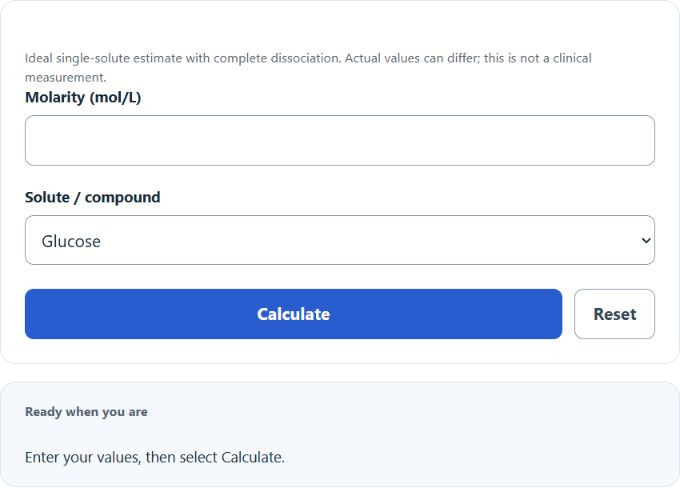
Calculate osmolarity and mOsm/L from molarity by selecting a solute such as NaCl, glucose, or CaCl2 for ideal solution concentrations.
- ppm To mol/L Calculator
- ng/ml to ppm Converter
- mg/m3 to ppm Converter
- nmol/L To ng/dL Calculator
- All Unit Converters
Molarity to Osmolarity Formula
The following formulas are used to convert molarity to osmolarity for an ideal solution.
Variables:
- O is the osmolarity in Osm/L
- M is the molarity in mol/L
- i is the van ’t Hoff factor, or the number of particles produced in solution
- mOsm/L is the osmolarity in milliosmoles per liter
To calculate osmolarity, multiply the molarity by the number of dissolved particles the solute produces. To convert that result to mOsm/L, multiply by 1000.
What is Molarity to Osmolarity Conversion?
Molarity measures the number of moles of solute per liter of solution. Osmolarity measures the total number of dissolved particles per liter. Because some solutes remain as whole molecules while others dissociate into ions, osmolarity may be equal to or greater than the molarity depending on the substance.
For non-electrolytes such as glucose and urea, the solute does not dissociate significantly in solution, so the molarity and osmolarity are numerically the same. For electrolytes such as sodium chloride or calcium chloride, each mole of solute can produce multiple particles, which raises the osmolarity.
How to Convert Molarity to Osmolarity?
The following steps outline how to convert molarity to osmolarity.
- First, determine the molarity of the solution in mol/L.
- Next, identify the solute and determine how many particles it produces in solution.
- Then, multiply the molarity by the van ’t Hoff factor using the formula O = M × i.
- Finally, multiply the Osm/L value by 1000 if you need the result in mOsm/L.
Common Van ’t Hoff Factors
- Glucose, Urea: i = 1
- Sodium Chloride (NaCl), Potassium Chloride (KCl): i = 2
- Calcium Chloride (CaCl₂), Magnesium Chloride (MgCl₂): i = 3
- Sodium Phosphate (Na₃PO₄): i = 4
Molarity to Osmolarity Conversion Table
The table below shows example osmolarity values for a 1.0 mol/L solution of several common solutes, assuming ideal dissociation.
| Solute | Approximate Particles (i) | 1.0 mol/L in Osm/L |
|---|---|---|
| Glucose | 1 | 1.0 Osm/L |
| Urea | 1 | 1.0 Osm/L |
| Sodium Chloride (NaCl) | 2 | 2.0 Osm/L |
| Potassium Chloride (KCl) | 2 | 2.0 Osm/L |
| Calcium Chloride (CaCl₂) | 3 | 3.0 Osm/L |
| Magnesium Chloride (MgCl₂) | 3 | 3.0 Osm/L |
| Sodium Phosphate (Na₃PO₄) | 4 | 4.0 Osm/L |
In real solutions, interactions, dissociation and other reactions can change the effective particle count. These ideal values are chemistry estimates, not measured osmolarity or osmolality, and should not be used to make clinical decisions.
Example Problem:
Use the following variables as an example problem to test your knowledge.
Molarity (M) = 0.15 mol/L
Solute = Sodium Chloride (NaCl)
Van ’t Hoff Factor (i) = 2
Osmolarity (O) = 0.15 × 2 = 0.30 Osm/L = 300 mOsm/L