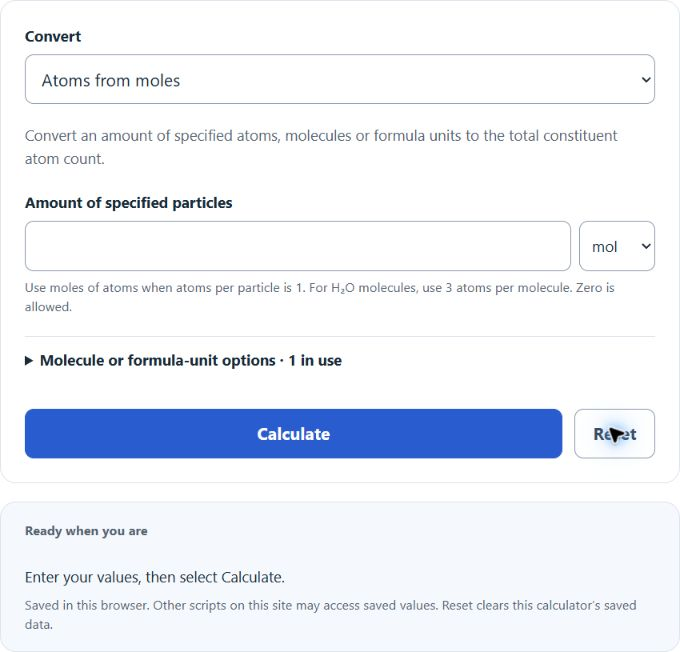
Convert moles, millimoles, micromoles, or nanomoles to atoms and back using the exact Avogadro constant, with optional atoms per particle.
- All Chemistry Calculators
- Atoms to Grams Calculator
- Grams to Moles Calculator
- Moles to Molecules Calculator
- Moles to Mass Calculator
- Moles to Ions Calculator
- Mass of Atoms Calculator
| Calculator Operations | Required Inputs |
|---|---|
| Convert Moles to Atoms | Number of Moles |
| Convert Atoms to Moles | Total Number of Atoms |
Moles to Atoms Formula
The following formula is used to convert the total moles to total atoms.
- Where A is the number of atoms
- M is the amount in moles of specified atoms, molecules or formula units; k is the number of constituent atoms per specified particle (1 for atoms)
Multiply the amount in moles by the exact Avogadro constant, 6.02214076 × 10^23 mol⁻¹, and by the atoms per specified particle. Use k = 1 for moles of atoms; for H₂O molecules, use k = 3. The SI mole definition requires the entity to be specified.
| Moles (mol) | Atoms |
|---|---|
| 0.000001 | 6.02 × 10¹⁷ |
| 0.001 | 6.02 × 10²⁰ |
| 0.005 | 3.01 × 10²¹ |
| 0.01 | 6.02 × 10²¹ |
| 0.02 | 1.20 × 10²² |
| 0.05 | 3.01 × 10²² |
| 0.1 | 6.02 × 10²² |
| 0.25 | 1.51 × 10²³ |
| 0.5 | 3.01 × 10²³ |
| 0.75 | 4.52 × 10²³ |
| 1 | 6.02 × 10²³ |
| 1.5 | 9.03 × 10²³ |
| 2 | 1.20 × 1024 |
| 2.5 | 1.51 × 1024 |
| 3 | 1.81 × 1024 |
| 5 | 3.01 × 1024 |
| 7.5 | 4.52 × 1024 |
| 10 | 6.02 × 1024 |
| 25 | 1.51 × 1025 |
| 50 | 3.01 × 1025 |
| * Rounded to 3 significant figures. Uses exact Avogadro constant NA = 6.02214076 × 10²³ mol−1 and 1 atom per specified particle. | |
Moles to Atoms Definition
The mole (mol) is the SI unit of amount of substance. One mole contains exactly 6.02214076 × 10^23 specified entities. Multiplying moles of atoms by this constant gives atoms; multiplying moles of molecules gives molecules, then the constituent atom count requires the atoms-per-molecule factor.
Example Problem
How to calculate the number of atoms from moles?
First, determine the total number of moles in the substance. In general, this is done by multiplying the total number of moles per unit of volume by the total volume.
For this example, assume an amount concentration of 0.500 mol/L of H₂O molecules and a total solution volume of 3.00 L. Each H₂O molecule contains 3 constituent atoms.
Amount = concentration × volume = 0.500 mol/L × 3.00 L = 1.50 mol of H₂O molecules.
First calculate the number of H₂O molecules, then multiply by 3 to count their constituent atoms:
Number of molecules = M × 6.02214076 × 10^23 mol⁻¹.
Number of molecules = 1.50 × 6.02214076 × 10^23 = 9.03321114 × 10^23.
Total constituent atoms = 3 × 9.03321114 × 10^23 = 2.709963342 × 10^24, conventionally reported as 2.71 × 10^24 atoms for the three-significant-figure inputs. These atoms remain constituents of the molecules.
FAQ
The mole (mol) is the SI unit of amount of substance. One mole contains exactly 6.02214076 × 10^23 specified elementary entities, such as atoms, molecules or formula units. The entity count is dimensionless; the amount of substance has unit mol.
Multiply the amount in moles by the molar mass in grams per mole: mass (g) = amount (mol) × molar mass (g/mol). Specify the substance and use its appropriate molar mass.
Current formula: total atoms = amount (mol) × 6.02214076 × 10^23 mol⁻¹ × atoms per specified particle. The constant is exact; use 1 atom per particle for moles of atoms.