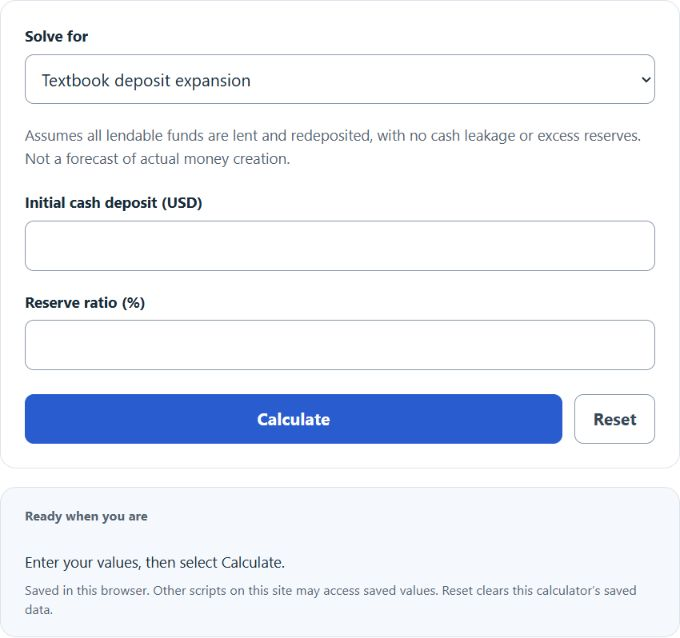
Select textbook deposit expansion or sum supplied U.S. M1/M2 components. Deposit expansion assumes full lending and redepositing, no cash leakage and no excess reserves; it is not a forecast of actual money creation.
- All Business Calculators
- Excess Reserves Calculator
- Money Multiplier Calculator
- Money Factor to Interest Rate Calculator
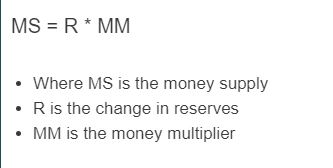
Money Supply Formula
The following formula estimates a change in money supply from a new reserve injection under the simplified multiplier assumptions. In the deposit-expansion mode, the calculator reports total deposits and additional lending separately; redepositing existing currency does not itself create money.
- Where ΔM is the change in money supply
- ΔR is the change in reserves (often discussed as part of the monetary base)
- m is the money multiplier
To estimate the change in the money supply, multiply the change in reserves by the money multiplier.
Money Supply Definition
Money supply is the total amount of money available in an economy at a given time and is commonly measured using monetary aggregates such as M1 and M2. In a simplified money multiplier framework, a change in bank reserves can be used to estimate a corresponding change in the money supply using a multiplier.
Money Supply Example
How to estimate the change in the money supply?
- First, determine the change in reserves (ΔR).
Find the change in reserves to be applied in the multiplier model.
- Next, determine the money multiplier (m).
Calculate or choose the money multiplier to be applied to the change in reserves.
- Calculate the change in money supply (ΔM).
Using the formula, estimate the change in the money supply.
FAQ
The money supply is a measure of the total stock of money in an economy, including currency and certain types of deposits, depending on the definition used (for example, M1 or M2).
U.S. M1 includes eligible currency, demand and other checkable deposits, and savings deposits. M2 adds small-denomination time deposits and retail money market funds, then subtracts IRA and Keogh balances at depository institutions and money market funds. Use non-overlapping components from the same date and dollar scale.