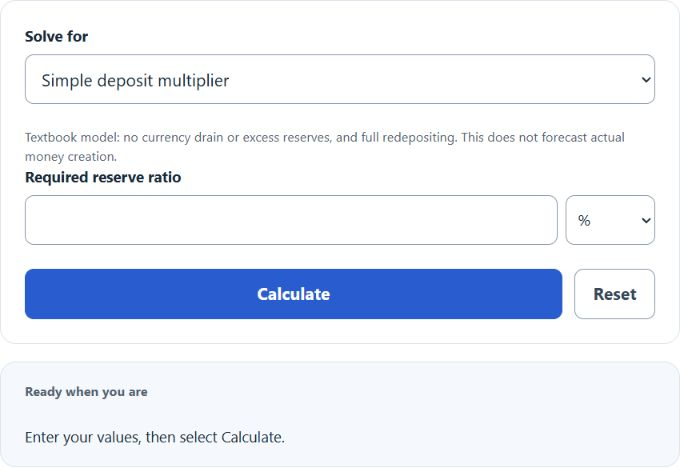
Select the simple deposit multiplier or implied reserve ratio, then enter the known value. The model uses multiplier = 100 ÷ reserve ratio (%).
- All Business Calculators
- Excess Reserves Calculator
- Money Supply Calculator
- Velocity of Money Calculator
Money Multiplier Formula
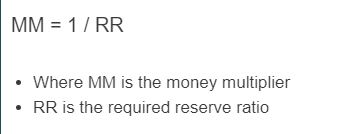
The money multiplier, often called the simple deposit multiplier, estimates how much total bank deposits can expand from a given reserve base under a simplified banking model. In this calculator, the multiplier is determined directly from the required reserve ratio.
- MM = money multiplier
- rr = required reserve ratio written as a decimal
- RR% = required reserve ratio written as a percent
If you know the multiplier and want to solve for the reserve ratio, use the inverse relationship:
What the Money Multiplier Means
The multiplier shows the maximum theoretical expansion of deposits in the textbook model of fractional reserve banking. A lower reserve ratio produces a larger multiplier because banks are assumed to hold less of each deposit in reserve and lend more of the remainder back into the banking system.
For example:
- A 10% reserve ratio implies a multiplier of 10.
- A 5% reserve ratio implies a multiplier of 20.
- A 20% reserve ratio implies a multiplier of 5.
How to Use the Calculator
- Enter the required reserve ratio (%) if you want to calculate the multiplier.
- Or enter the money multiplier if you want to calculate the implied reserve ratio.
- Use the result as a simple model estimate, not as a guaranteed real-world expansion amount.
Quick Reference Table
| Required Reserve Ratio | Decimal Form | Money Multiplier |
|---|---|---|
| 1% | 0.01 | 100 |
| 2% | 0.02 | 50 |
| 5% | 0.05 | 20 |
| 10% | 0.10 | 10 |
| 12.5% | 0.125 | 8 |
| 20% | 0.20 | 5 |
| 25% | 0.25 | 4 |
| 50% | 0.50 | 2 |
Example Calculations
If the required reserve ratio is 8%, convert it to decimal form:
Then compute the multiplier:
That means each additional dollar of reserves could support up to $12.50 of deposits in the simplified model.
If the multiplier is 4, the implied reserve ratio is:
Deposit Expansion Relationship
When paired with an initial increase in reserves, the simple multiplier can be used to estimate potential total deposits:
- ΔD = potential change in deposits
- ΔR = initial change in reserves
- MM = money multiplier
If reserves increase by $1,000 and the multiplier is 10, the maximum deposit expansion in the textbook framework is $10,000.
Why the Actual Multiplier Can Be Lower
The simple formula is useful for learning and quick estimation, but real banking systems rarely behave exactly like the textbook case. Actual money creation may be smaller because of:
- Excess reserves held by banks above the minimum requirement
- Currency drain, where people keep part of funds as cash instead of redepositing them
- Weak loan demand from households or businesses
- Credit risk standards and underwriting constraints
- Capital and liquidity requirements that limit lending even when reserves exist
Because of these factors, this calculator should be interpreted as a simple reserve-ratio multiplier calculator, not a full forecast of real-world money supply growth.
Common Mistakes
- Using 10 instead of 0.10 when the formula requires a decimal reserve ratio
- Confusing the reserve ratio with the amount of reserves
- Assuming the theoretical multiplier is always achieved in practice
- Forgetting that a smaller reserve ratio creates a larger multiplier
FAQ
Is the money multiplier the same as the deposit multiplier?
In basic textbook problems, the terms are often used interchangeably. In broader economics, “money multiplier” can also refer to the relationship between a money supply measure and the monetary base, which is more complex than the simple reserve-ratio model.
Why does a lower reserve ratio increase the multiplier?
Because banks are assumed to keep a smaller share of deposits in reserve and lend out more, allowing more rounds of redepositing across the banking system.
Can the multiplier be less than 1?
Not in this simple model when the reserve ratio is greater than 0% and at most 100%. The multiplier is at least 1; at a 0% ratio the formula has no finite value and does not describe unlimited real lending.
When is this calculator most useful?
It is most useful for economics courses, banking fundamentals, and quick reserve-ratio estimates where the goal is to understand the idealized relationship between reserves and deposits.