Select velocity, nominal GDP, or money supply to solve for, then enter the two displayed values. Use nominal GDP and a matching average money stock in the same currency. The calculator applies GDP = money supply × velocity.
- Money Supply Calculator
- All Business Calculators
- Economic Growth Calculator
- Money Multiplier Calculator
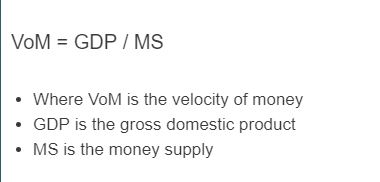
Velocity of Money Formula
The velocity of money measures how frequently a unit of money is used to support final spending in an economy during a defined period. This calculator estimates velocity by comparing nominal gross domestic product to a selected money supply measure for the same time frame.
In this formula:
- V = velocity of money, expressed as times per period
- GDP = nominal gross domestic product for the period
- MS = money supply for the same period, typically using a consistent measure such as M1 or M2
Rearranged Forms
If you know any two variables, you can solve for the third.
| Unknown Value | Formula |
|---|---|
| Velocity of Money | V = (GDP) / (MS) |
| Gross Domestic Product | GDP = V × MS |
| Money Supply | MS = (GDP) / (V) |
How to Use the Calculator
- Enter the nominal GDP for the period you want to analyze.
- Enter the matching money supply value using the same currency and same time period.
- If you already know the velocity, you can instead enter velocity and one of the other variables to solve for the missing value.
- Select Calculate to see velocity in times per GDP time basis, or the selected monetary result in dollars.
How to Interpret the Result
- Higher velocity means money is circulating more rapidly relative to the measured money stock.
- Lower velocity means money is turning over less often, which can indicate more saving, more cash holding, or weaker spending activity.
- Changes over time are often more useful than a single isolated value, especially when comparing the same country and the same money supply definition.
- Consistency matters because changing from one money supply measure to another can materially change the result.
Example Calculation
If nominal GDP is $1,000,000 and the money supply is $500,000, the velocity of money is:
A result of 2 means the measured money supply supports spending equal to roughly two turnovers during the selected period.
Input Guidelines
| Input | Best Practice | Why It Matters |
|---|---|---|
| GDP | Use nominal GDP, not inflation-adjusted GDP | Velocity is typically based on current-dollar spending in the economy |
| Money Supply | Use one consistent definition, such as M1 or M2 | Different definitions produce different velocity values |
| Time Period | Match the GDP reference period with the money-stock averaging period, and note whether GDP is annualized | Unmatched periods or an overlooked annualized GDP basis make interpretation misleading |
| Currency | Keep all figures in the same monetary unit | Prevents scaling errors and invalid comparisons |
| Comparison | Compare results across similar periods and methods | Improves interpretation and trend analysis |
Why Velocity of Money Matters
Velocity is a compact way to connect the size of the money supply with the level of economic spending. Economists, students, investors, and analysts often use it to study:
- Changes in household and business spending behavior
- Periods of expansion or slowdown in economic activity
- How quickly newly created money moves through the economy
- The relationship between money, output, and inflationary pressure
- Long-term shifts in savings preferences and liquidity demand
Common Mistakes
- Using real GDP instead of nominal GDP
- Mixing an unmatched GDP flow basis and money-stock reference period; annualized quarterly GDP produces annualized velocity, not within-quarter turnovers
- Switching between M1 and M2 without noting the change
- Assuming a high velocity is always positive
- Ignoring that velocity can move because of changes in either spending or money balances
FAQ
What does a velocity of 1 mean?
A value of 1 means the measured money supply supports spending equal to about one full turnover during the period being analyzed.
Can velocity be less than 1?
Yes. A value below 1 means nominal spending is smaller than the selected money supply for that period.
Should I use M1 or M2?
Either may be used, but the interpretation changes with the money measure selected. For meaningful comparisons, keep the definition consistent across all calculations.
Is a higher velocity always better?
No. A higher result may reflect stronger spending activity, but it can also occur alongside inflation, a reduced money base, or short-term instability. Context matters.
Can this calculator solve for GDP or money supply too?
Yes. If you know velocity and one other variable, the calculator can determine the missing value using the rearranged formulas above.