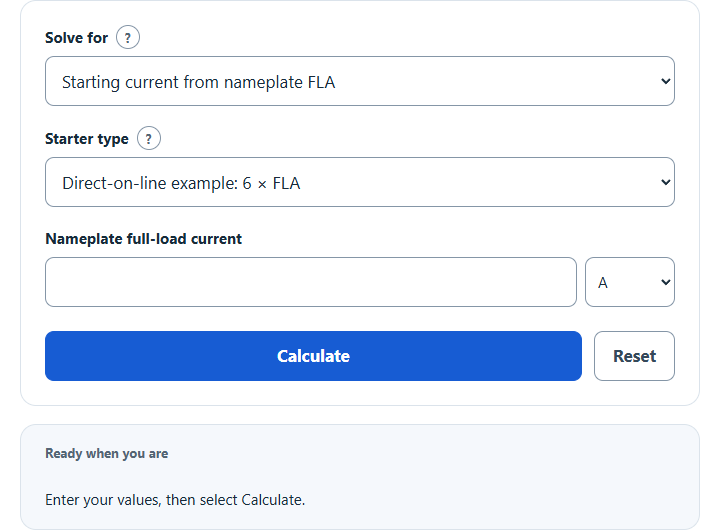
Calculate motor starting current (inrush amps) from full-load amps or motor kW/hp, using typical multipliers for direct-on-line, star-delta or VFD starts.
- All Physics Calculators
- All Electrical Calculators
- Motor Current Calculator
- Stepper Motor Voltage Calculator
- Motor Absorbed Power Calculator
Calculator Functions
| Function | What it does | What it requires |
|---|---|---|
| Starting current from nameplate FLA | Finds the starting current by applying a starter multiplier to the full-load current on the nameplate | Requires a starter type, or a custom multiplier, and the nameplate full-load current (A, mA or kA) |
| Starting current from output power | Estimates the full-load current from the motor rating, then applies the starter multiplier | Requires a starter type, the AC supply (three-phase or single-phase), the rated output power (kW, hp or W), the RMS voltage, the full-load power factor and the full-load efficiency |
| Full-load current from starting current | Finds the full-load current that a known starting current corresponds to | Requires a starter type, or a custom multiplier, and the starting current (A, mA or kA) |
Starter type sets the multiplier: 6 for direct-on-line, 2 for star-delta, 3 for a soft starter, 1.2 for a VFD, or any value under Custom multiplier. Power factor starts at 0.85 and efficiency at 90%, and both can be replaced with nameplate figures. Every result shows the full-load current, the starting current, the ratio between them and the starting current as a percentage of full load.
Motor Startup Current Formulas
| Istart | Starting current (A) |
| k | Starting current multiplier for the starter type |
| FLA | Full-load current (A) |
Starting current here means the locked-rotor current, the steady current a motor draws from the moment it is switched on until it nears running speed [1]. The presets sit inside the typical ranges for each starting method:
| Starter type | Multiplier | Typical starting current |
|---|---|---|
| Direct-on-line | 6 × FLA | 6 to 7 times rated current, and up to 9 or 10 times on some motors [2] |
| Star-delta | 2 × FLA | About 30% of the direct-on-line starting current [2], taken here as one third of 6 |
| Soft starter | 3 × FLA | About 3 to 4 times rated current [2] |
| VFD | 1.2 × FLA | 0.5 to 1.0 times rated current, 1.5 times at most [2] |
Starting current from nameplate FLA
The main formula as written. A motor with a 10 A full-load current starts at about 60 A direct-on-line, 20 A with star-delta, 30 A on a soft starter and 12 A on a VFD.
Starting current from output power
(√3 × V × PF × η) [1]
P is the rated output power in watts, V the line-to-line RMS voltage, PF the full-load power factor and η the full-load efficiency as a decimal. The √3 belongs to a three-phase supply [1] and is left out for single-phase. Horsepower is converted at 745.6999 W [3]. A 7.5 kW, 400 V three-phase motor at the default 0.85 and 90% draws 14.1507 A at full load and about 84.9 A on a direct-on-line start. A 3 hp, 240 V single-phase motor draws 12.1846 A and starts at about 73.1 A. Star-delta is not offered for a single-phase supply.
Full-load current from starting current
The main formula solved for full-load current. A measured 120 A direct-on-line start points to a full-load current of 20 A.
Limits of This Estimate
- The multipliers are typical values, not ratings. Direct-on-line starting current varies from about 6 to 10 times full load between motors [2], and soft starter and VFD currents depend on their settings.
- A nameplate code letter gives a firmer figure for a NEMA motor: locked-rotor amps = hp × kVA per hp × 1,000 ÷ (√3 × volts). A 100 hp, 460 V, Code C motor (up to 4.0 kVA per hp) comes to 502 A [1].
- The result is an RMS current. For the first half cycle a peak of up to 2.8 times the locked-rotor current can occur, which is what trips instantaneous breakers [1].
- The star-delta preset assumes the motor would draw 6 times full load direct-on-line, and star-delta only suits loads that start lightly [2].
- Protection, cable and generator sizing should use the motor’s locked-rotor amps or code letter and the applicable electrical code, not this estimate.
Sources
- U.S. Department of Energy, Motor Systems Tip Sheet #6: Avoid Nuisance Tripping with Premium Efficiency Motors (DOE/GO-102012-3731, November 2012): locked-rotor current as the starting current, the NEMA code letter formula with √3 for three-phase, and a momentary peak of up to 2.8 times that
- ABB, Softstarter Handbook: typical starting currents of 6 to 7 times rated current direct-on-line, about 30% of that with star-delta, 3 to 4 times with a softstarter and 0.5 to 1.5 times with a drive
- NIST, Guide for the Use of the International System of Units (SP 811), Appendix B.8: the mechanical horsepower as 745.6999 W