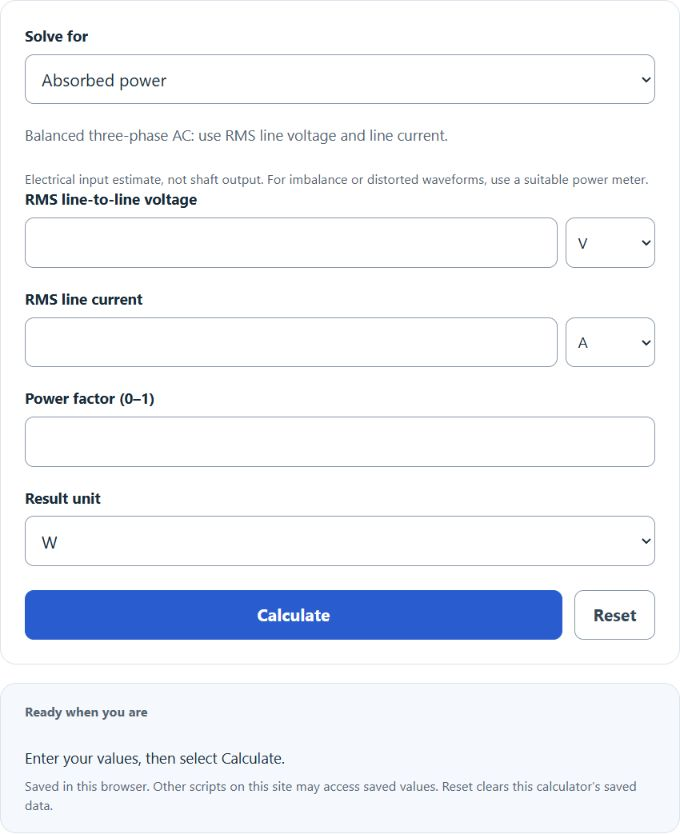
Calculate three-phase motor absorbed power, voltage, current or power factor from the other three using line-to-line voltage and amps.
- All Physics Calculators
- All Electrical Calculators
- Brushless Motor Power Calculator
- Motor Startup Current Calculator
Motor Absorbed Power Formula
Motor absorbed power is the real electrical input power drawn by a balanced three-phase motor. This calculator uses line-to-line voltage, line current, and power factor to estimate how much true power the motor is taking from the supply.
If you want the answer in kilowatts instead of watts, divide by 1,000.
Variable Definitions
| Variable | Meaning | Typical Unit |
|---|---|---|
| Pa | Motor absorbed power, or real electrical input power | W, kW, MW |
| VLL | Applied line-to-line voltage | V, kV, MV |
| IL | Line current drawn by the motor | A, mA, kA |
| pf | Power factor of the motor | Unitless decimal |
How to Calculate Motor Absorbed Power
- Measure or identify the motor’s line-to-line voltage.
- Measure the line current under the operating condition you care about.
- Determine the power factor as a decimal value.
- Multiply voltage, current, and power factor by √3.
- Convert watts to kilowatts if needed.
This relationship applies to a balanced three-phase AC system. It estimates true input power, not apparent power and not shaft output power.
Rearranged Forms
If you need to solve for a different variable, the same formula can be rearranged as follows.
Equivalent Phase-Value Form
If phase voltage and phase current are known for a balanced system, the same real power can also be written in phase terms.
For most motor nameplate and field measurements, however, using line-to-line voltage and line current is more convenient.
Examples
Example 1: A motor operates at 460 V line-to-line, draws 30 A, and has a power factor of 0.90.
The motor absorbs approximately 21.51 kW of real electrical power.
Example 2: A motor absorbs 22,000 W at 460 V with a power factor of 0.91. Solve for current.
The required line current is approximately 30.34 A.
Absorbed Power vs. Output Power
Absorbed power is the motor’s electrical input. Mechanical shaft power is lower because some energy is lost as heat, magnetic losses, friction, and windage. If motor efficiency is known, output power can be estimated from input power.
Common Input Mistakes
- Using line-to-neutral voltage: this calculator expects line-to-line voltage.
- Entering power factor as a percent: enter it as a decimal such as 0.82, not 82.
- Using startup current: inrush current can be much higher than normal running current and will overstate absorbed power.
- Confusing apparent and real power: absorbed power includes power factor, while apparent power does not.
- Applying the formula to single-phase systems: a different power equation is required for single-phase motors.
When This Calculator Is Most Useful
- Estimating motor electrical demand
- Checking panel and feeder loading
- Comparing operating conditions at different loads
- Estimating input power before evaluating efficiency
- Converting measured voltage, current, and power factor into real power
Practical Notes
For the best estimate, use measured values taken while the motor is running under its actual load. In systems with strong imbalance, harmonic distortion, or rapidly changing load, a dedicated power meter will usually provide a more accurate true power reading than a simplified calculator formula.