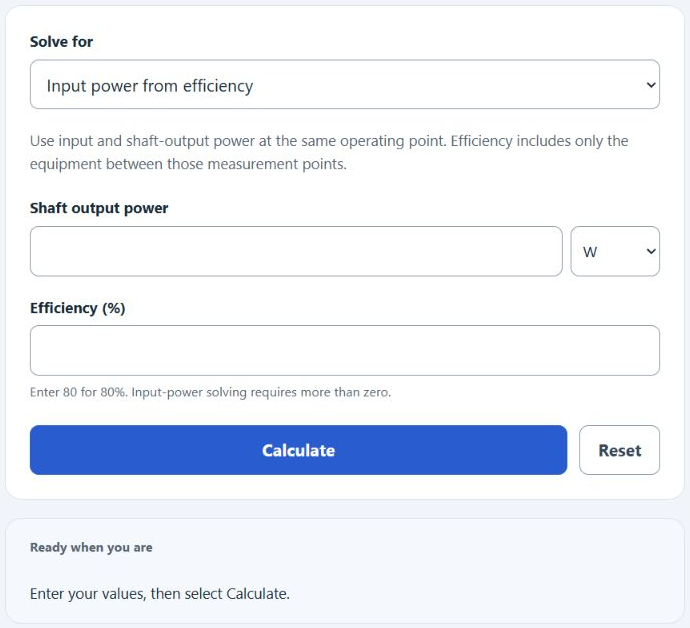
Choose an explicit task to calculate input or shaft power, efficiency, torque, speed, an ideal Kv/Kt conversion, or DC supply voltage/current. Optional battery runtime and current-margin comparisons are estimates, not validated ESC ratings.
- All Physics Calculators
- All Electrical Calculators
- Hoist Motor Power Calculator
- Input Power Calculator
Brushless Motor Input Power Formula
The following formula is used to calculate the Brushless Motor Input Power.
- Where Pi is the Brushless Motor Input Power (watts)
- Po is the output power (watts)
- E is the efficiency (%)
To calculate the brushless motor input power, divide the output power by efficiency expressed as a fraction (percentage divided by 100).
How to Calculate Brushless Motor Input Power?
The following example problem outlines how to calculate the Brushless Motor Input Power.
Example Problem #1:
- First, determine the output power (watts). In this example, the output power (watts) is measured to be 50.
- Next, determine the efficiency (%). For this problem, the efficiency (%) is calculated to be 50.
- Finally, calculate the Brushless Motor Input Power using the formula above:
Pi = Po/(E/100)
Inserting the values from above and solving the equation with the imputed values gives:
Pi = 50/(50/100) = 100 (watts)
FAQ
What is the significance of efficiency in calculating brushless motor input power?
Efficiency plays a crucial role in calculating brushless motor input power because it represents how well the motor converts electrical energy into mechanical energy. A higher efficiency means less electrical power is wasted as heat, and more of the input power is effectively used for generating the desired output power. This makes the motor more energy-efficient and cost-effective in the long run.
Can the formula for calculating brushless motor input power be used for any type of motor?
Yes. Input power = output power / efficiency is an energy-balance relationship for any motor when the power measurements and efficiency refer to the same operating point and system boundary. DC supply power uses V × I; AC motor phase power needs the appropriate measurement method.
How can one improve the efficiency of a brushless motor?
Improving the efficiency of a brushless motor can involve several strategies, including optimizing the motor design, selecting appropriate materials for the windings and magnets, reducing friction and electrical losses, and using precise control methods. Additionally, ensuring the motor operates within its optimal load and speed range can also help maintain high efficiency. Regular maintenance to keep the motor clean and well-lubricated is also essential for minimizing efficiency losses over time.