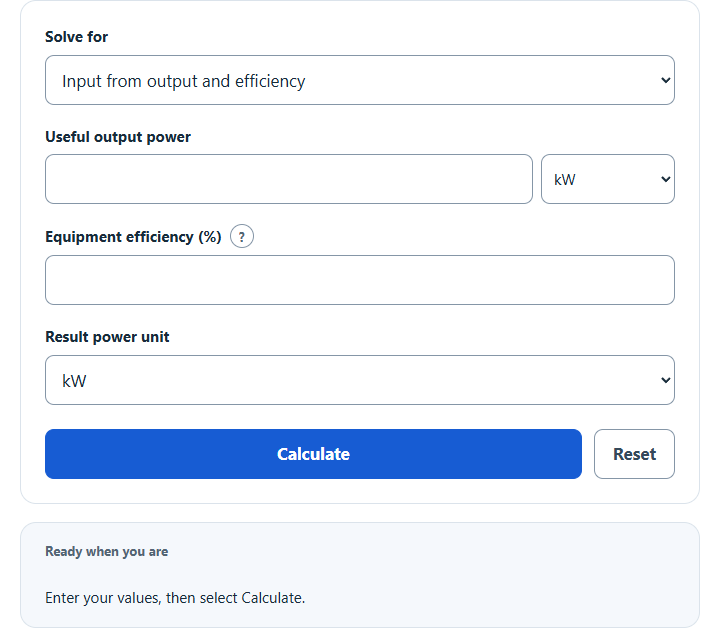
Calculate input power from output power and efficiency, or from voltage, current and power factor, and solve output power, efficiency or input current.
- All Physics Calculators
- All Electrical Calculators
- Single Phase Power Calculator
- Output Power Calculator
- Instantaneous Power Calculator
Input Power Formula
The following formula applies to steady DC. For single-phase AC it gives real power only at unity true power factor; balanced three-phase line quantities require the √3 factor.
- Where IP is the Input Power (watts)
- IV is the input voltage (volts)
- II is the input current (amps)
To calculate the input power for DC, multiply the input voltage by the input current. For AC real power, power factor matters: single-phase real power is P = VRMS · IRMS · PF, and balanced three-phase real power is P = √3 · VLL,RMS · IL,RMS · true PF. Use true PF = P/S, including distortion; displacement cosφ alone may not suffice. The AC magnitude √(S² − P²) is non-active power, and equals reactive magnitude only under sinusoidal conditions. Efficiency is useful output divided by real input; it is separate from power factor. See Fluke’s power-factor explanation.
How to Calculate Input Power?
The following two example problems outline how to calculate the Input Power.
Example Problem #1:
- First, determine the input voltage (volts). In this example, the input voltage (volts) is measured to be 86.
- Next, determine the input current (amps). For this problem, the input current (amps) is measured to be 54.
- Finally, calculate the Input Power using the formula above:
IP = IV * II
Inserting the values from above and solving the equation with the input values gives:
IP = 86 * 54 = 4644 (watts)
Example Problem #2:
Using the same process as example problem 1, we first define the variables outlined by the formula. In this case, the values are:
input voltage (volts) = 4
input current (amps) = 56
Entering these values into the formula or calculator above gives us
IP = 4 * 56 = 224 (watts)